A key contributor to this effort is Woodknowledge Wales (WKW), whose deep commitment to building a sustainable, low-carbon future has shaped both the content and direction of this Yearbook. Led by Sarah Lawton, an editor and communicator working to connect the timber industry with the wider climate, land-use and design agenda, the WKW team has played a central role in curating the insights, case studies, and technical contributions you'll find in these pages.
Andrew Hodge outlines how timber preservation is evolving in response to changing specification demands, highlighting the role of treatment systems in supporting durability, compliance and long-term performance across the built environment.
Extending service life is becoming central to timber specification, as durability, maintenance cycles and whole-life carbon move into sharper focus. This article examines how preservative systems are evolving to meet performance requirements across applications.
Extending service life in specification
Extending service life is a central requirement in timber specification, particularly where durability, maintenance cycles and whole-life carbon are under increasing scrutiny.
Specification decisions are typically driven by use class, exposure conditions and required service life, alongside compliance with relevant standards and environmental data such as EPDs.
Modern preservative systems extend service life, reducing replacement cycles and supporting long-term carbon storage in timber products.
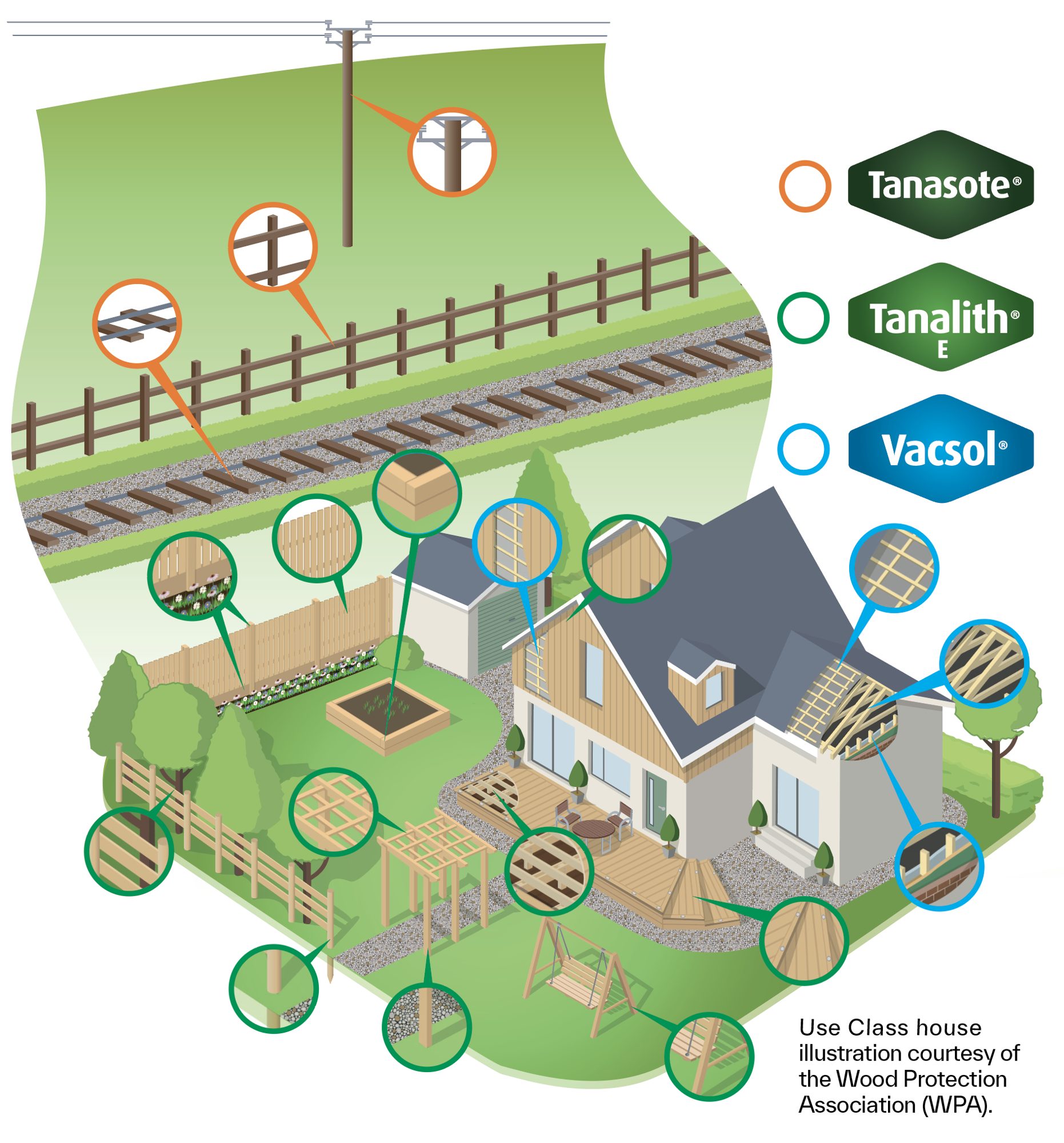
Arxada’s timber preservation portfolio includes systems such as Tanalith® E for external and ground-contact applications, Tanasote® for heavy-duty infrastructure uses, and Vacsol® for internal and protected environments — each designed to meet specific performance requirements across defined use classes and service life expectations.
Applications across use classes
Water-based preservative systems combining copper and organic biocides are commonly specified for Use Classes 1–4. These systems are used across fencing, landscaping and agricultural timber where exposure to weather is a primary consideration. Environmental data, including EPDs and LCAs, can support specification decisions.
Oil-based preservative systems are used for applications such as utility poles, railway sleepers and agricultural fencing. Service life expectations of up to 50 years are cited where treatment is correctly specified and applied, particularly in high-exposure environments.
Metal-free preservative systems are typically used for internal joinery, timber frames and roof battens. Service life expectations of up to 60 years may be achieved depending on correct application and use conditions. Their composition can support end-of-life reuse and recycling pathways.
Material pressures and supply considerations
Copper remains a key component in many preservative systems. Global demand has increased due to electrification, data centre expansion and renewable infrastructure. Market forecasts indicate continued supply constraints into the late 2020s, with implications for cost planning and material selection.
Emerging developments in preservative systems
Metal-free preservative systems are under continued development, particularly for above-ground applications such as cladding. Advances in biocide chemistry are expected to expand their use, although performance requirements remain application specific.
Preservation remains a critical component in delivering durable timber systems. For specifiers, the challenge is ensuring treatments align with use class, expected service life and project-specific performance requirements. As timber use expands, confidence will depend on consistent application, verification and long-term performance in use.
To provide the best experiences, we use technologies like cookies to store and/or access device information. Consenting to these technologies will allow us to process data such as browsing behavior or unique IDs on this site. Not consenting or withdrawing consent, may adversely affect certain features and functions.
Functional
Always active
The technical storage or access is strictly necessary for the legitimate purpose of enabling the use of a specific service explicitly requested by the subscriber or user, or for the sole purpose of carrying out the transmission of a communication over an electronic communications network.
Preferences
The technical storage or access is necessary for the legitimate purpose of storing preferences that are not requested by the subscriber or user.
Statistics
The technical storage or access that is used exclusively for statistical purposes.The technical storage or access that is used exclusively for anonymous statistical purposes. Without a subpoena, voluntary compliance on the part of your Internet Service Provider, or additional records from a third party, information stored or retrieved for this purpose alone cannot usually be used to identify you.
Marketing
The technical storage or access is required to create user profiles to send advertising, or to track the user on a website or across several websites for similar marketing purposes.