A key contributor to this effort is Woodknowledge Wales (WKW), whose deep commitment to building a sustainable, low-carbon future has shaped both the content and direction of this Yearbook. Led by Sarah Lawton, an editor and communicator working to connect the timber industry with the wider climate, land-use and design agenda, the WKW team has played a central role in curating the insights, case studies, and technical contributions you'll find in these pages.
Are timber buildings helping or harming forest biodiversity? asks Asselia Katenbayeva. An ASBP project explores the impacts of timber sourcing and the challenge of measuring biodiversity. Why biodiversity matters—now more than ever.
One million species are edging toward extinction, the global science body IPBES warns. [1] Forests remain their main refuge: four-fifths of all land plants and animals live under a canopy. Woodlands stabilise soils, regulate water, and sequester carbon; their biological richness is therefore a silent buttress for every climate-mitigation plan.
Net-gain rules—and a blind spot
The topic of biodiversity has never been as high as it is today. In England, Biodiversity Net Gain regulations now oblige most developments to deliver a 10% ecological uplift on site. Some companies also disclose nature related risks in supply chains under voluntary TNFD framework.[2] But how many consider whether a glulam beam CLT panel they specify helped or harmed the biodiversity of the forest it came from? Supply chain impacts remain a blind spot.
What the industry thinks
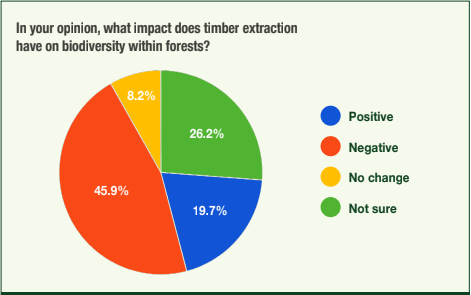
To gauge sentiment, the Alliance for Sustainable Building Products (ASBP) surveyed architects, engineers, developers, and other construction stakeholders; 46% thought that harvesting timber for construction has a negative impact on forest biodiversity and 26% were unsure. Barely one in five believed that timber harvesting could go hand-in-hand with thriving ecosystems.
The IMPACTT project
Bridging that gap was the goal of IMPACTT, an 18-month ASBP-led initiative funded by Built by Nature and partnered with PEFC UK, Stora Enso, DoubleHelix, Woodknowledge Wales, Agrodome, Eurban, and other partners. The team traced the supply chains of 11 timber buildings—from forest to frame—and published the journeys as interactive maps (see ASBP Impactt [3]). The project also addressed common misconceptions around sourcing timber.
Myth — “Commercial forests are ecological deserts”
Figure 1: Survey results. Source: ASBP
This view is outdated. While early commercial forests focused on monocultures and timber production only, modern sustainable forestry aims to integrate a balanced approach. The truth is, in the Anthropocene, we are beyond the idea of “just leave the forest alone”. Faced with rapid climate change, forests must be actively managed to curb pests and diseases, lessen fire risk, and buffer escalating climate impacts.
“The truth is, in the Anthropocene, we are beyond the idea of ‘just leave the forest alone’.”
How do we measure biodiversity in forests?
“Measure it, manage it” sounds simple until you enter the woods. A review of 149 studies6 found 83 different sets of indicators used by academics for biodiversity in European forests, which fall into two groups:
Species-based metrics – presence, richness or abundance of birds, beetles, fungi, microbes.
Structural metrics – habitat proxies such as deadwood volume, canopy layering, soil moisture.
No single, universally accepted forest biodiversity metrics exist. To capture varied perspectives, we convened a workshop with forest specialists, forest owners, leading academics, and eDNA analysis company.
Photo: ASBP
Two large-scale surveys assessed biodiversity in commercial forests of Great Britain:
2003 Forestry Commission study4 recorded 2,000+ species in commercial forests, with vascular plants and lichens sometimes richer than in native woods.
2024 survey5 confirmed that commercial forests can support specialist woodland mammals, birds, amphibians, and reptiles.
A key finding is that forest age and structure significantly affect biodiversity levels. Younger plantations tend to have lower species diversity, but as they mature – developing varied tree heights, understory growth, and deadwood accumulation – they become increasingly valuable wildlife habitats. In many respects, habitat development in planted forests in Great Britain has occurred by accident rather than design, as a result of ‘normal’ (not sustainable) commercial forestry practice during the 20th century. With deliberate, well-managed practices, the potential is far greater.
Let’s refer to real examples of biodiversity in commercial forests. Kielder Forest, England’s largest planted estate, shelters roughly half of Britain’s endangered red squirrel population. Thetford Forest, on the border of Norfolk and Suffolk, is a Site of Special Scientific Interest supporting nightjar, goshawk, woodlark and other birds. Under deliberate management, a working forest can be a thriving living landscape.
eDNA—reading the soil’s barcodes
UK-based NatureMetrics analyses forest soil and water, sequencing genetic fragments left by organisms. This method can reveal hundreds of taxa, including cryptic fungi and invertebrates, offering a rapid biodiversity snapshot. It cannot, however, establish a population size or confirm breeding success, but it widens the lens beyond what field observers can spot.
Digital twins of forests
CLT producer and one of the world’s largest forest owners, Stora Enso, apply a range of methods for monitoring and managing biodiversity. They build digital twin simulations of its forests to test management options and use predictive modelling to pinpoint where certain species are likely to thrive. Where the company buys from third-party forests, it offers financial incentives for owners who exceed sustainable forestry certification targets.
Beyond the numbers—function and value
Counting species alone does not tell the whole story. Chris Jones, silviculture specialist at Woodknowledge Wales, notes that each species should play a functional role—a “service” in the woodland ecosystem. For example, certain conifers, like spruce, are valuable for harvesting timber, while deep-rooted pine species offer wind resistance. Using an ecosystem services approach, different functions of the forest—timber, recreation, biodiversity, clean air—can be assigned value. In multifunctional forests, resilience to environmental change underpins the forest’s ability to support biodiversity.
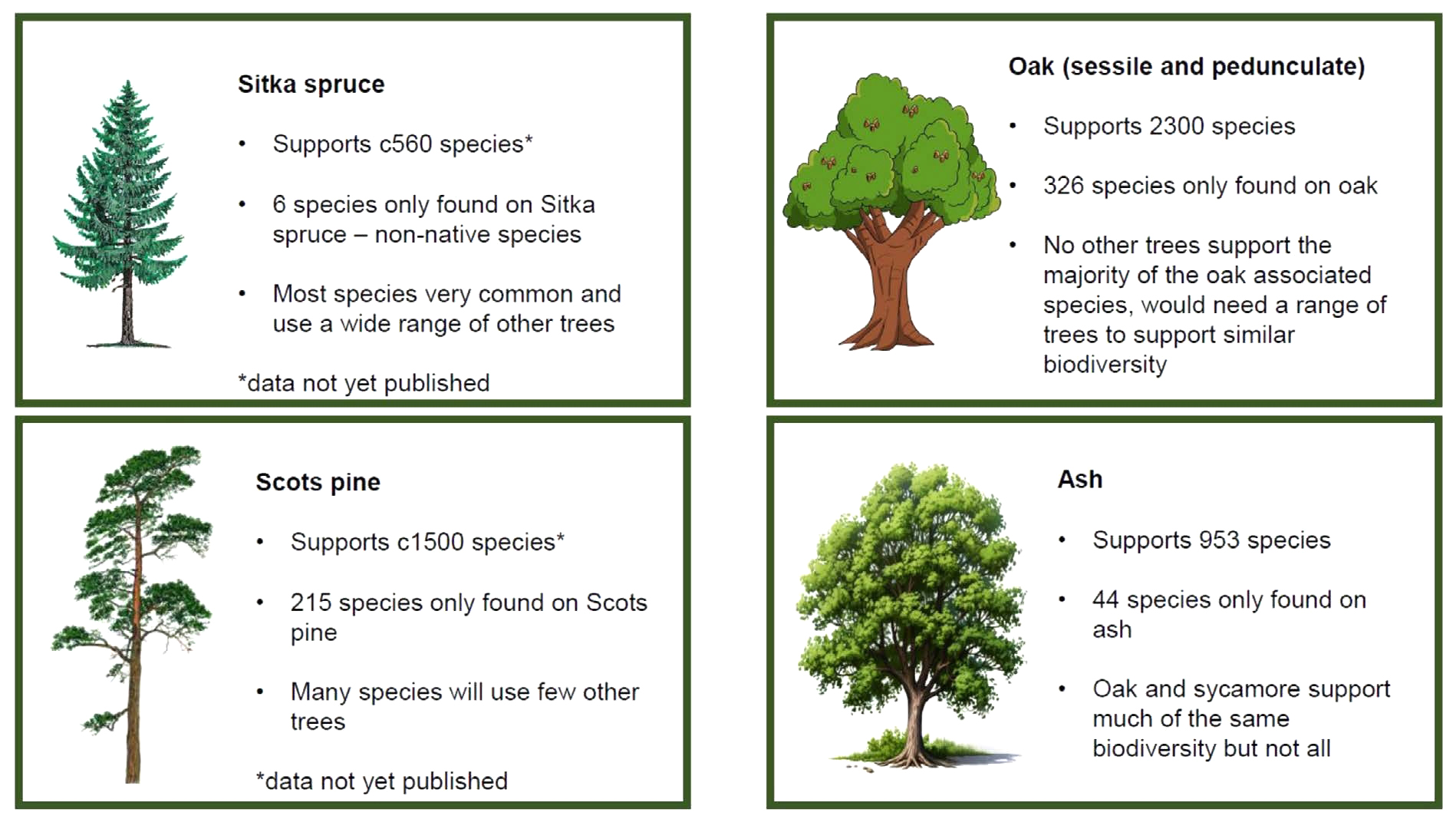
Different trees also host very different lives. Dr Ruth Mitchell from James Hutton Institute referred to research comparing four UK staples: Scots pine, oak, ash, and Sitka spruce.7,8 Scots pine, a native tree, supports far richer biodiversity than Sitka. However, simply counting the species is not enough; it is crucial to understand the roles these species play within the forest ecosystem. Likewise, tree species diversity alone is not sufficient for promoting biodiversity; forest managers must also consider how forests are structured and managed.
The baseline dilemma
“If we want to determine the impact,” noted Prof. John Healey of Bangor University, “how do we decide what to compare it against?” Should a production forest be compared with an unharvested reserve, an area managed exclusively for biodiversity, or another production forest managed differently? The choice of counterfactual can reverse conclusions. Biodiversity in forests is also influenced by complex variables such as management practices, geographic location, and the forest growth cycle. Furthermore, the metrics must consider not only species numbers but also conservation values. For example, a forest with fewer species might actually host a higher proportion of endangered animals.
Borrowing concepts from carbon accounting helps:
Additionality – gains must be above business-as-usual.
Leakage – protection in one area must not shift damage elsewhere.
Permanence – benefits should last in the long term.
Switching the narrative from ‘do no harm’ to ‘achieve net benefit’ is crucial.
Figure 2: Number of species supported by Sitka Spruce, Oak, Scots Pine, and Ash trees in the UK. Image courtesy of Ruth Mitchell
What we learned about forest biodiversity metrics
Measuring forest biodiversity is complex; no standard system yet exists.
Biodiversity and sustainable forest management are intertwined—timber, recreation, clean air, carbon sequestration and habitat are co-produced services.
Biodiversity is not a league table; what matters is ecosystem function and the resilience of forests in the face of rapid climate change.
Choosing the right baseline, considering complex variables (e.g. geographic location, and the forest growth cycle), as well as additionality, leakage and permanence, can help to turn metrics into meaningful management.
“Do no harm” is too low a bar; the real goal is net-positive biodiversity—forests that leave nature richer than they found it.
Closing thought
Every joist, beam and panel that rises inside a building begins life in a living forest. If we want architecture to serve the planet, the ledger must capture the full impact of sourcing materials. Specifying timber is not merely a procurement decision; it is a vote for the forest’s future. We should raise the bar and ask not only about cost and thermal performance—or even how many tonnes of CO2 were sequestered and locked into the building— but also: What did the forest of origin gain?
Photo: ASBP
References
IPBES (n.d.) A million species threatened: thirteen questions and answers. Intergovernmental Science-Policy Platform on Biodiversity and Ecosystem Services. Available at: https://www.ipbes.net/news/million-threatened-speciesthirteen-questions-answers
Taskforce on Nature-related Financial Disclosures (n.d.) Available at: www.tnfd.global
Alliance for Sustainable Building Products (n.d.) IMPACTT Project: Assessing and improving the performance of construction materials. Available at: www.asbp.org.uk/project/ impactt
Humphrey JW, Ferris R, Quine C. (2003) Biodiversity in Britain’s planted forests. Forestry Commission, Edinburgh, p. 118. Available at: www.cdn.forestresearch.gov.uk/2003/01/ fcrp004.pdf
Barsoum N, Field E, Broome A, Cottrell J. (2024) Rapid review of evidence on biodiversity in Great Britain’s commercial forests. Forest Research, Edinburgh, pp. i–iv + 1–44. Available at: www.forestresearch.gov.uk/publications/biodiversity- commercial-forests
Gao T, Nielsen AB, Hedblom M. (2015) Reviewing the strength of evidence of biodiversity indicators for forest ecosystems in Europe. Ecological Indicators. 57:420–434. www.doi.org/10.1016/j.ecolind.2015.05.028
Mitchell RJ, Beaton JK, Bellamy PE, Broome A, Chetcuti J, Eaton S, et al. (2014) Ash dieback in the UK: a review of the ecological and conservation implications and potential management options. Biological Conservation. 175:95–109. www.doi.org/10.1016/j.biocon.2014.04.019
Mitchell RJ, Bellamy PE, Ellis CJ, Hewison RL, Hodgetts NG, Iason GR, et al. (2019) Collapsing foundations: The ecology of the British oak, implications of its decline and mitigation options. Biological Conservation. 233:316–327. www.doi.org/10.1016/j.biocon.2019.03.040
To provide the best experiences, we use technologies like cookies to store and/or access device information. Consenting to these technologies will allow us to process data such as browsing behavior or unique IDs on this site. Not consenting or withdrawing consent, may adversely affect certain features and functions.
Functional
Always active
The technical storage or access is strictly necessary for the legitimate purpose of enabling the use of a specific service explicitly requested by the subscriber or user, or for the sole purpose of carrying out the transmission of a communication over an electronic communications network.
Preferences
The technical storage or access is necessary for the legitimate purpose of storing preferences that are not requested by the subscriber or user.
Statistics
The technical storage or access that is used exclusively for statistical purposes.The technical storage or access that is used exclusively for anonymous statistical purposes. Without a subpoena, voluntary compliance on the part of your Internet Service Provider, or additional records from a third party, information stored or retrieved for this purpose alone cannot usually be used to identify you.
Marketing
The technical storage or access is required to create user profiles to send advertising, or to track the user on a website or across several websites for similar marketing purposes.