A key contributor to this effort is Woodknowledge Wales (WKW), whose deep commitment to building a sustainable, low-carbon future has shaped both the content and direction of this Yearbook. Led by Sarah Lawton, an editor and communicator working to connect the timber industry with the wider climate, land-use and design agenda, the WKW team has played a central role in curating the insights, case studies, and technical contributions you'll find in these pages.
Phil O’Leary explores the complexities of strength grading reclaimed timber, drawing on real-world case studies and longstanding expertise to highlight both the opportunities and persistent barriers to structural reuse in modern construction.
The practice of specifying and utilising reclaimed materials has gained significant traction and appeal in recent times due to its environmental and sustainability benefits, character and historical value. Unlike new virgin timber, reclaimed wood often has an uncertain history, variable properties, and potential defects that have developed in service that can affect its structural load- bearing capacity.
There is a long history of structural appraisal of existing historic and listed buildings. The aim of these appraisals is to assess the current condition of a structure and to relate this to some defined requirement for its present or future use so that its structural adequacy can be judged to achieve a safe and desired performance. The prime considerations are strength and stability, durability and serviceability (deflection).
An appraisal of structural timbers in an existing building includes the effects of the construction process and its subsequent life and this may include alterations, deterioration, neglect, fire, fungal and insect attack and signs of distress or overloading.
First principles and modern grading rules
The strength of timber can be predicted by the measurement or quantification of properties (timber characteristics) that are known to have an effect on strength (strength-influencing characteristics).
In general terms, strength grading rules are based on strength data reached through destructive testing of clear samples of timber and of samples of timber containing naturally occurring strength-influencing characteristics. The relationship between each characteristic and strength, which is established from the test data, may be considered as ‘first principles’.
Grading timber of original size. Photo: Filros Timber Consultants
These ‘first principles’ are then modified to permit visual strength grading based on the measurement and assessment of the frequency and distribution of the strength-influencing characteristics against the permissible limits set out in National Standards.
Reclaimed timber doesn’t follow the rules
Part of the challenge for evaluating used timber is that this data is based on testing done on new timbers and may not represent mechanical properties of timber found in older buildings or timbers which have been under a load for an extended period.
Structural timber may be capable of achieving a higher strength class than those listed for the grade in question in the relevant design codes. This is more likely in timbers in older buildings. The question we often ask ourselves is are we underestimating or over estimating individual member properties.
Working with known history: an opportunity to upgrade
The visual strength grading rules usually assume that the end use and orientation of the timber in service is not known.
In practice, this means that if the end use and orientation of the timber is known, i.e. we know whether the timbers are being used as bending, tension or compression members, consideration may be given to ‘first principle’ data, to explore the possibility of increasing the strength grade for structural calculations. We have been able to successfully ‘upgrade’ timbers to avoid expensive strengthening works on a number of occasions.
However, for strength grading reclaimed timber much of the information obtained from a site assessment likely to be unavailable.
Hidden costs and practical hurdles of reuse
Extra challenges for using reclaimed structural timbers are
Safely taking timbers out of buildings without causing damage to the timbers;
Transport logistics and costs;
Storage;
Inconsistent dimensions;
Difficulty and cost of removing any embedded
Metalwork, such as nails, before any re-machining;
Impurity such as paint and preservative treatment;
Previous loading history—cyclic loading and creep may reduce strength that is not easily detectable visually;
Low ‘yield’ of visually regrading machine-graded timber if the original strength class can’t be
Relied on;
Providing a desired service life to timbers to be used externally if the timber has already
Been subjected to an unknown length of time in external conditions.
Towards better standards and tools
There is much interest and work being carried out in Europe on the development of re-use assessment methods for structural timbers. The Norwegians have developed, on the back of a project, a draft standard prNS 3691 (Parts 1 to 3) for evaluation of recycled wood. Part 3 provides provisions for visual strength grading of rectangular cross-section recycled wood of Nordic-grown spruce and pine. While not covering everything that is needed it is a good start.
A good review of work carried out on determining the strength of reclaimed timber is Ranttila, H., Fink, G., Brandner, R., & Ridley-Ellis, D. (2025). Circulating structural timber and engineered wood products—challenges and potentials towards reliable evaluation of mechanical properties. Wood Material Science & Engineering. www.doi.org/10.1080/17480272.2025.2517186
Other projects are ongoing. Criteria being developed include a ‘wish list’:
Documentary evidence of historical use;
Original strength grading documents;
Source of material (what species and where the timber was grown);
What the timber function was in its previous use;
Orientation in use;
Age of timber—what is the strength of aged wood in old construction?;
Determining whether timber loses much strength with age (there is no full consensus in the literature);
Whether design dimensional tolerances can be used as thresholds for detecting damage or
Stress-induced deformation.
Marine timbers used as joists. Photo: Filros Timber Consultants
Lessons from real-world reuse projects
Examples of re-using reclaimed timbers successfully include the repurposing of marine timbers (greenheart and ekki) for the Durley Chine Environmental Hub. The building includes 45 tonnes of wood reclaimed from local groynes. The timber has been used for parts of the roof structure, brise soleil, cladding and the decking.
A process of assessing structural timber before it was machined to size was undertaken to reduce the risk of machining timbers that would fail the strength grading exercise. Timber with potential was machined to size but kept to a minimum to ensure the section size was as close as possible to the original.
Purlins taken out. Photo: Filros Timber Consultants
As these timbers had already been subjected to over 20 years’ service life in an external environment it was not possible to provide a desired service life of 50 years or more if these timbers were to be exposed externally. Therefore, decisions had to be made where timbers were used. For example, using reclaimed timber where it could be easily replaced and in areas where the wood would be protected from the weather.
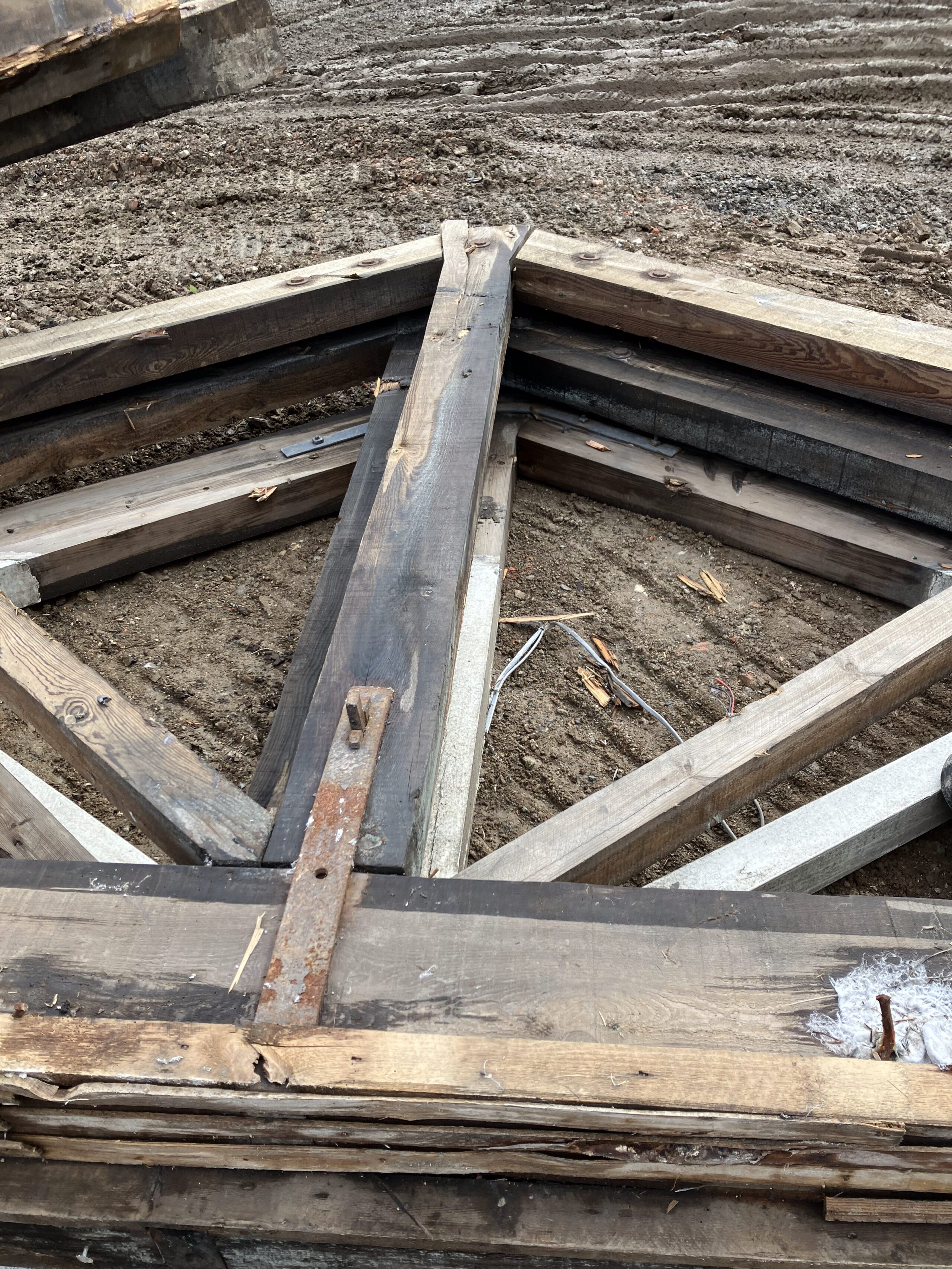
Part of truss. Photo: Filros Timber Consultants
Another project which highlights some of the difficulties is Gwynedd Council’s Bontnewydd School Project. Large section trusses made from very good quality slow grown timber were difficult to remove from the building. Their size made them difficult to store and to transport and it was an issue finding a company prepared to risk re-machining the timbers with embedded metal work. A possible solution was to dismantle the trusses and use them in their current size.
The road ahead: unlocking wider adoption
Is there a will to use reclaimed timber? The answer seems yes. However, will we need cost savings and regulation to drive more widespread uptake?
The challenge will be to find a practical path for removing timber, documenting and labelling (digitally tagged), storage, and robust methods for evaluating timber for reuse on visual and non-destructive methods. Visual strength grading will be a critical step for integrating into structural applications and we have plenty of experience of doing that in old buildings.
To provide the best experiences, we use technologies like cookies to store and/or access device information. Consenting to these technologies will allow us to process data such as browsing behavior or unique IDs on this site. Not consenting or withdrawing consent, may adversely affect certain features and functions.
Functional
Always active
The technical storage or access is strictly necessary for the legitimate purpose of enabling the use of a specific service explicitly requested by the subscriber or user, or for the sole purpose of carrying out the transmission of a communication over an electronic communications network.
Preferences
The technical storage or access is necessary for the legitimate purpose of storing preferences that are not requested by the subscriber or user.
Statistics
The technical storage or access that is used exclusively for statistical purposes.The technical storage or access that is used exclusively for anonymous statistical purposes. Without a subpoena, voluntary compliance on the part of your Internet Service Provider, or additional records from a third party, information stored or retrieved for this purpose alone cannot usually be used to identify you.
Marketing
The technical storage or access is required to create user profiles to send advertising, or to track the user on a website or across several websites for similar marketing purposes.