A key contributor to this effort is Woodknowledge Wales (WKW), whose deep commitment to building a sustainable, low-carbon future has shaped both the content and direction of this Yearbook. Led by Sarah Lawton, an editor and communicator working to connect the timber industry with the wider climate, land-use and design agenda, the WKW team has played a central role in curating the insights, case studies, and technical contributions you'll find in these pages.
Dr Diana Waldron explores how the Bontnewydd School project in North Wales is pioneering structural timber reuse—testing the limits of circular construction through careful deconstruction, glulam innovation, and collaborative design thinking.
In North Wales, the Bontnewydd School and Community Centre project is quietly rewriting the rulebook for low-carbon construction—placing materials reuse at the core of its sustainability strategy. Backed by £15m from the Welsh Government’s Sustainable Schools Challenge, this ambitious development goes beyond net-zero rhetoric. It’s testing real-world solutions to one of the industry’s biggest questions: how can we build with what we already have?
At the heart of the project lies an in-depth exploration of structural timber reuse, including the challenges and potential of reusing glulam (glued laminated timber). The Bontnewydd team, lead by Cyngor Gwynedd, is pushing boundaries not only in architectural design, but in material logistics, grading, and processing systems that remain largely underdeveloped for the reuse market.
Circular design begins with deconstruction
Rather than opting for wholesale demolition, the design process began with a careful deconstruction of two local buildings: Ysgol Glanadda (built in the late 1800s) and the 1970s-built Ysgol Bontnewydd. Each structure was treated as a ‘donor’ of potential materials. Frame Four and Baker Brown developed a detailed materials audit, creating a digital ‘bank of materials’ that could be reused in the new build.
Key materials identified included Welsh slate, Victorian bricks, solid timber beams, and several glulam elements from the 1970s building. Salvaging, testing, and reintegrating them into the new structural design is complex, but it reduces embodied carbon and extends the life of high-quality components that might otherwise be landfilled or downcycled.
Timber first: Solid sections and structural assessment
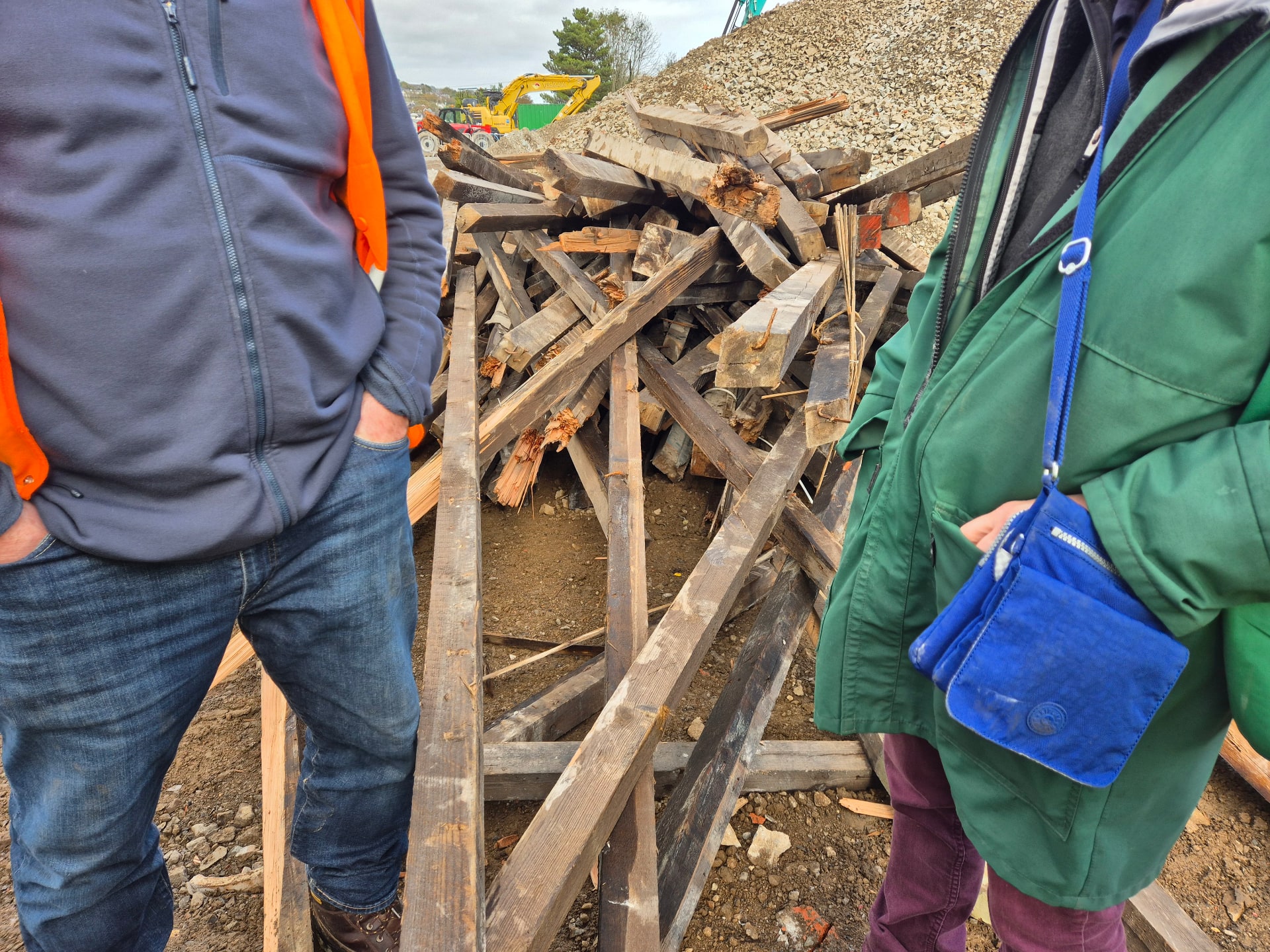
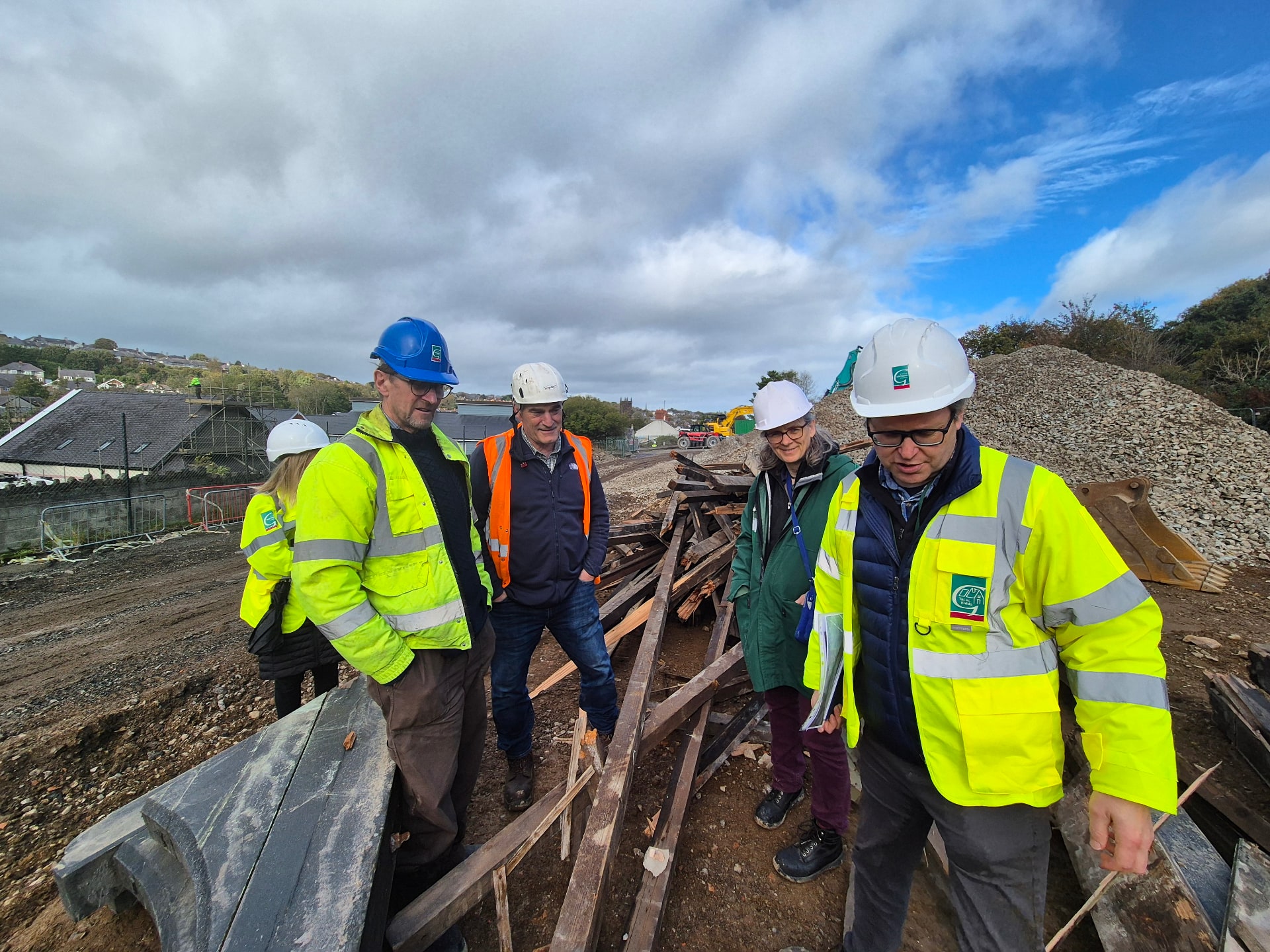
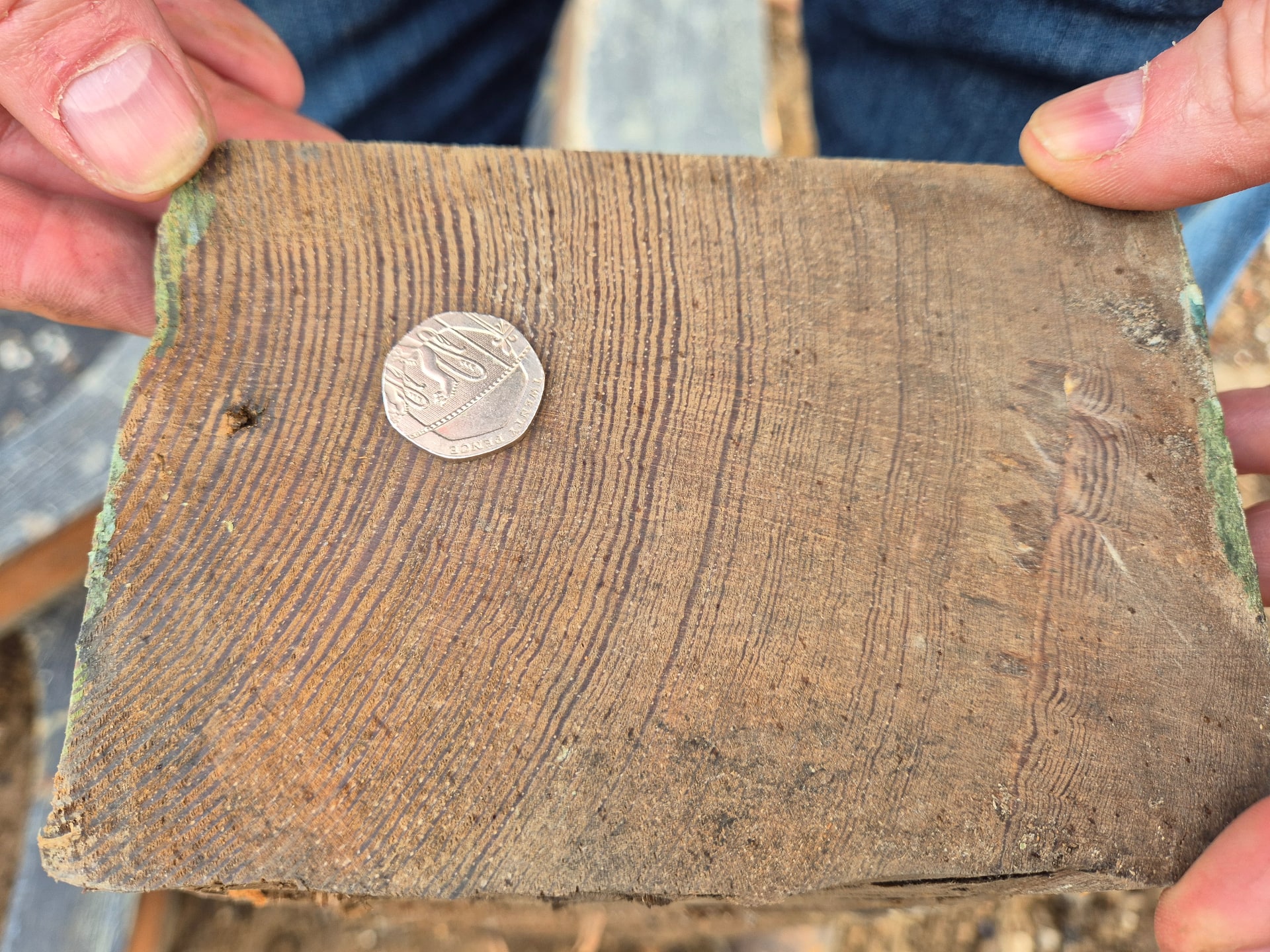
Reclaimed solid timber—particularly from the Victorian Glanadda site—has shown strong potential for reuse. Large structural-grade trusses, many with minimal surface degradation, were earmarked for reintegration. In collaboration with Woodknowledge Wales, the project team assessed the origin, moisture content, and strength to identify suitable structural applications. The size and shape of these salvaged elements directly informed the design of the new community hall, minimising processing needs and reducing the embodied carbon of reuse. This enabled full integration of reclaimed materials and underscores the importance of considering reuse from the earliest design stages to maximise sustainability and resource efficiency. This has involved close collaboration with local sawmills and timber processors to explore low- intervention refurbishment. While the reuse of solid wood presents fewer technical challenges than engineered wood, access to appropriate grading facilities, structural testing, and suitable design integration remain significant barriers to mainstream adoption.
Assessing old timber on site. Photo: Woodknowledge Wales
Glulam: a technically demanding reuse frontier
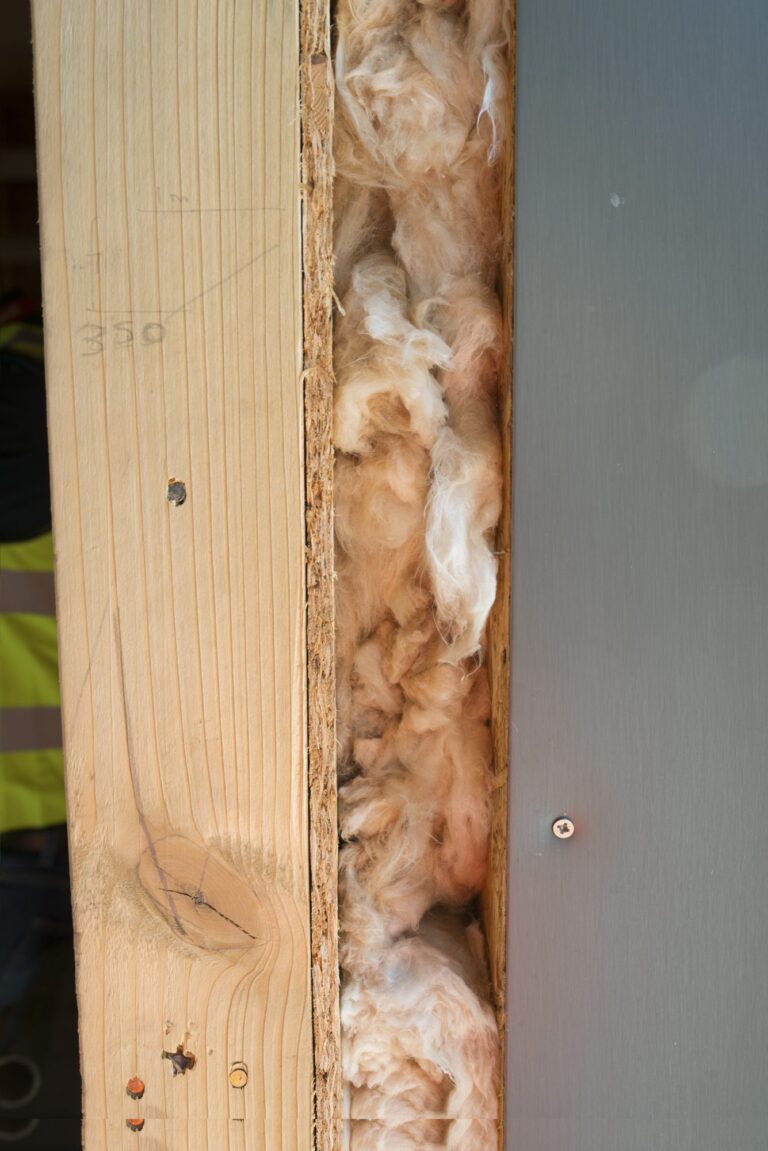
Among the more intriguing discoveries during the deconstruction process were several glulam beams in excellent condition. These glue-laminated components present unique challenges. While structurally efficient and lightweight, glulam is also difficult to assess for reuse due to its composite nature.
Unlike solid timber, glulam consists of bonded layers of lamellae using synthetic adhesives. The long-term integrity of these adhesives—often not designed for reuse—requires rigorous scrutiny. Factors such as delamination, adhesive ageing, and off-gassing must all be assessed before reuse in structural applications can be approved.
For this reason, the project team has opted to undertake a full structural integrity assessment of the glulam elements. Options remain open: if deemed suitable, the beams could be reintegrated as load-bearing elements. If not, alternative uses are being explored—from downscaling into secondary structures or furniture, to being milled into new components.
This process is as much about creating precedent as sourcing materials. The team has drawn on expertise from structural engineers and glulam manufacturers with experience in post-use assessment to inform their approach. The long-term aim is to contribute to developing standards and workflows that allow future projects to evaluate and reuse glulam with greater confidence.
From reuse to regeneration
In parallel with salvaging materials, the team is also investigating remanufacturing new glulam from reclaimed timber. While still at an exploratory stage, this would involve identifying suitable lamellae from reclaimed stock, machining them to tolerance, and rebonding under controlled conditions. If viable, the potential resource savings could be significant.
This approach, however, is not without complexity. It requires clean de-nailing, consistent sectioning, access to glulam presses, and rigorous strength verification. Moreover, it raises questions about adhesive selection, fire performance, and regulatory compliance—all currently under-researched in a reuse context.
Nonetheless, these investigations are generating important insights into what’s possible, and what’s still missing in the UK’s timber reuse infrastructure. They expose gaps in grading protocols, insurance frameworks, and processing capacity—challenges that projects like Bontnewydd help to surface and begin to address.
Photo: Woodknowledge Wales
More than materials: embedding knowledge
Bontnewydd is more than a construction project. It’s a testbed for circularity—a collaborative learning process that aims to normalise the reuse of complex materials like glulam within mainstream public procurement. Its success doesn’t lie only in what’s built, but in the technical groundwork and data generated for future projects.
By rethinking waste as resource—and subjecting reused materials to the same rigour as new—the project demonstrates how circular principles can coexist with quality assurance. Its explorations into glulam reuse are particularly valuable, shining a light on an area that is often neglected in sustainability discussions due to its technical complexity.
As the building progresses toward completion in 2026, the hope is that Bontnewydd becomes a case study not just in sustainable design, but in regenerative material thinking—one that inspires broader systemic change in how we source, evaluate, and reuse the materials we already have.
To provide the best experiences, we use technologies like cookies to store and/or access device information. Consenting to these technologies will allow us to process data such as browsing behavior or unique IDs on this site. Not consenting or withdrawing consent, may adversely affect certain features and functions.
Functional
Always active
The technical storage or access is strictly necessary for the legitimate purpose of enabling the use of a specific service explicitly requested by the subscriber or user, or for the sole purpose of carrying out the transmission of a communication over an electronic communications network.
Preferences
The technical storage or access is necessary for the legitimate purpose of storing preferences that are not requested by the subscriber or user.
Statistics
The technical storage or access that is used exclusively for statistical purposes.The technical storage or access that is used exclusively for anonymous statistical purposes. Without a subpoena, voluntary compliance on the part of your Internet Service Provider, or additional records from a third party, information stored or retrieved for this purpose alone cannot usually be used to identify you.
Marketing
The technical storage or access is required to create user profiles to send advertising, or to track the user on a website or across several websites for similar marketing purposes.