A key contributor to this effort is Woodknowledge Wales (WKW), whose deep commitment to building a sustainable, low-carbon future has shaped both the content and direction of this Yearbook. Led by Sarah Lawton, an editor and communicator working to connect the timber industry with the wider climate, land-use and design agenda, the WKW team has played a central role in curating the insights, case studies, and technical contributions you'll find in these pages.
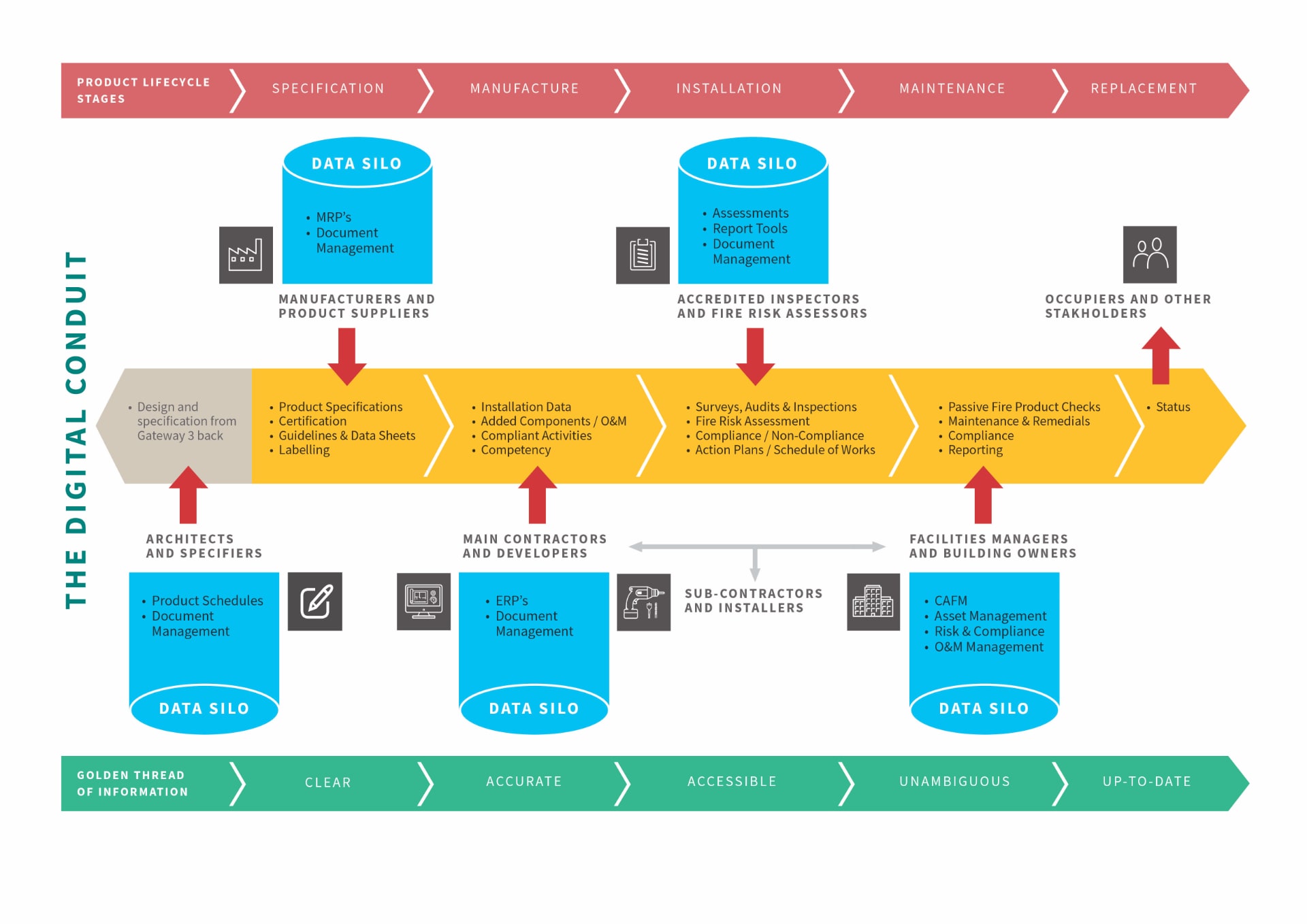
Philip Duckworth explains why moving from fragmented data silos to integrated digital conduits is essential for managing critical fire safety data, ensuring compliance, improving accountability, and ultimately helping to save lives.
One of the main problems for manufacturers of passive fire products, such as fire doors, doorsets, fire screens, fire barriers, partitions and walls has been ensuring the delivery of the products specification and technical data along the supply chain, making sure the right information is available and easily accessible, at the point-of-need, for every stage of a products lifecycle.
Specification and Technical data, such as:
Product sourcing and specification – certification of legal sourcing and sustainability from the forest of origin, evidencing responsible management and chain of custody.
Third-party test evidence and certification – UKAS approved and independently third-party audited and approved data for fire, security, smoke and acoustics.
Installation guidance – from detailed specifications, dimensions and technical drawings through to training and ‘how to’ documents and videos.
Maintenance guidance & permissible repairs – On-site remediation and adjustment guidance and standards
This information, much of which is ‘critical fire safety data’ not only has to be understood, used and implemented by everyone in the ‘chain of responsibility’ from main contractors, sub-contractors and installation teams through to fire safety inspectors and building safety regulators, but also has to be collated and stored within the buildings O&M and Fire Safety Manual in line with BS 9999:2017-Section 9, Annex H, to meet the latest legislative compliance standards.
Managing data in line with ‘Golden Thread’ principles
Information and data also need to be managed in line with the ‘Golden Thread’ principles as per the following guidance:
Single source of truth: Gathering all information into a single location that is continuously updated throughout its lifecycle.
Culture change: Facilitate a culture change by increasing the requirement for competence, information management and process optimisation.
Accurate and trusted: To enable effective management, maintenance, inspection, competency and compliance data needs to be accurate, trustworthy and relevant.
Peace of mind for occupiers: Relevant information must be made available to occupants, as well as construction and maintenance teams. Empowering stakeholders to hold building safety managers to account.
Data security: Data needs to be secure to maintain its accuracy and must comply with GDPR legislation.
Easy to access: Information must be stored in a structured way that is easy to locate, update and effectively manage.
Accountability: Detailed ‘time- and date-stamped’ record of changes will drive greater accountability. It also sets out clear duties for the ongoing maintenance and inspection regimes.
Relevance: The information and data should be continuously updated and must be relevant and unambiguous.
Longevity: Needs to conform with the principle of ‘interoperability’, whereby it can be easily handed over through a building’s operations, as the roles of responsible individuals change.
Consistency: The Golden Thread will include information from various sources, organisations, professions and individuals, so maintaining consistency is key to ensure the data can be utilised effectively.
Storage and maintenance of electronic data must evolve
With the digital revolution hurtling into the ‘AI’ era, the current established protocol of supplying electronic data via email and through download portals in CSV and PDF format is today commonplace, but how these files are then stored, updated, managed, accessed and shared needs to evolve further.
One of the main problems are ‘data silos’, where organisations and individuals store data on stand-alone servers and drives. Data Silos restrict visibility and access, can increase inefficiencies and costs, and can hinder effective management.
Data Silos are a problem. They can harm an organisation and can include the following:
Incomplete data sets – when data can’t be accessed by all users, business strategies can be affected, as decisions aren’t being made on all the available data.
Inconsistent data – silos often aren’t consistent with other data sources, this can create accuracy and integrity issues that can affect end-users in both operational and analytical roles.
Data security & regulatory compliance issues – silos can increase data security and privacy risks and complicate efforts to comply with data privacy and protection laws
Duplicate data platforms and processes – silos can add to IT costs by requiring additional hardware, and in many cases are managed by separate departments rather than the data
management team, which further increases duplication costs, and reduces efficiencies.
Reduced collaboration – isolated data sources reduce data sharing and collaboration opportunities making it harder for teams to work together effectively.
A siloed culture – is often behind siloed data, where vertical divisions work independently and rarely share information or knowledge.
All these points affect businesses organisation-wide but are particularly pertinent in relation to the critical fire safety data of passive fire products.
Moving away from siloed data helps organisations manage and use data more effectively, but this needs to start with cultural and behavioural change.
Re-evaluating moral duties and embracing accountability
Organisations will need to ‘think differently’ including re-evaluating moral duties and embracing accountability. Adjust working practices to adopt digital data management and change from data silos to centralised data sharing. Sharing best practice knowledge, will in turn drive-up competencies.
Again, in line with the Golden Thread principles, this entails:
Data integration: Implementing systems that allow seamless data sharing and integration across different departments and stakeholders. This can be achieved using centralised databases using cloud-based platforms that provide real- time access to information.
Standardisation: Establishing common standards for data entry, storage, and retrieval to ensure consistency and accuracy. This includes using standardised formats and protocols for data exchange.
Collaboration tools: Utilising collaboration tools and platforms that facilitate communication and teamwork among stakeholders. These tools can help break down barriers and encourage the sharing of information.
Training and competency: Providing training and resources to ensure that all stakeholders are competent in using the information management systems and understand the importance of data sharing.
Transparency and accountability: Promoting a culture of transparency and accountability where data is accessible to those who need it, and there is a clear audit trail of data usage and modifications.
Regular audits and reviews: Conducting regular audits and reviews of information management practices to identify and address any issues related to data silos.
We believe information and data should be available and managed through a ‘digital data conduit’ a cloud-based data structure, that is live, accessible, always up-to-date, as well as secure, fast and responsive for today’s mobile technology culture that allows critical data to be delivered immediately ‘straight to the point of need’, while on-the-go, or on-site, with or without WI-FI connection.
Passive fire product tracking and the management of critical fire safety data through a digital conduit not only saves time and cost, but also helps maintain critical fire safety requirements, competency standards and meets regulatory compliance, but ultimately can help to save lives.
To provide the best experiences, we use technologies like cookies to store and/or access device information. Consenting to these technologies will allow us to process data such as browsing behavior or unique IDs on this site. Not consenting or withdrawing consent, may adversely affect certain features and functions.
Functional
Always active
The technical storage or access is strictly necessary for the legitimate purpose of enabling the use of a specific service explicitly requested by the subscriber or user, or for the sole purpose of carrying out the transmission of a communication over an electronic communications network.
Preferences
The technical storage or access is necessary for the legitimate purpose of storing preferences that are not requested by the subscriber or user.
Statistics
The technical storage or access that is used exclusively for statistical purposes.The technical storage or access that is used exclusively for anonymous statistical purposes. Without a subpoena, voluntary compliance on the part of your Internet Service Provider, or additional records from a third party, information stored or retrieved for this purpose alone cannot usually be used to identify you.
Marketing
The technical storage or access is required to create user profiles to send advertising, or to track the user on a website or across several websites for similar marketing purposes.