A key contributor to this effort is Woodknowledge Wales (WKW), whose deep commitment to building a sustainable, low-carbon future has shaped both the content and direction of this Yearbook. Led by Sarah Lawton, an editor and communicator working to connect the timber industry with the wider climate, land-use and design agenda, the WKW team has played a central role in curating the insights, case studies, and technical contributions you'll find in these pages.
Adrian Beckingham examines how the timber frame sector can scale through coordinated action on skills and delivery, drawing on workforce data and industry programmes shaping modern methods of construction.
Timber frame construction is one of the fastest growing construction sectors, driven by a need for consistency and speed, improved energy performance, carbon savings, and Government policy. Once framed as a cost-efficient and fast-build alternative to traditional methods, timber frame is now increasingly embedded within discussions about modern methods of construction (MMC), productivity, quality, and long-term resilience, with its low-carbon credentials becoming more prominent.
The UK Government’s ambitions to build 1.5 million homes in five years is challenged by the need to recruit skilled workers and the need to meet net zero targets. Our Construction Workforce Outlook [1] forecasts that the UK construction industry needs an average of 47,000 extra construction workers each year until 2029 to meet current demand.
Policies such as the Timber in Construction Roadmap (TiCR) promote timber-based MMC to deliver sustainable housing more efficiently. The National House Building Council estimates constructing with timber frame can save up to three months in construction time as opposed to other methods. However, widespread adoption is constrained less by basic awareness and more by gaps in skills, training and on-site delivery capacity, alongside limited confidence in delivery at scale. Addressing these gaps will require coordinated action between industry, Government and CITB to build the skills and capacity to scale delivery.
Future-proofing the workforce with timber skills
The Structural Timber Association [2] estimates that timber frame accounts for around 24% of new build homes across the UK. As timber frame construction continues to scale across the UK, the conversation is shifting from advocacy towards productivity, precision and confidence.
Factory automation, digital design and quality assurance (QA) are central to making timber construction reliable and scalable. Digital design enables timber systems to be accurately engineered and coordinated before manufacture, reducing errors and risk. Factory automation then translates those designs into precise, repeatable components produced in controlled conditions, improving quality and productivity. Robust QA processes provide traceability and evidence of performance across design, manufacture and installation.
This scale-up requires consistent standards, reliable supply chains, and a workforce capable of operating in factory-led environments.
Many timber frame manufacturers now resemble advanced manufacturing operations more than traditional construction firms, with structured production cycles, controlled environments and formal QA systems.
For the skills system, this has profound implications. Traditional site-based trades remain vital, but they are now complemented by factory-based roles such as line operatives and assembly technicians, alongside roles in digital design, production engineering, quality management and logistics. The task now is ensuring the training pipeline evolves in step with this new operating model and to encourage collaboration across the industry to tackle skills shortages, improve diversity, and future-proof the workforce.
Addressing the skills and workforce considerations
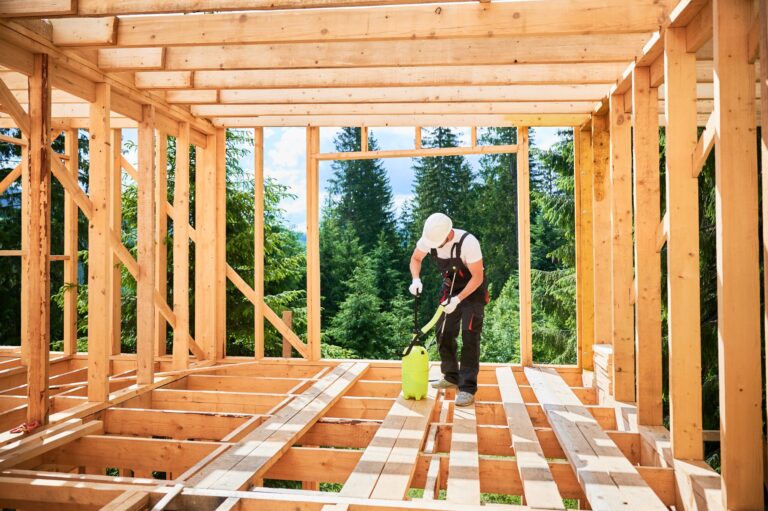
Timber frame homes are increasing in popularity across the UK, driving demand for skilled workers. However, while there has been significant investment in timber frame manufacturing, comparatively little attention has been paid to develop the specialised skills needed for timber construction management and on-site installation.
Site installation requires problem-solving skills; contractors need workers who can adapt to unforeseen issues and are able to ‘think out of the box’ to ensure sites are ready to receive components for efficient assembly. This contrasts with factory-based MMC roles where consistency, adherence to process and effective reporting of issues are required to maintain quality and productivity, rather than relying on workarounds or informal fixes.
Transportation from factory to site can also present challenges. Unlike manufacturing plants or logistics warehouses which are permanent sites designed for efficient access and high-volume deliveries, construction sites are highly variable and often relatively short-term operations. As a result, delivery and logistics systems must be developed quickly with flexibility to adapt to site-specific constraints.
Our Industry Picture [3] finds that the construction workforce cannot continue with a ‘business as usual’ approach as this will result in a growing skills gap, limiting what industry can deliver and leading to unmet Government aspirations.
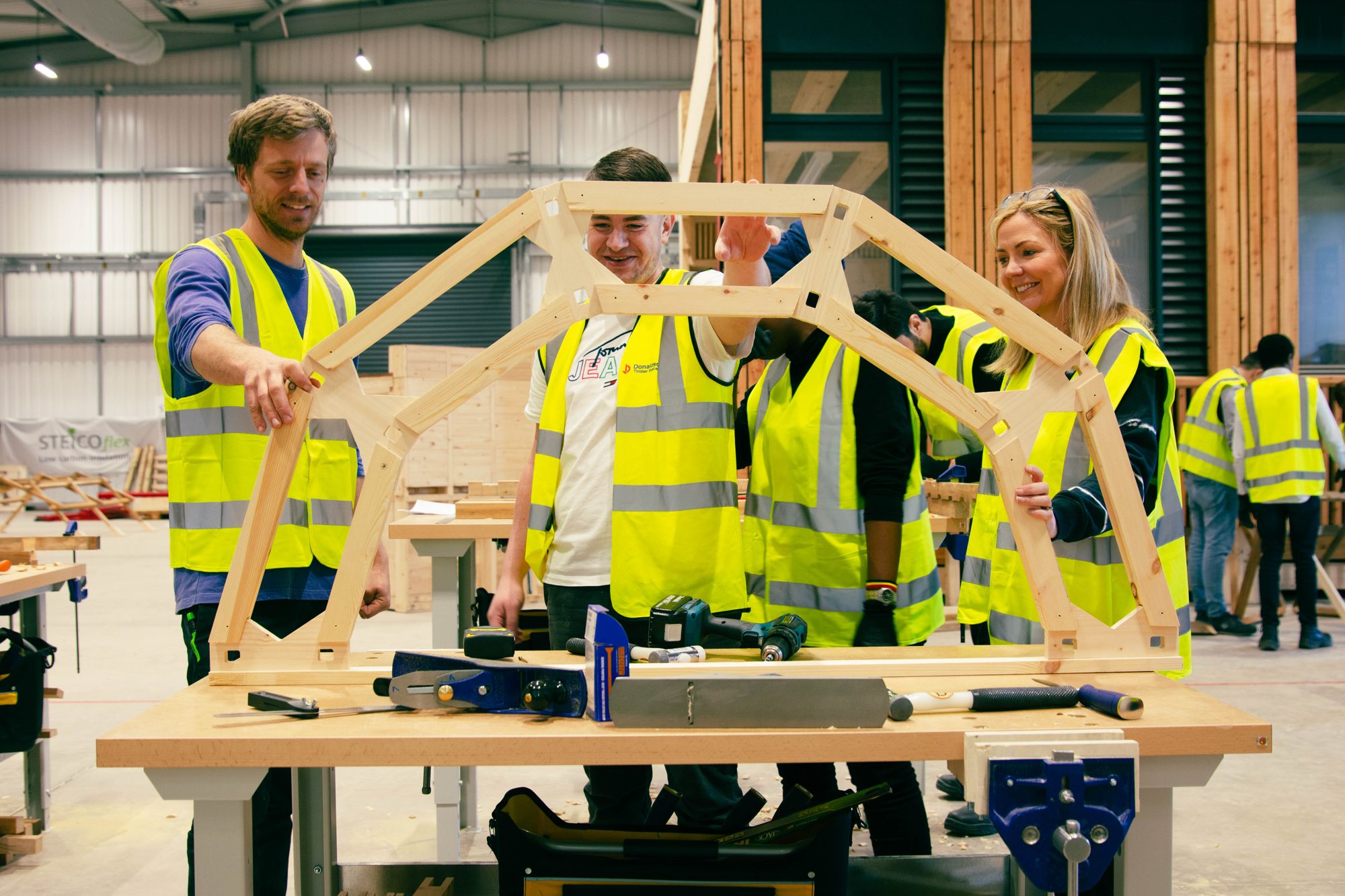
Recently, we awarded £427,000 from our Industry Impact Fund to develop a comprehensive industry training programme to accelerate timber construction in the UK. Led by Donaldson Timber Systems and supported by academic and industry partners, the funding will be used to develop training content and courses for improved pathways for those entering the construction industry as well as help upskill and reskill existing construction workers, so they are equipped to meet the needs of the rapidly growing timber construction sector. It will also help support the aims of the TiCR.
Together, collaborative efforts like this will help to build a sector that not only meets today’s challenges but is ready to thrive in the future.
Reducing embodied carbon in construction with timber
Construction is a significant contributor to carbon emissions in the UK, with the built environment accounting for an estimated 40% of total emissions when both operational and embodied carbon are considered. Now, more than ever, there is increased focus on improved reporting of embodied carbon in buildings, alongside exploring the introduction of maximum embodied carbon levels in new developments.
Timber is a good choice for helping to reduce embodied carbon in construction, and efforts to reduce the embodied carbon emissions of new builds is one of the main reasons for the increased use of timber in construction in England. According to a report from the Climate Change Committee [4], using timber as a construction material can reduce embodied emissions in a single building by 20-60%. But this can’t be done unless industry works together.
Improved reporting on embodied carbon in buildings and exploring the potential of maximum embodied carbon levels in new buildings could have significant positive impacts on the construction sector’s contribution to the clean growth agenda. This is where industry collaboration becomes critical. Initiatives such as the Homebuilding Sector Skills Plan demonstrate how CITB, stakeholders, employers and educators are working together to align training with the demands of modern homebuilding, including MMC. Similarly, the Future Homes Hub is bringing together homebuilders, policymakers and the supply chain to support practical implementation of future standards.
Opportunities for the timber sector
The growing demand for timber in construction is clear. Delivering on this potential will require a sustainable and resilient workforce that meets the needs of the future, today. Government, industry, and stakeholders must align their efforts to decarbonise and build efficiently, as well as close the skills gap.
Together, we can build a sector that not only meets today’s challenges but is ready to thrive in the future. To deliver on national ambitions, it must invest in people, modernise its approach to skills and training, and work collaboratively across the sector. Now, we must align to promote the use of safe, best practice, high-performing timber construction that will provide the most benefit.
Author info
Adrian Beckingham
Corporate Performance Director
CITB
citb.co.uk
References
[1] CITB. Construction Workforce Outlook 2025–2029, (2024).
[2] Orriss A. Structural timber and the drive for net zero. Structural Timber Association, (2023).
[3] CITB. The Industry Picture 2026, (2026).
[4] Climate Change Committee. Wood in Construction in the UK: An Analysis of Carbon Abatement Potential, (2019).
To provide the best experiences, we use technologies like cookies to store and/or access device information. Consenting to these technologies will allow us to process data such as browsing behavior or unique IDs on this site. Not consenting or withdrawing consent, may adversely affect certain features and functions.
Functional
Always active
The technical storage or access is strictly necessary for the legitimate purpose of enabling the use of a specific service explicitly requested by the subscriber or user, or for the sole purpose of carrying out the transmission of a communication over an electronic communications network.
Preferences
The technical storage or access is necessary for the legitimate purpose of storing preferences that are not requested by the subscriber or user.
Statistics
The technical storage or access that is used exclusively for statistical purposes.The technical storage or access that is used exclusively for anonymous statistical purposes. Without a subpoena, voluntary compliance on the part of your Internet Service Provider, or additional records from a third party, information stored or retrieved for this purpose alone cannot usually be used to identify you.
Marketing
The technical storage or access is required to create user profiles to send advertising, or to track the user on a website or across several websites for similar marketing purposes.