A key contributor to this effort is Woodknowledge Wales (WKW), whose deep commitment to building a sustainable, low-carbon future has shaped both the content and direction of this Yearbook. Led by Sarah Lawton, an editor and communicator working to connect the timber industry with the wider climate, land-use and design agenda, the WKW team has played a central role in curating the insights, case studies, and technical contributions you'll find in these pages.
Professor Jim Glockling outlines how research into the fire performance of ceiling-mounted fixing systems has informed practical specification guidance and illustrates the role of evidence-led research in strengthening confidence in timber construction.
The relationship between timber construction and fire safety is often framed as a debate. In practice, however, the challenge is not whether timber can be used safely, but how risks are identified, understood and managed through evidence-led design, specification and regulation.
As timber systems become more widely adopted across the UK construction sector, questions from insurers, regulators, fire services and building owners increasingly focus on assurance. Confidence is rarely created through claims alone. It is built through testing, transparent evidence and the continual refinement of standards and guidance.
A recent research programme funded by the Fire Service Research & Training Trust (FSRTT) with contribution from UK insurers via RISCAuthority and delivered in partnership with the Alliance for Sustainable Building Products (ASBP) provides a useful example of how this process works in practice.[1] The project built on earlier published research by Dr Dale Kinnersley of the Fire Protection Association into fire spread via fixings and interfaces in timber construction.[2]
The research discussed here was undertaken on behalf of the Fire Service Research & Training Trust in partnership with the Alliance for Sustainable Building Products.[1] It examines the fire performance of ceiling-mounted fixing systems supporting mechanical and electrical services and demonstrates how evidence can be translated into improved specification, guidance and assurance.
The confidence challenge
Fire safety remains one of the most scrutinised aspects of timber construction. Significant progress has been made in understanding the fire performance of engineered timber systems, compartmentation, suppression technologies and structural behaviour under fire conditions.
At the same time, the transition towards greater use of timber in construction introduces new design considerations that do not always fit neatly within guidance developed around concrete and steel buildings.
This is not unusual. Throughout the history of construction, changes in materials and methods have required standards and regulations to evolve alongside industry practice.
The challenge for the timber sector is therefore not simply to demonstrate compliance with existing requirements, but to identify emerging risks early enough for appropriate guidance, testing methods and design solutions to be developed before problems occur.
Identifying a previously overlooked risk
The research originated during an earlier investigation led by Dr Dale Kinnersley into sprinkler installations within mass timber buildings. During that work, researchers unexpectedly observed a potential weakness in the performance of fixings used to suspend mechanical and electrical services from timber ceilings under fire conditions. Although the issue was less significant for sprinkler-supported installations, its wider implications for other suspended services, firefighter safety and means of escape were recognised, prompting further investigation supported by the Fire Service Research & Training Trust.[1][2]
While standards exist for many fixing applications in concrete structures, there is currently less guidance concerning the behaviour of heavily loaded fixings under fire conditions in timber substrates.
Laboratory testing demonstrated that some fixing arrangements investigated during the study experienced a significant reduction in load-bearing capability when exposed to fire conditions. The research highlights potential consequences should suspended services become detached during a fire event.
These services can include ventilation systems, pipework, electrical installations, emergency lighting and other building systems that may play an important role during evacuation and firefighting operations.
The implications extend beyond property damage. Researchers identified potential risks associated with falling services, including obstruction of escape routes, loss of compartmentation and hazards for attending firefighters.
Learning from previous experience
The research draws parallels with lessons learned following the Shirley Towers fire in Southampton in 2010, where two firefighters lost their lives. [3]
Subsequent investigations identified falling cables as one of several factors that complicated escape and rescue operations. Regulatory changes later introduced requirements for fire-resistant cable support systems to prevent similar incidents occurring in future.
The challenge identified within timber buildings is different in its technical cause but similar in its potential outcome.
In traditional construction, the weakness was associated with plastic cable supports. In mass timber construction, the concern relates to the interaction between steel fixings and timber substrates exposed to fire.
The findings do not suggest an inherent limitation of timber construction. Rather, they illustrate how evolving construction methods can introduce design considerations that require additional research, guidance and specification.
Recognising the potential significance of this unexpected finding—and securing funding to investigate it further—proved critical. Without that combination of technical judgement and financial support, the issue may never have progressed beyond an isolated observation.
From discovery to solution
The most significant outcome of the research is that the issue appears to be solvable through specification and design.
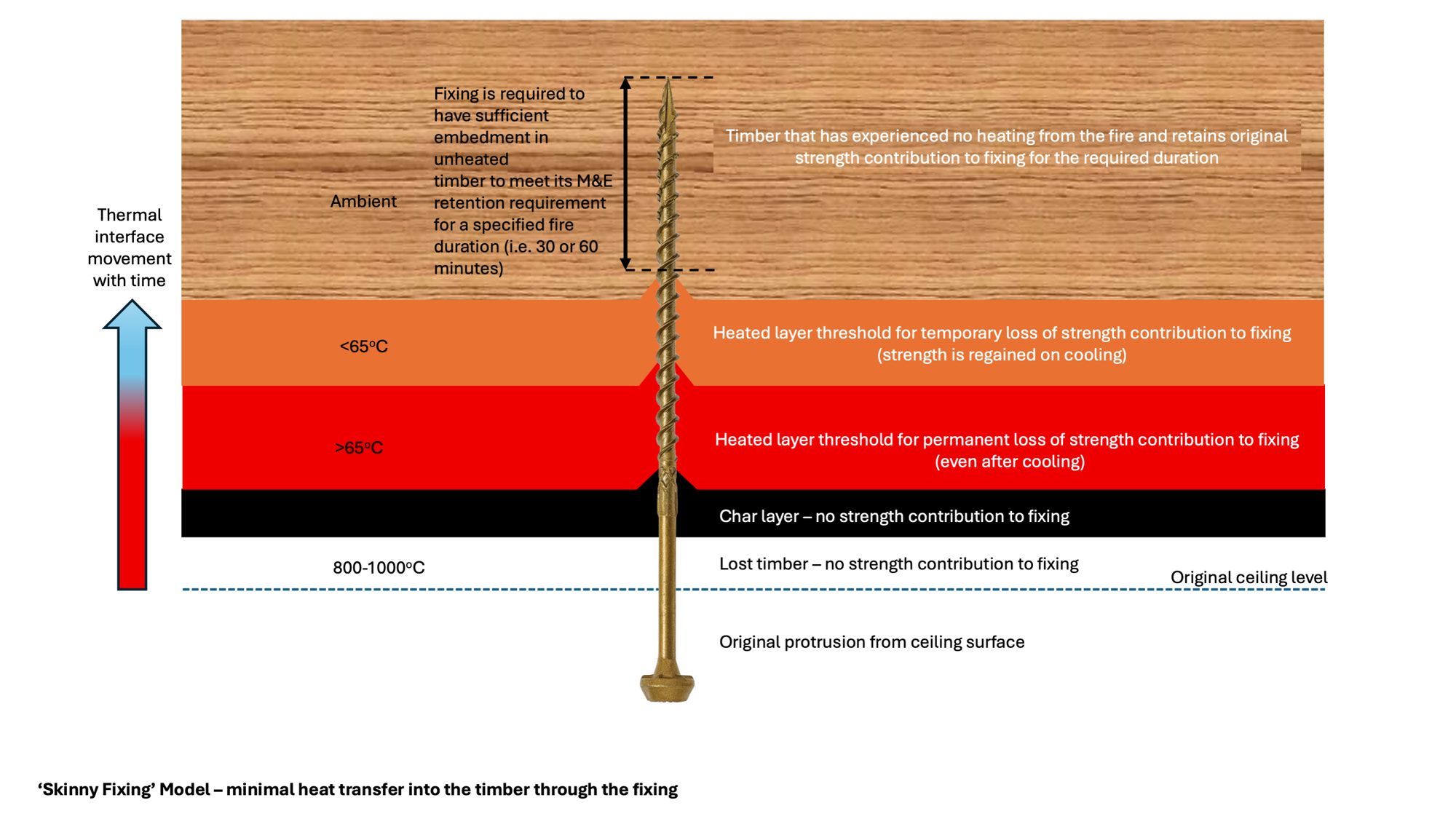
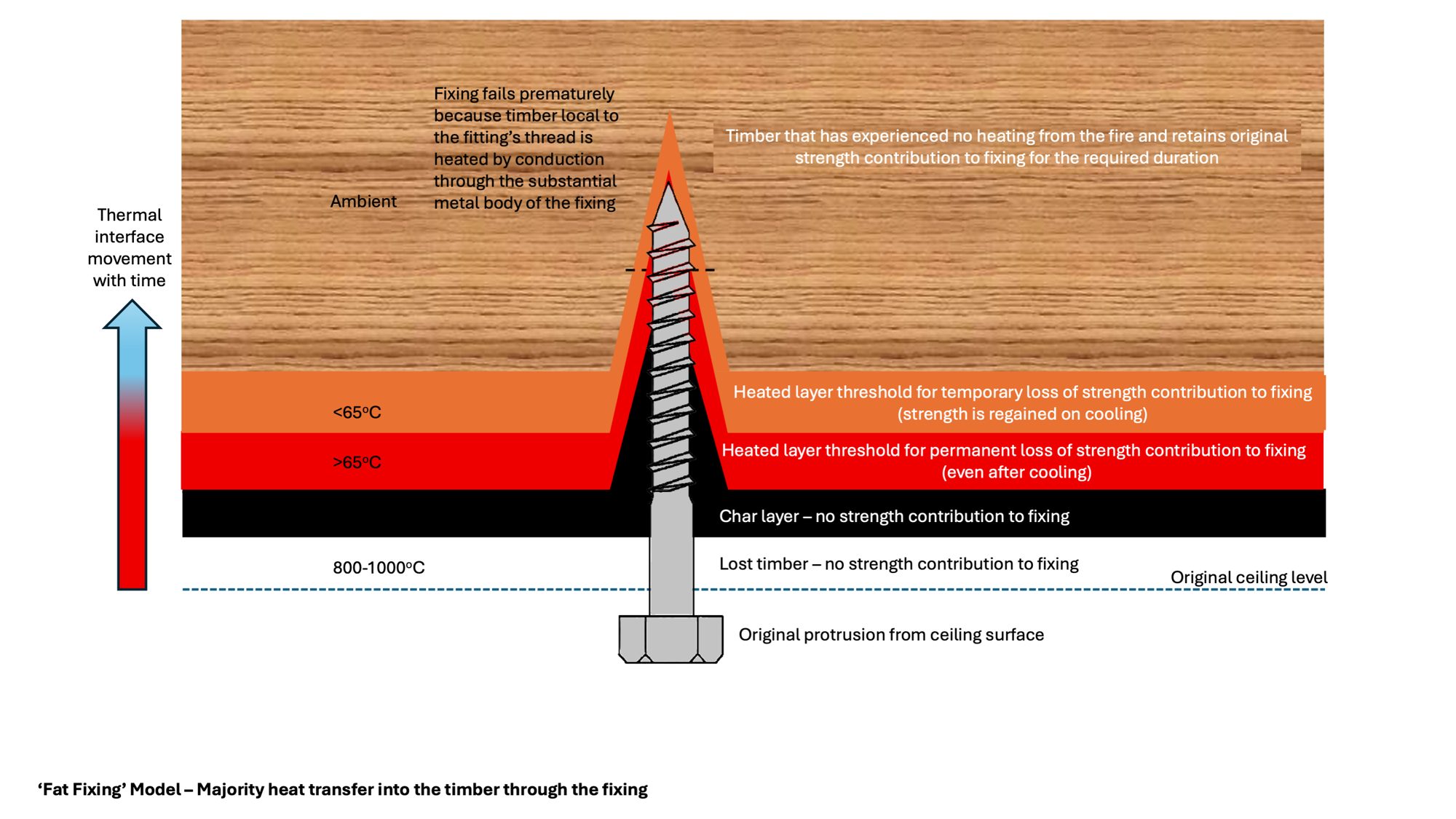
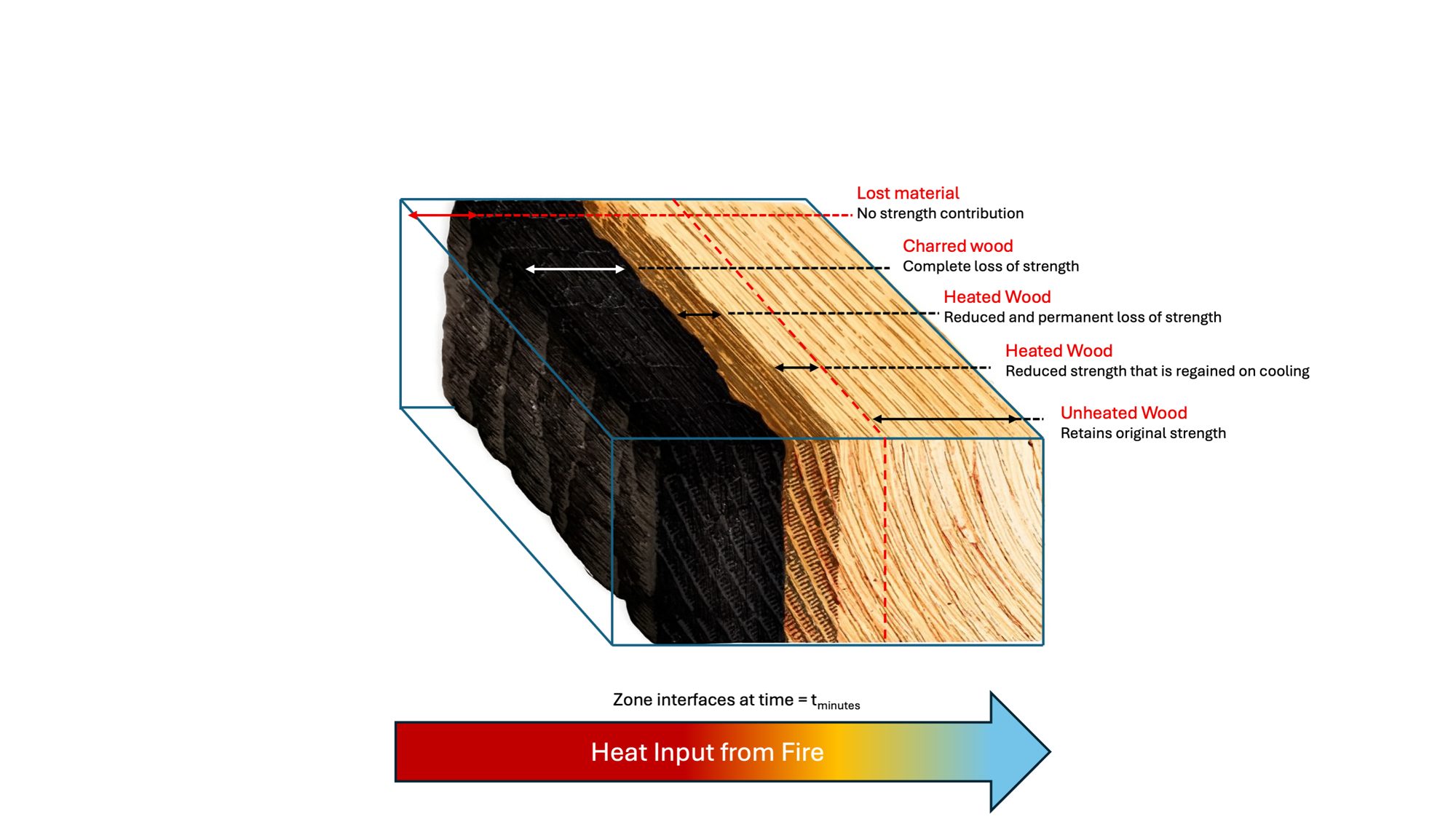
Testing showed that fixing geometry plays a critical role in performance. Larger diameter fixings can transfer heat more effectively into the timber surrounding the fixing, accelerating localised weakening.
By contrast, longer and narrower fixings were shown to retain their performance for substantially longer periods under fire exposure.
The study describes this as the difference between ‘fat’ and ‘skinny’ fixing behaviour. While simplified, the concept provides a practical framework for understanding how fixing selection can influence fire performance.
The findings suggest improved outcomes may be achieved through specification and installation practices that:
Provide adequate embedment depth: Fixings should maintain engagement with timber that remains unaffected during the critical period required for evacuation and firefighting intervention.
Limit heat conduction: Fixing selection should minimise heat transfer into the timber surrounding the threads.
Use appropriate materials: Hardened steel fixings demonstrated advantages in maintaining performance under fire conditions.
Consider critical service periods: Specification should reflect the time during which suspended services must remain operational and securely supported.
Importantly, these solutions do not rely on entirely new technologies. They can largely be achieved through improved specification and a better understanding of fire performance requirements.
What assurance looks like
For the timber sector, the broader significance of this work lies not in the specific fixing arrangements tested, but in the process itself.
Assurance is created when potential risks are identified, investigated and addressed before they become widespread problems. Confidence grows when evidence informs standards, standards inform specification and specification informs delivery.
This approach is particularly important for insurers, warranty providers and regulators, all of whom require objective evidence that risks have been understood and managed appropriately.
The FSRTT and ASBP project demonstrates how collaboration between researchers, industry bodies, manufacturers and fire safety professionals can strengthen the evidence base that underpins timber construction.
As timber construction continues to evolve, similar work will be required across many areas of design, manufacture and operation. The industry’s long-term success will depend not only on innovation, but on its ability to demonstrate performance through robust testing and transparent knowledge sharing.
The future of timber construction will ultimately be shaped less by perception and more by evidence. Research programmes such as this also demonstrate the importance of collaborative funding, technical curiosity and knowledge sharing. Together, these help ensure confidence in timber construction is built on measurable assurance rather than assumption.
The project also illustrates a broader lesson for the sector. Important improvements to building safety do not always arise from planned research programmes. Sometimes they emerge from unexpected observations that warrant further investigation. Ensuring that mechanisms exist to recognise, fund and explore these findings forms an important part of maintaining confidence in evolving construction systems.
References
[1] Glockling J. Preventing firefighter and evacuee entanglement, electrocution and obstruction risks in timber buildings on fire. Fire Service Research & Training Trust and Alliance for Sustainable Building Products (2026).
[2] Kinnersley R, Glockling J, Hull TR. Fire spread via fixings and interfaces in timber construction. Fire Safety Journal, 134, 103747 (2023).
[3] Hampshire Fire and Rescue Service. Fatal Fire Investigation Report: Firefighters Alan Bannon and James Shears, Shirley Towers, Southampton, 6 April 2010 (2013).
To provide the best experiences, we use technologies like cookies to store and/or access device information. Consenting to these technologies will allow us to process data such as browsing behavior or unique IDs on this site. Not consenting or withdrawing consent, may adversely affect certain features and functions.
Functional
Always active
The technical storage or access is strictly necessary for the legitimate purpose of enabling the use of a specific service explicitly requested by the subscriber or user, or for the sole purpose of carrying out the transmission of a communication over an electronic communications network.
Preferences
The technical storage or access is necessary for the legitimate purpose of storing preferences that are not requested by the subscriber or user.
Statistics
The technical storage or access that is used exclusively for statistical purposes.The technical storage or access that is used exclusively for anonymous statistical purposes. Without a subpoena, voluntary compliance on the part of your Internet Service Provider, or additional records from a third party, information stored or retrieved for this purpose alone cannot usually be used to identify you.
Marketing
The technical storage or access is required to create user profiles to send advertising, or to track the user on a website or across several websites for similar marketing purposes.