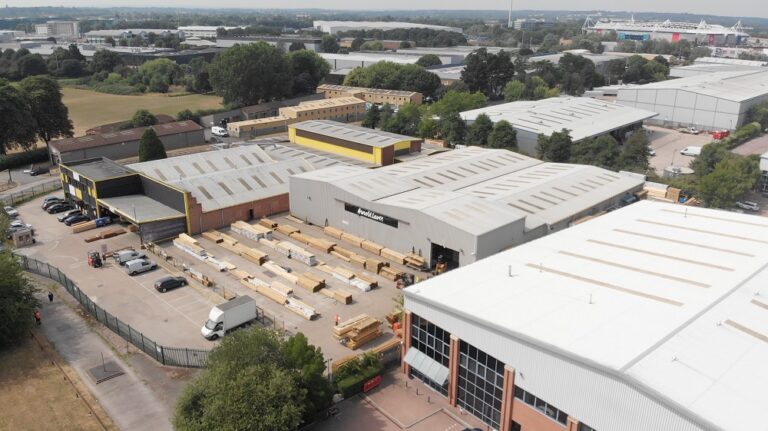
A key contributor to this effort is Woodknowledge Wales (WKW), whose deep commitment to building a sustainable, low-carbon future has shaped both the content and direction of this Yearbook. Led by Sarah Lawton, an editor and communicator working to connect the timber industry with the wider climate, land-use and design agenda, the WKW team has played a central role in curating the insights, case studies, and technical contributions you'll find in these pages.
On Tuesday the 20th May Architype welcomed collaborators to our London Studio for a roundtable discussion between actors at key stages of the material reuse journey – from those designing and commissioning buildings to those building and taking them apart, those determining what can be salvaged, and those trying to find materials a new home.
Historically, the challenge of reusing construction materials was not typically one of physical nor technical complexity – having been commonplace and entirely unremarkable until the last half-century. Setting out to build with reused materials today means contending with and navigating economic, industry and legislative norms and systems with in-built preferences for building entirely anew within restrictive timeframes. It has been made substantially more difficult still by the infancy of the U.K.’s reuse infrastructures – from under-developed supply chains and storage solutions to recertification routes.
As what the sector builds with has changed over the last century – with the development of adhesives, bonding agents, cementitious mortars, and composites to name a few, the physical work of deconstructing buildings and salvaging materials for reuse has become more complicated. This is also often made significantly more difficult by decisions that were made by those who designed and realised any given building in the first place and may well be disconnected from the building at the point of intervention.
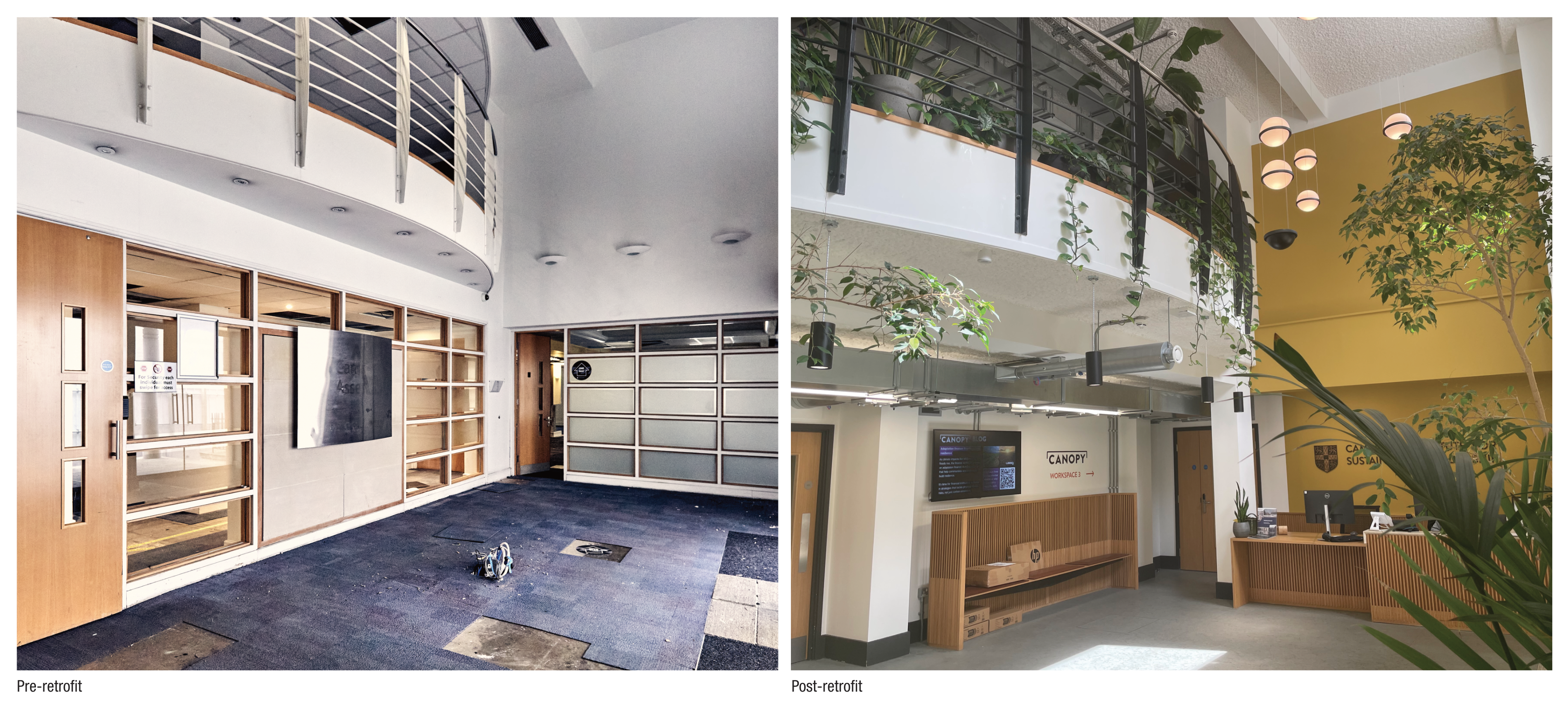
Rather than removing and scrapping the existing steel balcony balustrade in the Entopia Building and replacing it entirely, Architype advocated for its refurbishment as part of an opening up and celebration of the space as an entrance bringing in greenery and adapting a desk recovered from the headquarters of Netflix to make it inclusively welcoming and carefully repairing cracks in its surface with Kintsugi – the art of celebrating defects and repair.
There are growing numbers of excellent examples demonstrating what’s possible, and passionate individuals championing reuse, but the day-to-day reality of construction’s circular economies are yet to sufficiently resemble conditions that enabled the one-off exemplar projects we see at conferences and making it the norm. Discussions and events still tend to focus on these stories, rather than – the less comfortable systemic barriers beyond individual projects or the daily onsite and project-wide difficulties and missed opportunities that, with a little more resourced time and collaboration, could be solved.
Inspired by post-CPD session discussions Architype co-owners had with KpH Deconstruction and as part of Architype’s wider Regenerative Design and Infrastructures approach, we hosted a roundtable that spanned as much of the reuse journey as possible – carefully developing a format that purposefully made time to learn and to share experiences between those working at different stages of the reuse process.
Assembling a panel that gathered insights from Architype, KpH Deconstruction, Franchi, Saint Gobain, Marks Barfield Architects, Circo Trade, Material Index, and Willmott Dixon, we leaned into these practicalities and challenges. After our host Scott McAulay set the scene, each panellist introduced themself by sharing the story of how they began engaging with material reuse in their work and the trigger points for their company getting involved with it in a bigger way, and over the course of the evening attendees shared their most common barriers and opportunities, lessons practically learned, advice they‘d give to clients and recommendations they’d offer policymakers to increase reuse in their work.
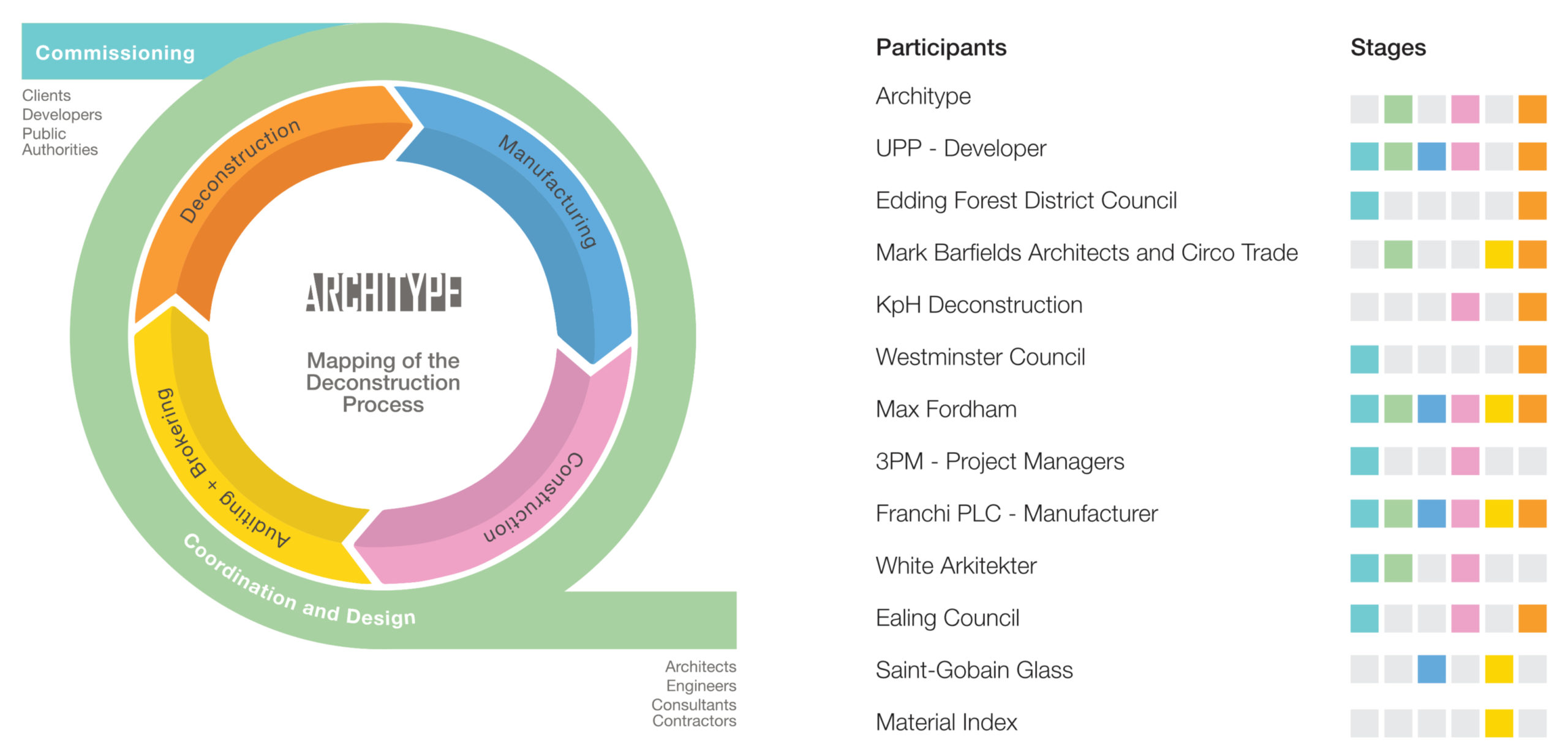
Mapping exercise illustrating which stages of the Deconstruction Process that participants in the roundtable worked across and covered between them. Critically, this illustrates collaboration, expertise and experience across stages – beyond works traditionally covered by architects – is crucial to unlocking reuse opportunities.
The energy brought by attendees and the generosity with which experiences were shared made for an encouraging and energising evening. Deconstruction and reuse are viable possibilities; client ambition and long-term buy-in can make inspiring things possible; embodied carbon considerations are beginning to shift conversations on projects – as took place during the delivery of the Entopia building; manufacturers are exploring routes to recertify and material recovery, and the greatest impacts continue to be made by collaborative efforts – often requiring disruption, finding that first collaborator willing to try to make your idea possible, and beginning conversations as early as possible – embedding circularity into written briefs and documentation. Coordinating the reuse of construction materials on projects takes time that must be allowed and accounted for – being a role in and of itself that we know pays off in a multitude of ways, and we look forward to championing it and to playing our part to realise circular economies in the future – both on our projects and beyond them.
Architype would like to thank panellists Alasdair Donn (Willmott Dixon), Darcy Arnold-Jones (Circo Trade and Mark Barfields Architects), Marco Franchi (Franchi), Rochelle Collard (Saint-Gobain), Oliver Lawson (Material Index), Lyndsey West (KpH Deconstruction) and Steve Peterson (KpH Deconstruction) for joining us and the collective experience and insight they shared, and to all our participants for a fascinating evening!
Architype provides retrofit and new build net zero carbon and regenerative architectural design and strategy, as well as a specialist consultancy Perform+ that provides strategic insight and guidance, and technical services.
For a free one-hour chat about your zero carbon challenges and regenerative design ambitions, please contact: [email protected]
Our latest Carbon Reduction Plan can be found here.
To provide the best experiences, we use technologies like cookies to store and/or access device information. Consenting to these technologies will allow us to process data such as browsing behavior or unique IDs on this site. Not consenting or withdrawing consent, may adversely affect certain features and functions.
Functional
Always active
The technical storage or access is strictly necessary for the legitimate purpose of enabling the use of a specific service explicitly requested by the subscriber or user, or for the sole purpose of carrying out the transmission of a communication over an electronic communications network.
Preferences
The technical storage or access is necessary for the legitimate purpose of storing preferences that are not requested by the subscriber or user.
Statistics
The technical storage or access that is used exclusively for statistical purposes.The technical storage or access that is used exclusively for anonymous statistical purposes. Without a subpoena, voluntary compliance on the part of your Internet Service Provider, or additional records from a third party, information stored or retrieved for this purpose alone cannot usually be used to identify you.
Marketing
The technical storage or access is required to create user profiles to send advertising, or to track the user on a website or across several websites for similar marketing purposes.