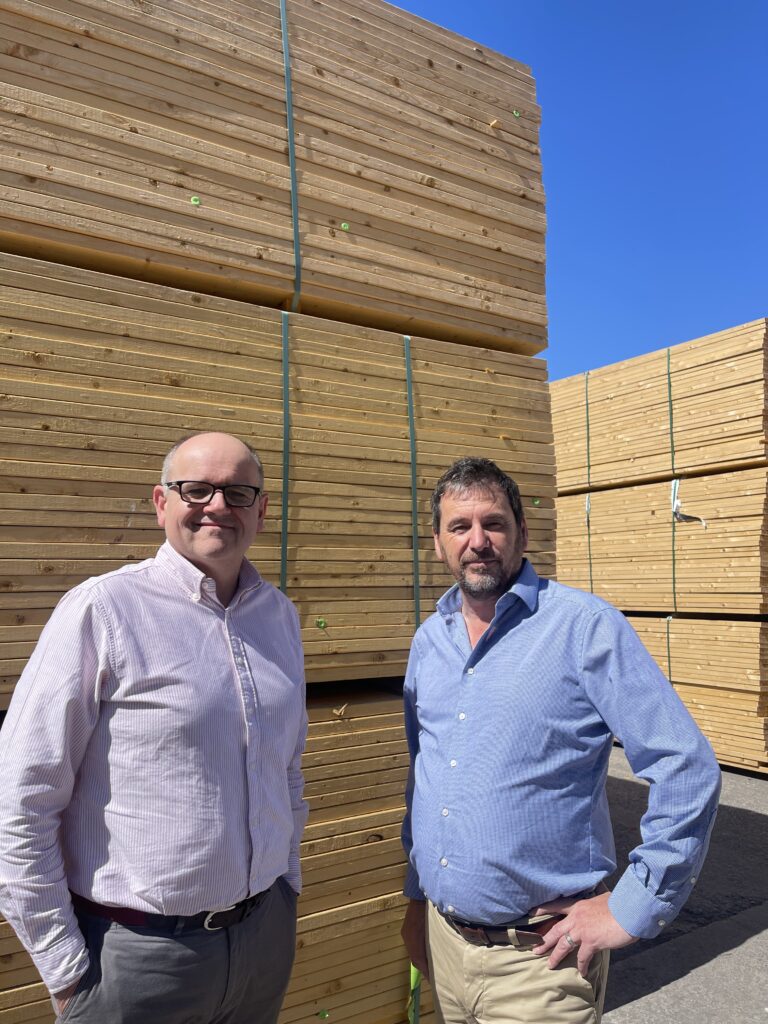
A key contributor to this effort is Woodknowledge Wales (WKW), whose deep commitment to building a sustainable, low-carbon future has shaped both the content and direction of this Yearbook. Led by Sarah Lawton, an editor and communicator working to connect the timber industry with the wider climate, land-use and design agenda, the WKW team has played a central role in curating the insights, case studies, and technical contributions you'll find in these pages.
Palisade fencing has been the primary choice for perimeter security for decades. Providing protection against theft and intrusion, it is known for its sturdiness and is easily recognisable by the vertical steel pales and sharp profile.
Structure
Made of steel, the palisade fence is constructed with two horizontal rails (which can vary in height) and vertical pales (usually D or W-profiles).
W-Profile: Offers higher security as the shape makes it harder to cause any damage to the pales with tools.
D-Profile: Often used for medium-security or where a more traditional look is preferred.
Tops: Usually finished with triple-pointed, single-pointed or rounded tops to deter scaling.
Security Features
Palisade is a formidable physical deterrent. Due to its height, sharpness and spiked tops, it is extremely difficult to climb. High-security bolts increase the fence’s strength and maintain the appropriate distance between pales. It’s frequently used for railway, water treatment plants, power stations, and industrial estates. We recommend that, as a minimum, the product is checked to ensure it always conforms to BS1722-12:2016 and, for higher security establishments, LPS 1175.
Installation and Maintenance
Method: Palisade can be installed on various terrain types, making it a good choice for uneven ground or steep gradients. Posts can be bolted down to hard substrates (e.g. concrete ground) or dug into softer ground, and pales can be adjusted individually to follow terrain levels without stepping.
Maintenance: Palisade fences are low-maintenance. Hot-dip galvanised steel (BS EN ISO 1461) can last 25+ years, depending on local conditions. It will require periodic checks of bolt tightness and keeping it clean.
2. Welded Mesh Fence
Mesh fencing (for example, V-Mesh or 358 Mesh) has overtaken palisade fencing at some sites, thanks to a strong combination of aesthetics and high security.
Structure
Mesh fence systems consist of steel wires welded at every intersection.
V-Mesh (Profiled): Features ‘V’ folds for rigidity. Ideal for schools and retail parks.
358 Mesh: The benchmark for high security. Often referred to as “anti-climb”, the apertures (76.2mm x 12.7mm) are small to prevent a finger/toe hold, and narrow enough to deter bolt cutters from gaining a good grip.
Security Features
Mesh provides excellent through-visibility (unlike palisade fencing that can create blind spots when viewed at an angle). For sites using CCTV or other video security systems, it ensures there are no hiding places for intruders.
Installation and Maintenance
Method: Mesh comes as rigid panels, which facilitates a faster installation on flat ground. For slopes, the process becomes more complex, where panels must be stepped. This might require additional posts or custom fabrication to close gaps at the bottom.
Maintenance: Very low, provided it is galvanised, polyester powder-coated (PPC), and kept clear of vegetation and debris.
3. Chain Link Fence
Chain link is a versatile and cost-effective option. It was primarily used for demarcation, but it can lack the high-security component, and it is difficult to install and repair.
Structure
It’s made from woven steel wire in a diamond pattern, galvanised and/or vinyl-coated to improve durability and is usually attached to tubular or angle-iron posts. It is lightweight and offers a “soft” boundary look.
Security Performance
Chain link is a low-security, demarcation option; it can be cut with standard hand tools. To increase the level of security it can offer, extra elements can be added, such as barbed or razor wire toppings for industrial sites. It can be used for internal zoning or as a temporary perimeter for low-risk sites.
Installation & Maintenance
Method: Highly flexible, it can be easily tensioned across long, uneven runs.
Maintenance: Moderate. It may require re-tensioning over time if the wire stretches or is subjected to impact.
Technical Comparison Table
Feature
Steel Palisade
Welded Mesh
Chain Link
Security Level
High
High
Low / Medium
Visual Deterrent
Exceptional
Discreet
Low
Visibility
Obstructed at angles
Good
Good
Climb Resistance
High
High
Low
Ground Adaptation
Excellent
Limited
Good
Installation Speed
Moderate
Fast
Moderate
Maintenance
Low
Low
Moderate
Typical Lifespan
15+ Years
15+ Years
10+ Years
Fencing Selection
There are four elements to consider to find the best solution for your project:
1. The Topography (Ground Conditions)
If the site has significant slopes, palisade is likely the most cost-effective option because it avoids the bottom-gap issue found with rigid mesh panels, without requiring expensive groundworks.
2. Planning and Aesthetics
For urban construction sites or projects near residential areas, mesh is usually the preferred choice of planning officers. It looks professional and can be powder-coated in any RAL colour to match corporate branding or the local environment.
3. Security Ratings (LPS 1175)
For the MoJ, MoD, or utility site projects, the LPS 1175 security rating is widely required and considered the standard benchmark.
Palisade is often specified for its physical bulk.
358 Mesh is specified where “Delay and Detect” (CCTV + Anti-cut) is required.
4. Integration with Technology
When sites use smart security, mesh is the winner. The rigid structure of mesh panels makes them the ideal solution for PIDS (Perimeter Intrusion Detection Systems), like vibration sensors or fibre-optic cables.
To provide the best experiences, we use technologies like cookies to store and/or access device information. Consenting to these technologies will allow us to process data such as browsing behavior or unique IDs on this site. Not consenting or withdrawing consent, may adversely affect certain features and functions.
Functional
Always active
The technical storage or access is strictly necessary for the legitimate purpose of enabling the use of a specific service explicitly requested by the subscriber or user, or for the sole purpose of carrying out the transmission of a communication over an electronic communications network.
Preferences
The technical storage or access is necessary for the legitimate purpose of storing preferences that are not requested by the subscriber or user.
Statistics
The technical storage or access that is used exclusively for statistical purposes.The technical storage or access that is used exclusively for anonymous statistical purposes. Without a subpoena, voluntary compliance on the part of your Internet Service Provider, or additional records from a third party, information stored or retrieved for this purpose alone cannot usually be used to identify you.
Marketing
The technical storage or access is required to create user profiles to send advertising, or to track the user on a website or across several websites for similar marketing purposes.