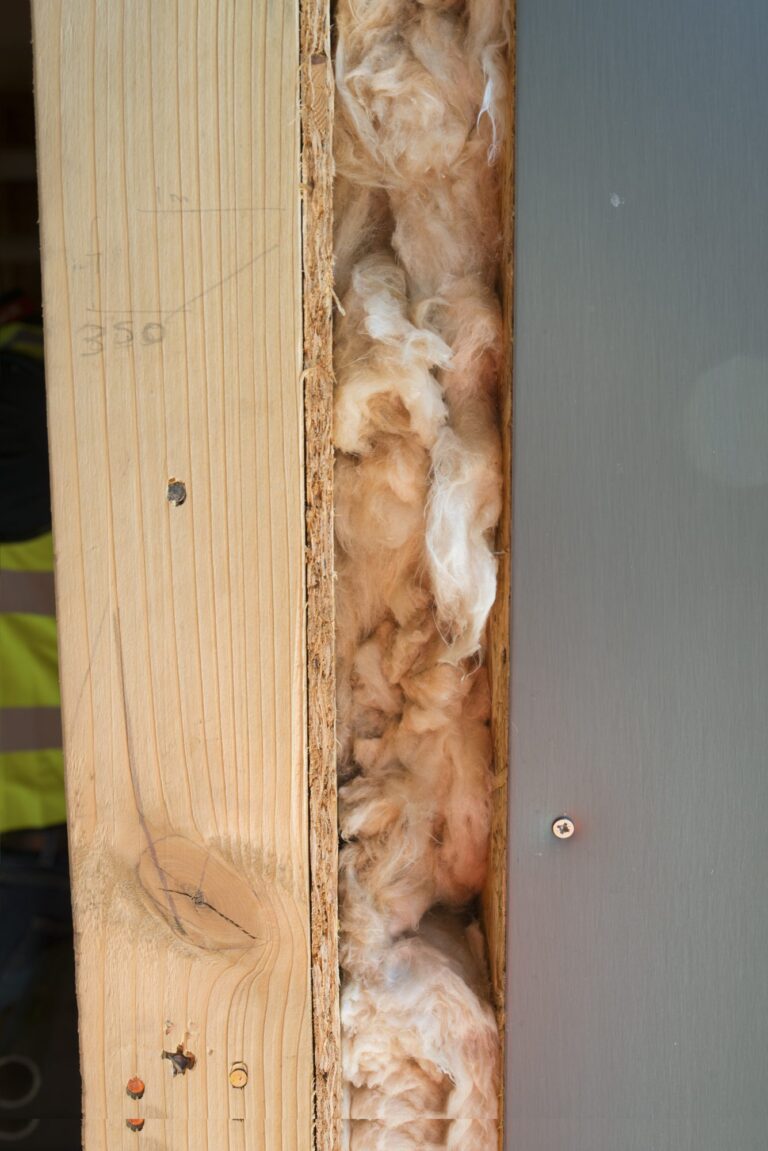
Gary Newman discusses why wood fibre insulation is becoming increasingly relevant to low-carbon construction, and how domestic manufacturing could strengthen UK supply chains while supporting healthier, moisture-resilient buildings.
The UK has the forest resource, the technical knowledge, and growing demand for low-carbon construction. Yet when it comes to wood fibre insulation, the market remains heavily dependent on imports.
We spoke to Gary Newman, CEO of Woodknowledge Wales, about the case for domestic – and why material choice, moisture performance, and carbon all need to be considered together.
Q: There’s a lot of talk about biobased materials. What’s actually changed?
We’re moving beyond just operational energy. Embodied carbon is now increasingly part of mainstream decision-making. Once you look at whole life carbon, materials matter. Biobased materials don’t just reduce emissions, they store carbon. That’s a fundamentally different proposition to mineral or fossil-derived products.
In our work on wood fibre insulation, we’ve framed this as a system issue by linking forestry, processing and construction into something that delivers environmental and economic value together. That’s the shift: from isolated products to connected supply chains.
Q: And insulation is a key part of that?
Yes, and it’s often misunderstood. From a purely thermal perspective, wood fibre insulation sits in the 0.036–0.040 W/m.K range, which is broadly comparable to mineral wool. So on performance alone, there’s no real disadvantage. But buildings aren’t one-dimensional. Once you factor in moisture, heat capacity, acoustics, insulation products that that do more than one job start to make sense. The issue is we still tend to specify insulation on a single metric, which doesn’t reflect how buildings actually behave.
Q: Moisture performance comes up a lot with wood fibre. Why is it so important?
Because this is where things either work or go badly wrong. A lot of the UK housing stock, particularly pre-1920 solid stone buildings, was never designed to be sealed up. These buildings rely on breathability – they manage moisture by allowing it to move through the fabric. If you put the wrong insulation system on them, you disrupt that balance. What we’ve seen in practice is that when moisture can’t move, it accumulates. That leads to mould, decay, and in some cases structural damage.
There’s solid technical evidence behind this. Comparative studies show that wood fibre insulation can absorb and redistribute moisture within the wall build-up, reducing localised moisture risk, whereas more vapour-closed systems tend to concentrate it .
Recent scrutiny of UK retrofit schemes has shown what happens when building physics is ignored. MPs have called for a Serious Fraud Office investigation after widespread failures in insulation programmes – often involving damp, mould and damage to solid wall homes [1].
In many cases, the issue wasn’t insulation itself, it was inappropriate systems and poor design. So the key point is simple, you can’t treat all buildings the same. If you’re working with solid stone or traditional construction, maintaining breathability isn’t optional, it’s fundamental. Materials like wood fibre work with the building, not against it.
Q: How does carbon factor into the argument?
It’s central, but we’re still not measuring it properly. Wood fibre insulation has low embodied carbon, but that’s only part of the story. The real value is carbon storage. You’re taking atmospheric carbon and locking it into the building fabric for decades, potentially longer if materials are reused.
That’s exactly the basis of the wood in construction as a Greenhouse Gas Removal (GGR) mechanism argument. Timber buildings aren’t just lower carbon, they can function as a carbon removal and storage system at scale, effectively turning the built environment into a carbon sink rather than a source.
Some datasets even report negative global warming potential values, depending on how biogenic carbon is treated.
The problem is how we account for it. Current LCA methods are designed to measure emissions, not removals. They typically assume that all stored carbon is released at end of life, which cancels out the benefit on paper. But that ignores two critical things:
Duration of storage: carbon can be locked up for 60+ years in structural elements
Real-world pathways: reuse, cascading use, and delayed emissions
As highlighted in our GGR work, long-term storage in buildings is already recognised internationally as a legitimate form of carbon removal, but it isn’t properly valued in standard assessment methods. So we’re not just underestimating the benefit – we’re structurally misrepresenting it.
Q: Where are we in terms of market adoption?
In the UK, still early and that’s closely tied to manufacturing. Natural fibre insulation is around 0.5% of the market, compared to 5–10% in parts of Europe.
One of the key reasons for that gap is that we don’t have a domestic manufacturing base. We’re importing most of our wood fibre insulation, which affects cost, availability, and uptake. So the market isn’t just lagging, it’s structurally constrained.
Q: What’s driving growth now?
Policy and regulation. The Future Homes Standard is pushing a fabric-first approach. Whole life carbon is becoming standard practice. Timber frame construction is growing.
Those three things together create a natural space for wood fibre insulation. Then there’s retrofit. We’ve got around 28 million homes that need upgrading, many of them solid wall buildings where moisture risk is critical. That’s a huge opportunity but only if the supply chain can respond.
Q: If the case is strong, what’s holding it back?
It comes back to manufacturing and coordination. Cost is still a barrier, and without UK production we’re exposed to import costs and logistics. Supply is limited, which makes it harder for designers and contractors to specify with confidence. Then there are system barriers – if products aren’t embedded in standards, specifications and certification routes, adoption is slow regardless of performance. And finally, the coordination problem. Manufacturers want demand before investing, but demand depends on availability and price. That’s the gap we need to close.
Q: Your work looks specifically at manufacturing in Wales – what’s the opportunity there?
The opportunity is to connect the dots across the supply chain. Wales has the forest resource, sawmill co-products, infrastructure, and a growing timber construction sector. We also have a company establishing wood fibre insulation production from recycled MDF. The challenge is commercial – scale, investment, and market certainty.
But if you unlock that, you don’t just get a new insulation product and the associated employment, you get a more resilient supply chain and reduced import dependency.
Q: What needs to happen next?
We need alignment across policy, industry and investment.
That means:
recognising the full carbon value of biobased materials,
supporting domestic manufacturing capacity,
building skills, particularly in retrofit,
and integrating these materials into mainstream specifications.
If we get it right, the outcome is clear: lower carbon buildings, better indoor environments, and a stronger, home-grown bioeconomy.
Wood fibre insulation manufacturing in Wales
This Woodknowledge Wales report explores the potential for domestic wood fibre insulation manufacturing, examining forestry resource, market demand, supply chain opportunities and the role of biobased materials in low-carbon construction.
Using wood in construction as a significant greenhouse gas removal mechanism
This report examines how timber buildings can function as long-term carbon stores, outlining the role of harvested wood products within greenhouse gas removal strategies and whole-life carbon assessment.
References
[1] Harvey F. MPs ask Serious Fraud Office to investigate UK home insulation sector, The Guardian (2026).
Suggested images
LARGE image of Gary as illustration as well as headshot in folder.
Publication cover shots in folder for box out.