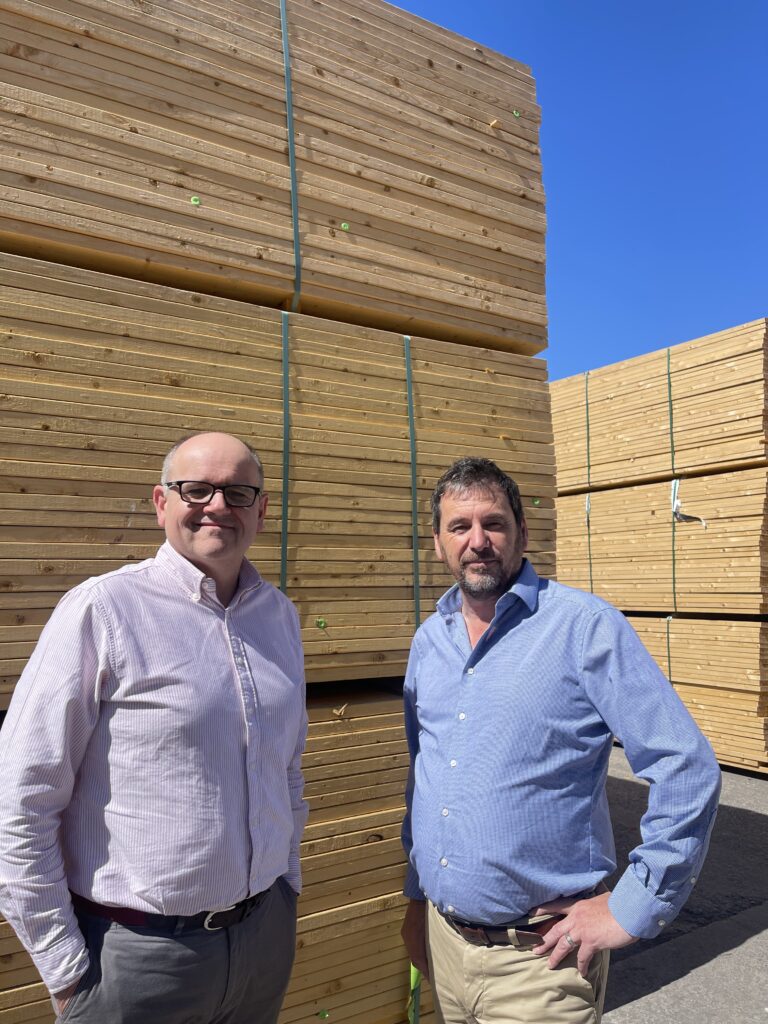
Supplying Timber spoke with Consolidated Timber Holdings’ CEO Richard Martin to learn how the company is reshaping its business to place customers at its heart.
Over the past 12 months, Consolidated Timber Holdings (CTH) has been quietly but decisively reshaping the way it operates. Through a series of practical, people-led changes, the CTH team is changing the way the group works with its customers, its teams, and its supply chain.
Overseeing that shift is Richard Martin, who joined the business in May 2024 and stepped into the CEO role in January 2025. His brief was clear. Consolidation across the group had already taken place, bringing together a number of individual businesses into two separate companies – Falcon Timber, CTH’s distribution business, and Hoffman Triesse, CTH’s manufacturing business. The next step was to turn that consolidated structure into something more outward-looking, more commercially focused, and more closely aligned to the needs of customers who are operating in one of the most challenging economic markets the timber sector has faced.
“The challenge that was set to me,” Richard explains, “was taking the more joined up, consolidated organisation into a more customer-orientated business. That’s what we’ve been focusing on over the last 12 months.”
What has followed is not a reinvention of CTH’s identity, but a recalibration of how the group uses its scale, expertise and people to add value in a changing market. The result is a more streamlined business that looks and feels more connected, is more confident in its proposition, and feels better equipped to support customers through a prolonged period of pressure.

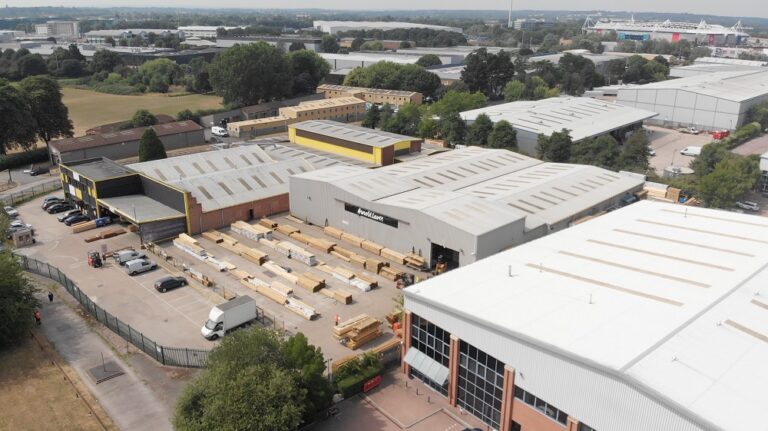
Falcon Timber’s warehouse
From structure to substance
For several years, much of the focus within CTH has been on getting the foundations of the business right. Bringing multiple businesses together, aligning their separate systems and building operational resilience within the group. Now that work is complete, it provides the backdrop for the next phase of CTH’s focus.
“There’s been a lot of good foundation work done,” Richard says. “This next phase is about market and customer orientation, and how we can really look to grow by being as aligned as possible to what our customers need.”
Central to that thinking has been a clear decision to organise the business around two core customer segments. On one side sits merchants, who are buying products for resale. On the other are CTH’s joinery and manufacturing customers, who are buying timber and panels to make or construct something specific.
“Those customers are fundamentally different in their challenges, their needs and the dynamics that they currently face,” Richard explains. “It’s really important that we align our product expertise and the solutions we provide to those different needs.”
Rather than treating the market as a single audience, CTH has reshaped its sales approach so that its teams are focused on either one sector or the other. That, Richard says, has allowed for deeper understanding, more relevant conversations and a better grasp of the trends shaping each part of the market.
“It gives us a head start,” Richard says, “but the important thing is getting close to our customers, understanding their individual businesses and working with them to support their own particular needs.”
Unlocking CTH’s hidden strengths
One of the more revealing insights from the work CTH has done over the past year has been just how much capability existed within the group that customers were not fully aware of.
“We found that we had aspects of our business that were the best kept secret,” Richard admits. “Customers knew about certain elements of what we do, but not about other pockets of the business that could really add value to them.”
For customers, that lack of visibility often meant using multiple suppliers to source products that could have all been supplied by CTH, thereby missing out on opportunities to streamline their own operations. For CTH, it meant under-utilised expertise, losing out on potential sales, and not always reaching the market in the most effective way.
CTH’s solution has been to equip their sales teams with a fuller picture of the group’s entire proposition, enabling them to bring those capabilities together in a way that makes sense for each customer.
“That’s how we’re enabling the sales team to add value,” Richard says, “and developing our product ranges so they align better with those two market segments.”
The effect has been a shift from transactional selling to more a consultative way of working, creating partnerships with their customers. Conversations now centre less on individual product lines and more on how CTH can support customers to grow their own businesses, even in difficult trading conditions.
Thinking differently about service

Hoffman Triesse’s warehouse
CTH’s national footprint has long been one of its strengths. Falcon Timber, for example, operates eight distribution sites across the UK, supported by manufacturing facilities in Essex and Yorkshire. Historically, those sites served their local customers very well, but the group recognised that the full benefit of that scale was not always realised to its full potential.
“What we found was that sites were great at serving the customers they looked after,” Richard explains, “but as a whole we weren’t leveraging the size and benefit of the business.”
The shift to address this has been subtle but significant. Rather than sites focusing primarily on “their” customers, the priority is now serving customers as part of a single CTH network.
“Our first and foremost desire from each site is to serve the customer,” Richard says. “We manage operational efficiencies alongside that, but fundamentally it’s about learning what our customers need and making sure we can get that to them, wherever it comes from within our estate.”
This approach goes hand-in-hand with a more integrated view of logistics across the group. With 34 of its own trucks and additional trailers, CTH has moved away from a site-by-site allocation model towards a more holistic fleet strategy.
“Rather than each site having its own trucks, we now manage our vehicles across the whole estate,” Richard explains. “That’s seen our on-time-in-full levels jump well into the mid-90s.”
For customers, the impact is straightforward, giving CTH the ability to provide improved reliability, greater flexibility and a service proposition that reflects the scale of the business behind it.
Tailored product propositions
The benefits of CTH’s new sector-focused approach are perhaps most visible in the way its product propositions are being shaped.
In the merchant sector, the emphasis is on helping merchant businesses move beyond simply stocking products towards building stronger, more differentiated offers of their own.
“If you look at our door core business and especially our fire rated door blanks,” Richard says, “we’re designing solutions for the merchant side that are aligned to what their customers need and gives them peace of mind about full fire certification.”
“It’s about helping merchants develop their sales lines,” Richard explains. “Not just filling shelves, but helping them grow.”
“For joinery and manufacturing customers, the conversation is different,” Richard says. “These businesses often work to very precise specifications and needs, whereby the quality and choice of our solutions are of the utmost importance as they are utilised by our customers within their own manufacturing, joinery or construction products.”
Because CTH’s sales teams are now focused on one particular sector, they can build a deeper understanding of how those customers operate. They see patterns, spot emerging market trends and can share insight that helps customers stay relevant in changing markets.
“They can see what’s working well elsewhere,” Richard says, “and act in an advisory capacity to ensure that our customers have the right product for today and the future”.
To support their larger merchant group customers, CTH’s approach balances national alignment with local delivery. Strategic discussions take place at the customers head-office level, covering the group’s wider goals and aspirations. From there, CTH works closely with local merchant branch managers to ensure those ambitions translate into practical support on the ground.
“It’s about helping local branches achieve what their central organisation wants,” Richard explains, “while still addressing the specific needs of that particular branch.”
In the joinery and manufacturing space, the emphasis is on understanding processes in detail. CTH teams spend time on customer sites, walking production floors, learning how timber and panels are used, establishing any challenges faced and identifying where specifications and service levels can be better aligned.
“That understanding allows us to match our products and specifications to exactly what our customers need,” Richard says.
None of these changes have taken place against an easy backdrop. The second half of 2025 has been challenging across much of the timber and construction supply chain, with July marking a particularly difficult period for many businesses.
“The market has been tough,” Richard acknowledges. “The more we can help our customers help their customers, the more value we can add.”
That support often starts with asking different questions. Rather than focusing purely on price or volume, CTH teams are encouraged to look at customer processes, end-user demand and gaps in existing offers.
“It’s not just ‘do you want to buy a pack of MDF?’” Richard says. “It’s understanding what their customer is asking for that they don’t provide or what complimentary products they could supply and helping them gain a competitive edge.”
In a market where margins are under constant pressure, that shift towards higher-value products and solutions can make a meaningful difference.
A new perspective on the industry
Richard’s perspective has been shaped by a career spent largely outside the timber sector. Before joining CTH he held senior roles across a range of industries including lifts and escalators, material handling, the metals industry and, most recently, the tyre industry as part of the Michelin Group. While those sectors may seem far removed from timber, Richard sees clear parallels.
“Tyres and timber are very similar,” he says. “They’re traditional industries with people who’ve worked there their whole career, and whose fathers and grandfathers worked there before them. They’re down-to-earth, knowledgeable and very values driven.”
That sense of continuity and pride is something he values deeply.
“It’s a joy to be part of an industry like that,” he says. “There’s so much expertise, knowledge and passion, and a strong set of values.”
Those values are now being formalised across the CTH Group through the introduction of a clear set of company values, designed to reinforce collaboration, accountability and customer focus.
“We try to do the right thing,” Richard says. “We don’t always get it right, but that’s our aspiration. We believe we’re an ethical company that can be trusted, and we will always try and do the right thing.”
Trust, he believes, underpins any effort to move beyond commodity trading towards higher-value solutions.
“If we align our service proposition to what customers want, and they trust us,” he says, “then we can get value back in what we provide, through our products, our expertise, our service proposition and the breadth of solutions we offer.”
As part of that thinking, CTH is increasingly viewing its product range not just as timber and panels, but as a spectrum from commodity through to mid-value and high-value added solutions.
“Commodities are commodities,” Richard says. “They become a price and service discussion. As we move up the value chain, the focus shifts to collaboration with customers and suppliers.”
Investing in capability and confidence
Behind the scenes, CTH has continued to invest heavily in its infrastructure and people. Over the past year, more than £1 million has been directed towards fire door testing, the development of a new state-of-the-art extraction system at Triesse, and the launch of a Door Technical Centre of Excellence near Chester.
“That centre is a real differentiator for us,” Richard says. “It allows us to focus on certification, testing and compliance in a way that supports both merchants and manufacturers.”
The group now operates three manufacturing facilities, alongside eight Falcon Timber distribution sites, offering around 700,000 square feet of storage. That scale, combined with a national logistics network and a workforce of around 300 people, underpins CTH’s service proposition.
Recognition from the industry has followed. CTH was named Panel Trader of the Year at the 2025 Timber Trades Journal Awards, while its procurement coordinator received an individual achievement award, reflecting the depth of expertise within the business.
This investment has not been limited to bricks, mortar and machinery. People development has also been a major focus over the past 12 months, with a mix of internal and external programmes.
“We’ve invested a lot in mentorship, coaching and training,” Richard says. “Whether that’s on product training, expertise-led sales skills, or personal development around leadership and time management.”
This focus reflects a belief that long-term success depends on building capability and confidence throughout the organisation, not just responding to immediate market pressures.
“It’s about building competency levels now,” Richard explains, “so we’re ready when the market does pick up and we can make the most of that opportunity.”
When asked about the year ahead, Richard is measured but optimistic. He expects trading conditions to remain challenging in 2026, with little external relief in the short term. That makes controlling the controllables more important than ever.
“It’s about navigating a difficult environment,” he says, “while continuing to grow the business through an increased commercial focus and by aligning our business strengths to the needs of our customers.”
He is clear that the changes underway at CTH Group are evolutionary rather than revolutionary, with the business aiming for steady progress, rooted in clear strategy, strong values and close customer relationships.
“We’re open to business,” Richard says. “Come and talk to us, and we’ll help you find solutions to prosper through these difficult times. It is possible, with the right focus and the right support through your supply chain.”
For a group that has spent recent years building its foundations, that message reflects a growing confidence. CTH is no longer simply consolidating what it owns. It is actively shaping how it serves, how it listens, and how it helps customers move forward. As the timber market waits for recovery, Consolidated Timber Holdings is positioning itself not just to weather the storm, but to emerge stronger, more connected and ready for what comes next.
www.cth.co.uk
The post Member Profile: CTH puts customers back at the centre appeared first on Timber Development UK.