A key contributor to this effort is Woodknowledge Wales (WKW), whose deep commitment to building a sustainable, low-carbon future has shaped both the content and direction of this Yearbook. Led by Sarah Lawton, an editor and communicator working to connect the timber industry with the wider climate, land-use and design agenda, the WKW team has played a central role in curating the insights, case studies, and technical contributions you'll find in these pages.
Thomas Henderson examines the role of small sawmills within Wales’s timber economy, arguing that their value lies less in scale than in their ability to connect local timber resources to flexible, practical end uses.
Small sawmills do not dominate the timber industry, but they do make wood a possibility for many. Most sit outside the headline numbers, easy to miss, yet quietly deal with timber the rest of the system struggles to handle.
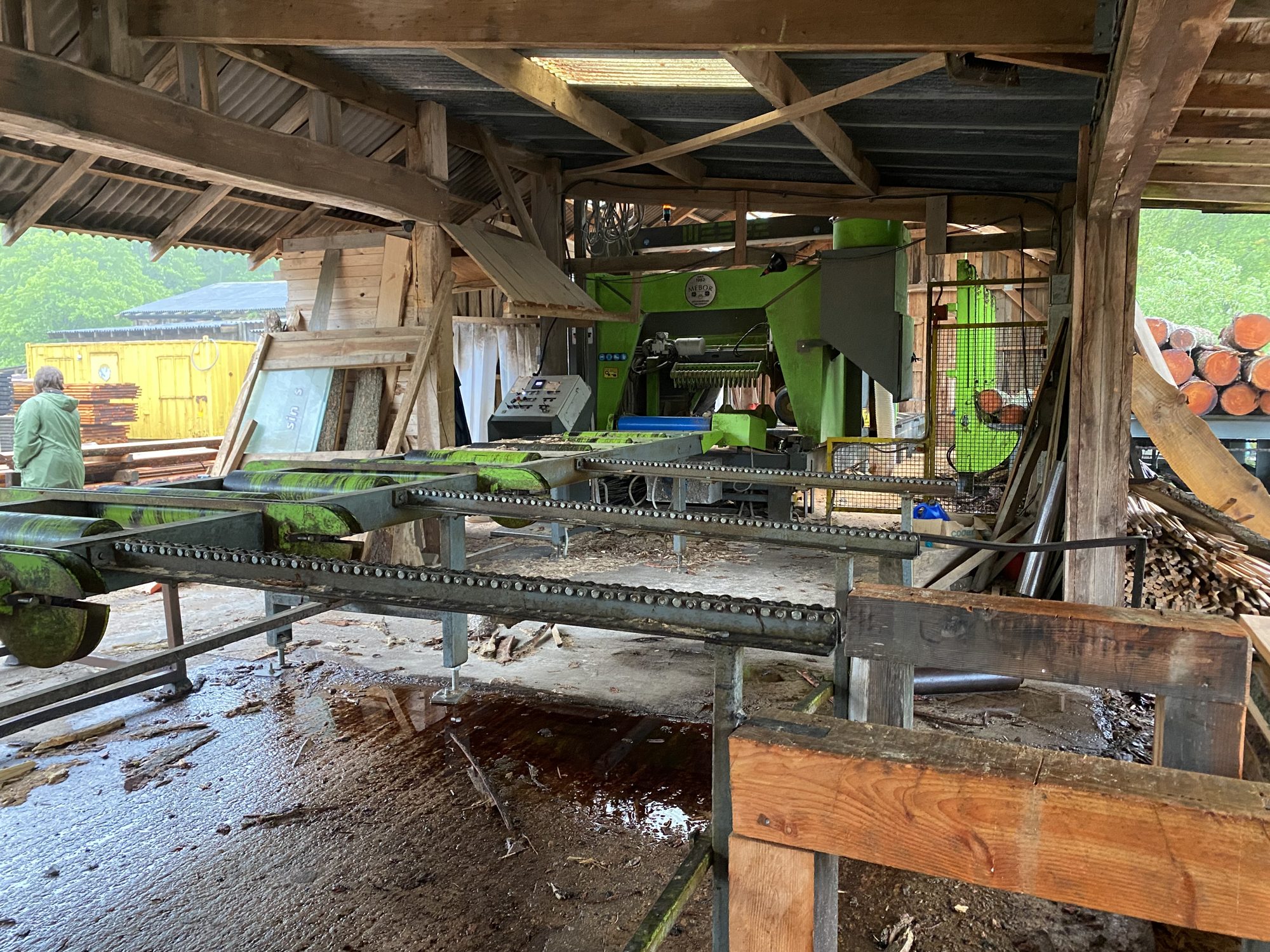
Across Wales, they form a loose, scattered network. Operations are often more organic than organised, with yards, sheds, workshops and bits of kit added over time. Recent work through the Welsh Local Timber Supply Chain Review [1,2] points to a simple idea: this sector does not matter because of size; it matters because it makes things possible.
At first glance, this sector may not impress. Small teams. Modest throughput. Businesses that rarely shout about themselves. If you were only considering volume, you might pass straight over them. But then you would miss their true impact, which lies in how they actually operate.
Small sawmills operate at a scale and in a way that fits their material, markets, and setup, rather than pursuing expansion as a primary goal. They occupy a different space to the increasingly automated, high-throughput, global commodity market-oriented and super-efficient large mills. This is a model that works with variation, responds to local conditions, and keeps timber in use close to where it is grown.
The task is not to change that, but to recognise it.
Local, flexible, grounded in the material
What comes out of the forest rarely does so in categories. Timber varies by species, size, characteristics and condition. This is where small sawmills come into their own. They work with what is available, taking on material from nearby farms, community woodlands, roadside stacks, and small woodlands. And they work to meet the demands of a varied market that includes builders, joiners, farmers, and private customers with specific requirements – from cladding to chopping boards – usually in quantities which would be considered small by industry standards.
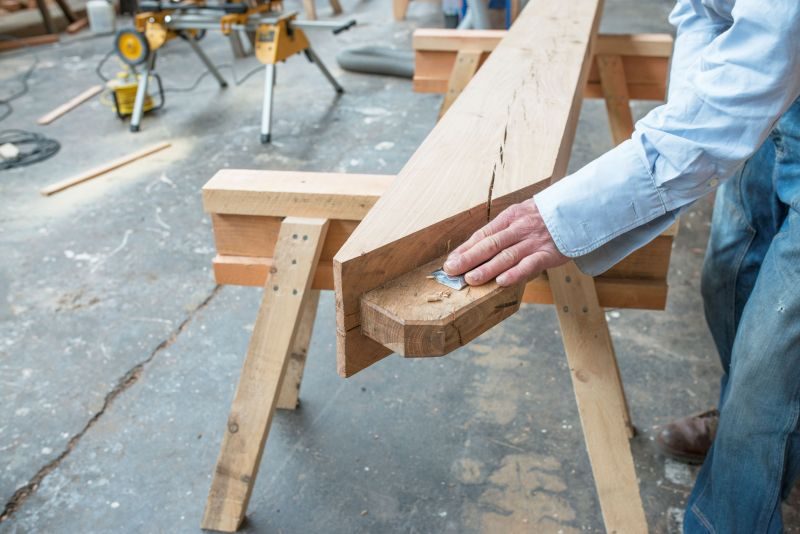
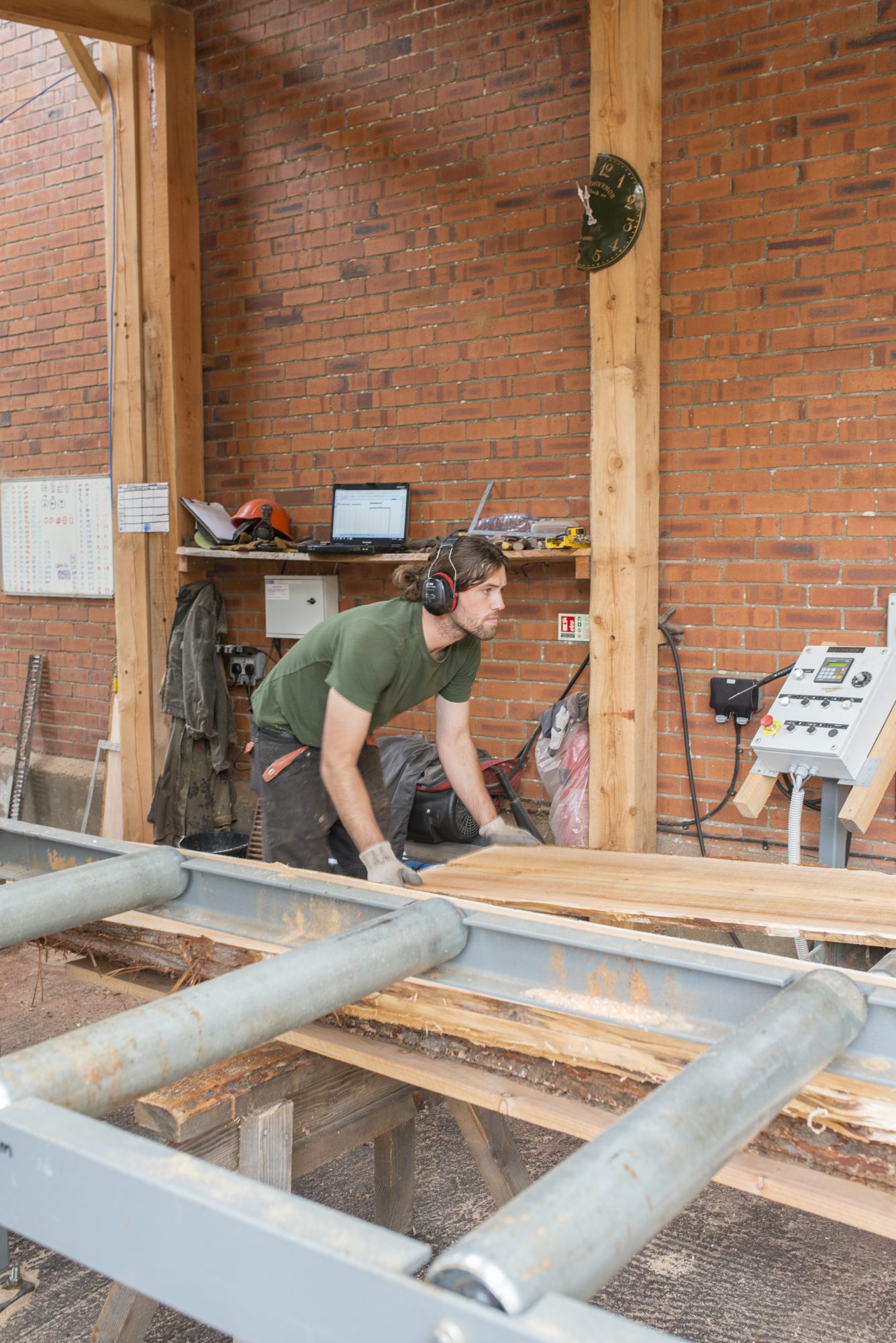
Between those two points, they turn raw material into something usable at the small scale, perfectly demonstrating the idiom that ‘small is beautiful’. An odd log becomes cladding, a beam, a stack of boards. Not in huge volumes. Just as is required. There is no long, complex chain here. Timber moves in, is processed, and exits into use. Where large mills rely on consistency and scale, small mills occupy niches that collectively absorb variation. Mixed species, irregular supply, small batches, one-off jobs. Small mills are built around these realities. And because of that, they extend usability of timber resources.
Focusing on the volumes small sawmills produce misses the point. Their value lies in what they enable. As a sector, they bring small woodlands into use, processing timber that would otherwise be chipped, burned, or left to rot, and taking on awkward pieces for one-off jobs. Each intervention is modest, but together they have wider effects. The small sawmill strengthens the link between woodland as a local resource and end use.
No two small sawmills are the same
There is no typical small sawmill. Some are part of farms. Some are standalone. Some are linked to joinery, construction, or timber framing. Others sit alongside firewood production or other land-based work.
Production varies just as much. Structural timber, cladding, fencing, bespoke work, often shaped by what is available locally and what customers are asking for. This individual mill diversity means the sector as a whole can respond to different conditions in different places.
Small sawmilling business models are often defined by local circumstances. Space, infrastructure, supply, and demand all place boundaries on what is possible. Those limits rarely prevent activity, instead they shape it. Set-ups evolve over time. Machinery is adapted and maintained. Decisions are often made based on what is workable rather than the ideal. There is a practical logic to this. Focus is on operations and improvements based on incoming materials and local demand. This is not about scaling up or maximising output. It is about making effective use of what is there.
The practical realities of timber supply
A single factor impacts small mill operations more than any other: timber supply.
What can be produced, how it is processed and who it can be sold to all depend on the species, quantities and characteristics of the wood available. When supply changes, the system changes with it.
The decline of larch in Wales is one example. This shift in species availability directly resulted in a shift in how mills operate, what they produce, and what markets they can serve.
Small sawmills do not shape supply, but respond to it.
As a result, when measured using conventional means such as volume, productivity and contribution to GVA, the sector appears insignificant. Traditional measures do not account for the small sawmill’s ability to work with material that falls outside standard systems, or their role in enabling local timber use.
To clarify this issue we must look, not just at how much timber moves, but at how often it moves.
This sector is characterised by a high number of small, local transactions between mills, landowners, contractors, joiners, timber framers and end users. Individually, these transactions are modest. Collectively, they represent a dense and active layer of the timber economy.
Additionally, these connections are not just transactional. They are often informal and collaborative. Small sawmillers will often pass on material, share equipment or storage and drying space. It is a loosely connected system, held together as much by relationships as by contracts.
This matters, particularly as interest grows in domestic timber, circular material use, and lower-carbon construction. These ambitions depend not just on forests, but on the ability to process and use timber in flexible, local ways.
Supporting what already works
Support for the sector should reflect how it operates. Investment in machinery and infrastructure remains important, but support that builds on collaboration, knowledge exchange, and coordination is just as relevant. Despite working in similar ways and facing similar challenges, many businesses operate in isolation. Strengthening those connections can improve resilience without changing the fundamental nature of the sector.
Supporting sawmillers
Woodknowledge Wales supports small sawmillers through it’s Sawmillers Community of Practice. Since summer 2021 small scale sawmillers meet every 4–6 weeks to discuss issues around log supply and demand, species selection, kiln drying, business models and technical support. Current activities revolve around building a cooperative buying group to source quality timber from the national and private estates.
To provide the best experiences, we use technologies like cookies to store and/or access device information. Consenting to these technologies will allow us to process data such as browsing behavior or unique IDs on this site. Not consenting or withdrawing consent, may adversely affect certain features and functions.
Functional
Always active
The technical storage or access is strictly necessary for the legitimate purpose of enabling the use of a specific service explicitly requested by the subscriber or user, or for the sole purpose of carrying out the transmission of a communication over an electronic communications network.
Preferences
The technical storage or access is necessary for the legitimate purpose of storing preferences that are not requested by the subscriber or user.
Statistics
The technical storage or access that is used exclusively for statistical purposes.The technical storage or access that is used exclusively for anonymous statistical purposes. Without a subpoena, voluntary compliance on the part of your Internet Service Provider, or additional records from a third party, information stored or retrieved for this purpose alone cannot usually be used to identify you.
Marketing
The technical storage or access is required to create user profiles to send advertising, or to track the user on a website or across several websites for similar marketing purposes.