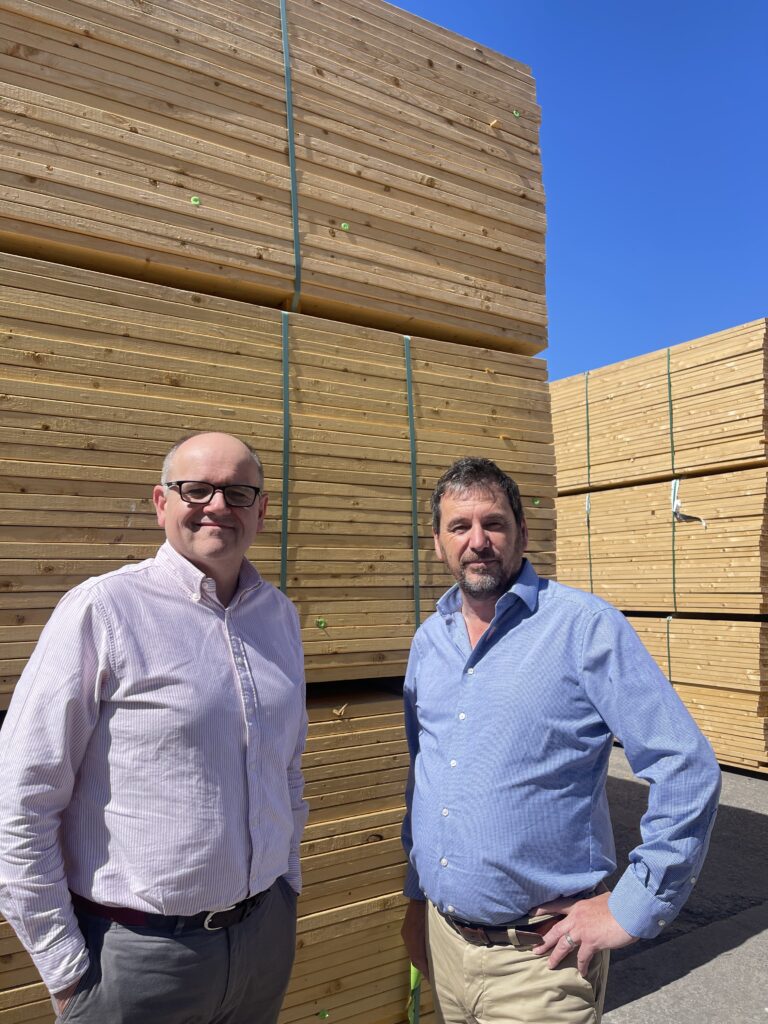
As Vida Wood UK celebrates 25 years in the UK, it looks back at how the business has grown and its role as a leading supplier of TR26 and CLS timber.
When Vida Wood UK’s Managing Director, Ian Drane, approached Vida Wood’s senior leadership team in Sweden in 2001 with the idea of establishing a dedicated UK operation, it was based on his market experience and a conviction that closer alignment between production and end users could better serve British customers.
Some 25 years later, that conversation has created one of the most significant Scandinavian supply operations serving the British timber sector.
Trading since August 2001 and merging with Boras Timber (UK) in October 2002, Vida Wood UK has grown into a £100 million turnover operation with a team of just 10 people based in Billericay, Essex. From that relatively modest office the company supplies structural timber to customers across the country, supporting timber frame house manufacturers, roof-trussed rafter and metal web joist producers, as well as a focused group of merchants businesses.
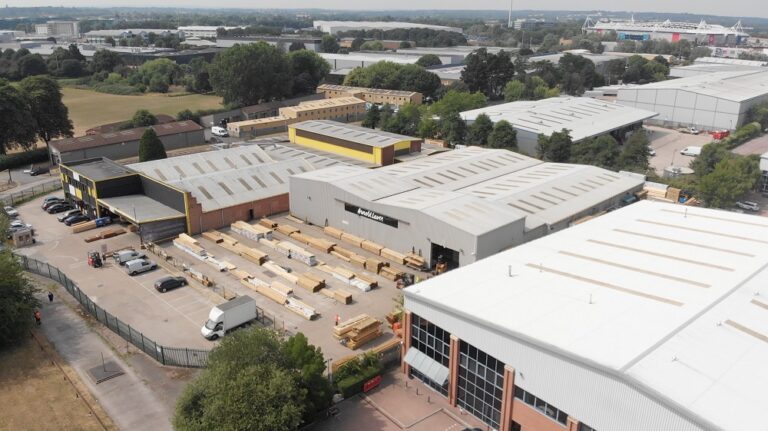
The Essex office sits within easy reach of its two main terminal operations in Kent and Essex, while a facility in Methil provides coverage for the Scottish market, enabling the business to maintain stock in locations that genuinely reflect the distribution of demand. For example, the business keeps CLS at Creeksea in Essex as well as at the Rochester site in Kent.
Vida AB is Sweden’s largest sawmilling group, operating 15 sawmills and producing approximately 3.3 million cubic metres of sawn timber annually. Around 88% of that output is exported worldwide, serving markets across Europe, North America, Australia, Africa and Asia.
Approximately 30% of Vida’s total production is destined for the UK market, either directly through Vida Wood UK or via strategic supply partners that distribute into merchant networks.
“As a group, turnover will be in the region of £850 million to £1 billion pounds each year depending on volumes and exchange rates,” says Sales Director Will Royle, emphasising that the UK subsidiary is part of a much wider organisation.

Direct links to production
One of the defining features of Vida Wood UK is its direct relationship with the sawmills. The business is not an independent importer or agent, but a wholly owned subsidiary of Vida AB, created to ensure the UK market has a consistent voice within the group’s global operations. That distinction matters, particularly in sectors where grading, dimensions and availability cannot be compromised.
“I worked for other companies in the timber trade before joining Vida and at that time I did not realise the scale of the business Vida had in the UK market. We can do more to increase awareness about Vida as a brand in the market.”
The relationship between Vida and the UK market pre-dates the formal creation of the subsidiary, but establishing a local office back in 2001 allowed the group to respond more effectively to the specific needs of British fabricators and merchants.
“The UK has been our biggest market since Vida was founded,” Ian says. “We’ve always had a strong commitment to supply in this country.”
That commitment has been tested repeatedly over the past few years, as it has across the entire timber industry. The pandemic disrupted global shipping routes, freight costs fluctuated dramatically and demand patterns have been shifting dramatically.
For businesses reliant on consistent structural timber supplies, these pressures have been significant, and Vida Wood UK has been working hard to make sure that it can offer continuity of supply.
“There’s been a lot of volatility in our sector over the last number of years both in the UK and globally, with the likes of Brexit and the Covid-19 pandemic but also anti-dumping duties and tariffs,” Despite this, Will says: “There’s always been a commitment from Vida to ensure that the UK market has timber available to it.”
The UK office plays a crucial role in maintaining that continuity. It feeds back information from customers, communicates forecast requirements and works closely with sawmills to ensure that production aligns with actual demand rather than theoretical projections.
“I always think we’re good listeners,” Ian explains. “We look hard at what our customers say to us and take that on board with the messages we give to the sawmills.”
That listening extends beyond volumes and into specification detail. Changes in cutting technology, grading preferences and packaging requirements are all relayed back to Sweden, creating a feedback loop that keeps Vida’s timber supplies relevant and fully compliant.
TR26 trussed rafters
If there is one product that defines Vida Wood UK’s presence in the British structural market, it is the TR26 timber used in roof-trussed rafters and metal web joists.
“We are a leading supplier of TR26 in the UK market for service and volume,” Ian says, reflecting a position built steadily over many years rather than through rapid expansion.
Vida’s production of TR26 timber is concentrated within specific sawmills, including at Borgstena, Sweden, which plays a central role in supplying TR26 to the UK market. In anticipation of improved market demand later this year and beyond, Vida Wood has now strengthened capacity at the sawmill.
Ian explains: “We’re ready to soak up more demand as and when it does finally appear.”
The truss sector typically operates on a just-in-time manufacturing model, which leaves little room for delay. Timber deliveries must align precisely with production schedules otherwise, as Will says: “If you haven’t got product, you’re not able to manufacture.”
To support that requirement, Vida Wood UK holds stock strategically in both Rochester, Kent, and Methil, Scotland ensuring that customers right across the mainland can be supplied without excessive lead times. Preservative treatment facilities allow timber to be treated and dispatched efficiently, and the company carries treated stock as part of its standard offering.
“The location of our stocks is key,” Ian notes.
Specification and service also remain central to customer relationships. Investment by fabricators in advanced machinery has altered the way timber is ordered and processed, placing greater emphasis on length specification, dimensional accuracy and consistency.
“We make sure that we’ve got the right lengths and dimensions in stock at any one time as this is critical to fill the customer’s needs,” Will says.
When assessing how customers evaluate suppliers, Will returns to the three fundamentals he believes underpin long-term relationships.
“Customers tend to look at three core principals, those being service, price and quality,” he says. “If we can ensure that we’ve got the quality and the service covered, then the only point we need to discuss with our customer base will be forward pricing.”
Trends in timber frame
Beyond TR26, Vida Wood UK supplies CLS and related structural grades into the timber frame sector, which is continuing to expand its share of UK housebuilding.
“In Scotland, housebuilding is about 90% timber frame,” Will says, pointing to the more mature timber frame market north of the border. “While the Structural Timber Association estimates England and Wales is currently only 15% but this is likely to increase to around 25-30% by 2030, so there is a great opportunity ahead!”
Recent investments by major housebuilders in their own timber frame manufacturing facilities reinforces that trajectory, reflecting confidence in offsite methods and the efficiencies they bring.
“If you can get a medium-sized three-bed timber frame house watertight in less than a week compared to several weeks for masonry, coupled with the fact there’s a shortage of labour, and ongoing weather concerns, then clearly that’s going to be a build method that’s widely adopted,” Will says.
For Vida Wood UK, its alignment with both truss and timber frame manufacturers ensures that it is positioned within two sectors that are likely to see structural growth over time. The group’s production capacity provides the foundation, while the UK office ensures that supply is channelled appropriately.
“Everyone expects timber usage to increase in the months and years ahead,” Will adds. “We’re perfectly aligned with our customer base to be able to support that.”
A focused merchant offering
While fabricators remain the primary focus, timber and builders’ merchants also form part of Vida Wood UK’s customer base. CLS, roofing battens and scant are supplied directly, while C24 structural timber is distributed through selected partners.
“We’re conscious not to step on the toes of our key supply partners,” Will explains. “The products we sell into the merchant sector are mainly CLS, battens and scant.”
Regional preferences are carefully considered. In parts of the Northwest, for example, scant remains the preferred product choice, and stock profiles are adjusted accordingly.
“There are a number of big merchants up and down the country that we’re currently not trading with that we could be,” Will says. “They could be buying Vida’s C24 timber through one of our partners, but purchasing CLS from a competitor and they might not realise they can buy Vida CLS directly from us.”
Raising awareness of that capability forms part of the company’s growth strategy, particularly in a market where brand recognition may not always reflect production scale.
“We probably go under the radar for the size and scale of our business,” Will admits.
Culture and continuity
Despite its turnover and global backing, Vida Wood UK remains intentionally lean. The Billericay office manages sales, accounts, certification, stock control and logistics with a team that has developed significant collective experience over time.
“It’s a relatively small team achieving that turnover,” Ian says. “Most people that start working for us are still here – and we have many years of experience under our belt.”
That continuity supports consistent customer relationships and ensures that knowledge of individual accounts is retained within the business. Across the wider group, three principles are often referenced: commitment, simplicity and drive.
“There used to be this phrase around the group – the Vida spirit,” Ian recalls. “You couldn’t describe it. You just felt it.”
For both Ian and Will, that spirit translates into a long-term view of the UK market rather than in making short-term responses to cyclical fluctuations. The immediate market may feel subdued, with delayed call-offs and a cautious sentiment, yet both Directors sense the underlying strength that exists in the UK timber market.
“It feels like we’re treading water at the moment,” Will says. “There’s definitely a lot of pent-up demand. Customers have strong order books. It’s just materialising those into call-off and deliveries that’s taking time.”
For a business such as Vida Wood UK, which has expanded sawmill capacity, established stock infrastructure and established relationships across the sector, readiness remains the priority.
“We’ve got the sawmills with the capacity to produce more,” Ian says. “We’re well aligned to meet the coming demand.”
Looking ahead to the coming years, Vida Wood UK’s objectives are clear.
“Increased volumes and increased brand presence,” Will concludes. “We want additional volume out of the door and greater awareness of what Vida can offer.”
From a single conversation in 2001 to a £100m UK operation embedded within one of the world’s largest sawmilling groups, Vida Wood UK has built its presence on dependable supply, listening to customers, and a commitment to the UK market. As timber continues to strengthen its position within UK construction, that combination of Swedish production scale and local responsiveness places the business in a strong position for the next stage of its development.
www.vida.se/en/topical/vida-wood-uk