A key contributor to this effort is Woodknowledge Wales (WKW), whose deep commitment to building a sustainable, low-carbon future has shaped both the content and direction of this Yearbook. Led by Sarah Lawton, an editor and communicator working to connect the timber industry with the wider climate, land-use and design agenda, the WKW team has played a central role in curating the insights, case studies, and technical contributions you'll find in these pages.
Dave Hopkins outlines the latest embodied carbon datasets, digital tools and specification guidance available to support informed timber specification, helping designers and contractors align performance, compliance and carbon reporting requirements.
Embodied carbon reporting is becoming embedded in planning policy, procurement frameworks and client briefs. Designers and contractors are increasingly expected to justify material choices using consistent and verifiable data.
Timber is widely recognised for its carbon storage potential, but informed specification depends on understanding how embodied carbon is calculated, reported and applied in context. Over the past year, Timber Development UK has expanded its suite of datasets and guidance to support more confident, evidence-based decisions.
The focus is practical: accessible tools that translate technical carbon data into usable specification support.
Updated embodied carbon data for timber products
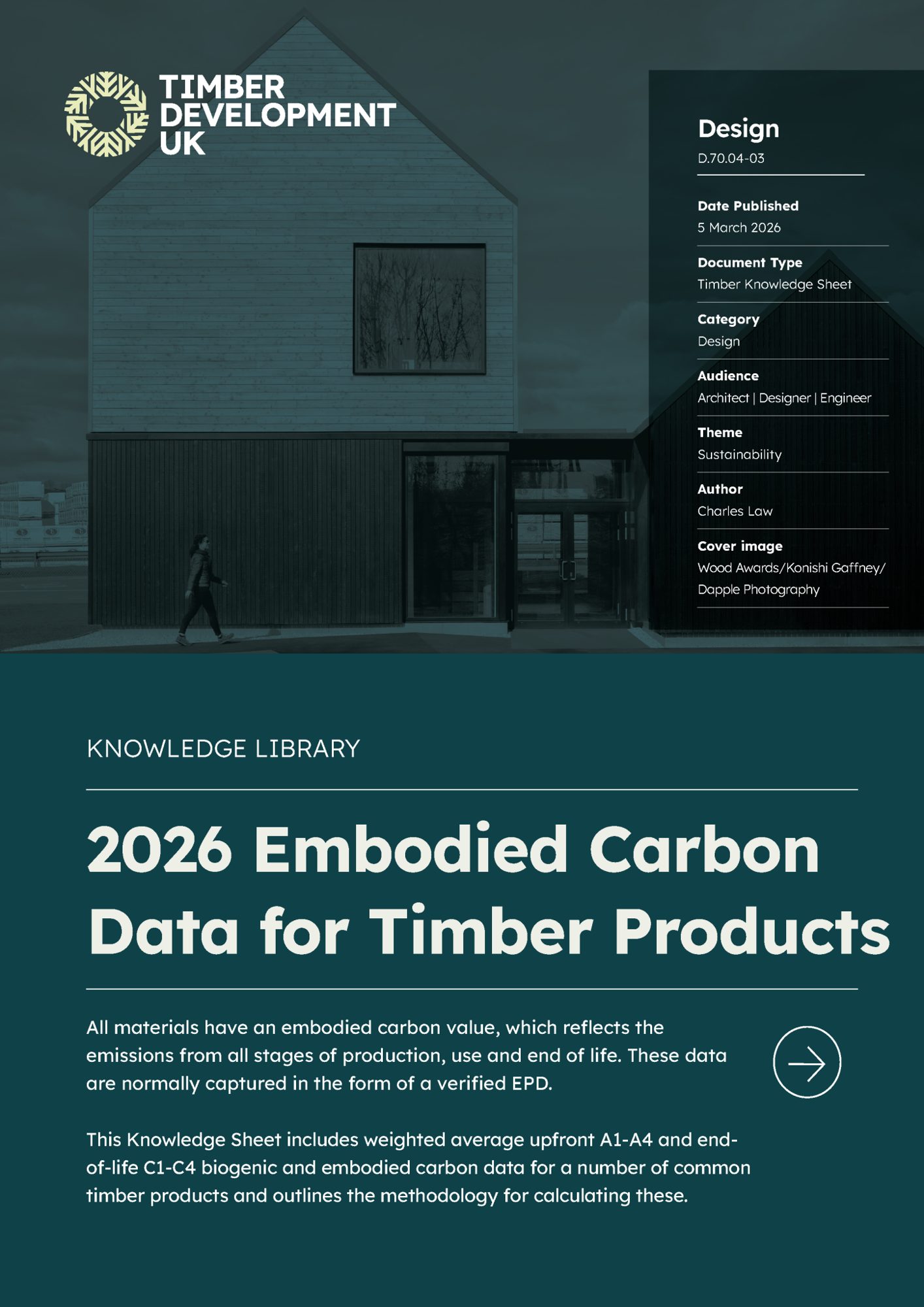
The 2025 update of TDUK’s Embodied Carbon Data for Timber Products provides weighted average A1–A4 figures for commonly specified timber materials in the UK market. The dataset draws on independently verified Environmental Product Declarations and reflects UK supply conditions.
Product categories include:
Sawn softwood: Structural and joinery grades.
Engineered timber: Glulam, cross-laminated timber and laminated veneer lumber.
Structural components: I-joists and related engineered sections.
Panel products: Plywood, OSB and MDF.
The dataset is intended to support early-stage design. At concept or feasibility stage, where project-specific EPDs may not yet be available, credible benchmark values allow designers to compare material options within a consistent framework.
Clear explanation of system boundaries, transport assumptions and treatment of biogenic carbon supports more transparent interpretation.
The EPD database
Alongside the headline dataset, TDUK maintains an online EPD database dedicated to timber products. This resource enables users to review verified product declarations and understand how life cycle modules are structured.
For general specifiers, the database supports:
Transparency: visibility of declared modules and carbon breakdowns.
Comparability: like-for-like review of product data.
Method consistency: alignment with recognised European standards.
As embodied carbon assessment tools become more widespread, familiarity with EPD terminology and structure is increasingly important. The database provides a reference point that supports informed discussion between designers, contractors and suppliers.
Timber and embodied carbon guidance
Data must be interpreted correctly to be meaningful. TDUK’s Timber and Embodied Carbon knowledge sheet explains how carbon storage, life cycle stages and end-of-life scenarios interact.
It clarifies:
Biogenic carbon: how timber stores carbon during growth.
Life cycle modules: what A1–A4 figures represent and what they exclude.
Whole-life context: the relationship between embodied carbon and operational performance.
For non-specialists, accessible explanation reduces the risk of oversimplification and supports proportionate decision-making.
Service life and long-term performance
Embodied carbon outcomes are influenced by durability and service life. A product that requires premature replacement increases whole-life impact regardless of low initial figures.
TDUK’s Optimising Service Life guidance frames specification within a long-term perspective, addressing:
Detailing for durability: protection from moisture and weathering.
Maintenance planning: realising intended design life.
Replacement cycles: minimising avoidable material renewal.
Service life should be considered alongside embodied carbon data, not separately from it. Robust detailing and appropriate specification support sustained performance.
Net Zero planning and responsible procurement
Beyond product-level data, TDUK has developed broader planning tools including a Net Zero Action Plan Tracker, strategy templates and a carbon calculator available to members.
These resources help organisations to:
Set measurable carbon objectives.
Track progress against targets.
Embed responsible purchasing policies.
Align procurement decisions with declared strategies.
While not timber-specific, these tools reinforce structured documentation and accountability, supporting alignment between sustainability ambition and procurement practice.
Integrated specification support
Embodied carbon is one dimension of material performance. Effective timber specification must also address structural capacity, fire compliance and durability.
The expanding TDUK resource library provides guidance across these areas, supporting an integrated approach that balances:
Structural performance: verified load-bearing and serviceability.
Fire compliance: integration within building fire strategies.
Durability: design for service life in exposure conditions.
As reporting frameworks mature, the expectation of documented evidence is increasing. Accessible datasets and clear guidance reduce uncertainty and support proportionate specification decisions.
Final thoughts
Embodied carbon assessment is no longer confined to specialist sustainability roles. A broader range of professionals now engage with carbon data at concept stage and throughout procurement.
The development of timber-focused datasets, EPD tools and specification guidance reflects this shift. For general built environment audiences, the priority remains access to reliable information, applied consistently and understood within a wider performance context.
Structured tools do not replace professional judgement. They support it – helping timber systems be specified with confidence as expectations around carbon transparency continue to evolve.
References
[1] Timber Development UK. 2025 embodied carbon data for timber products. Available from: https://timberdevelopment.uk/resources/2025-embodied-carbon-data-for-timber-products/
[2] Timber Development UK. EPD database. Available from: https://timberdevelopment.uk/solutions/epd-database/
[3] Timber Development UK. Timber and embodied carbon – knowledge sheet. Available from: https://timberdevelopment.uk/resources/timber-and-embodied-carbon/
[4] Timber Development UK. Optimising service life. Available from: https://timberdevelopment.uk/sustainability/optimising-service-life/
[5] Timber Development UK. Carbon and Net Zero resources. Available from: https://timberdevelopment.uk/sustainability/carbon/
[6] Timber Development UK. Responsible purchasing policy toolkit. Available from: https://timberdevelopment.uk/sustainability/carbon/
[7] Timber Development UK. Resource library. Available from: https://timberdevelopment.uk/resource-library-search/
To provide the best experiences, we use technologies like cookies to store and/or access device information. Consenting to these technologies will allow us to process data such as browsing behavior or unique IDs on this site. Not consenting or withdrawing consent, may adversely affect certain features and functions.
Functional
Always active
The technical storage or access is strictly necessary for the legitimate purpose of enabling the use of a specific service explicitly requested by the subscriber or user, or for the sole purpose of carrying out the transmission of a communication over an electronic communications network.
Preferences
The technical storage or access is necessary for the legitimate purpose of storing preferences that are not requested by the subscriber or user.
Statistics
The technical storage or access that is used exclusively for statistical purposes.The technical storage or access that is used exclusively for anonymous statistical purposes. Without a subpoena, voluntary compliance on the part of your Internet Service Provider, or additional records from a third party, information stored or retrieved for this purpose alone cannot usually be used to identify you.
Marketing
The technical storage or access is required to create user profiles to send advertising, or to track the user on a website or across several websites for similar marketing purposes.