A key contributor to this effort is Woodknowledge Wales (WKW), whose deep commitment to building a sustainable, low-carbon future has shaped both the content and direction of this Yearbook. Led by Sarah Lawton, an editor and communicator working to connect the timber industry with the wider climate, land-use and design agenda, the WKW team has played a central role in curating the insights, case studies, and technical contributions you'll find in these pages.
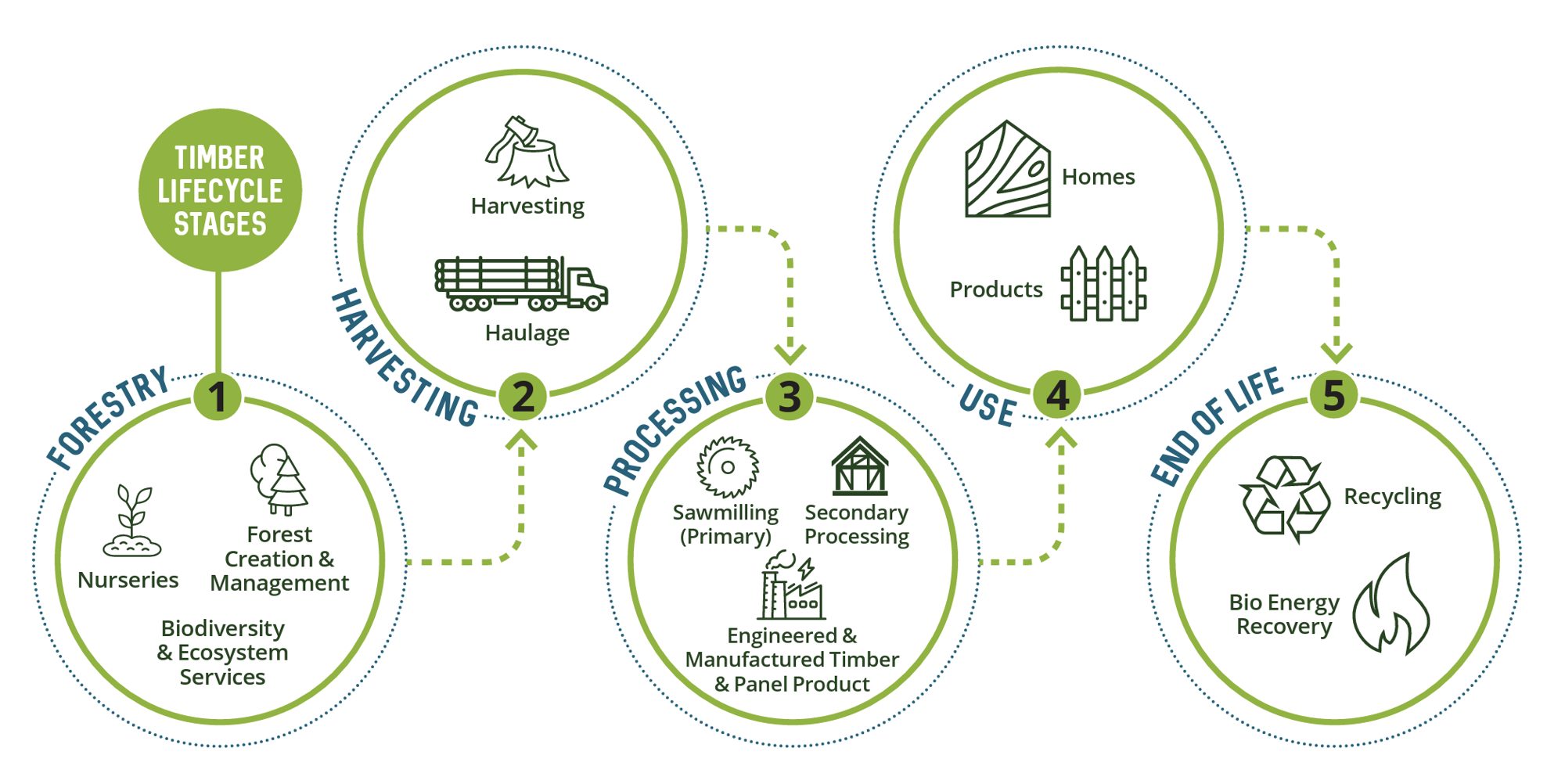
From forest creation to completed buildings, every part of the timber sector depends on the others. Gary Newman explores how shared standards and knowledge exchange help connect forestry, manufacturing, design and construction to support better project outcomes.
For many years, different parts of the timber sector have operated largely within their own professional and commercial boundaries.
Foresters have focused on growing and managing resources. Manufacturers have concentrated on processing timber into products. Designers and engineers have developed building solutions. Contractors have delivered projects on site.
Each part of the system has evolved to meet its own challenges.
The difficulty is that buildings do not emerge from isolated parts of a supply chain. They are the result of countless decisions made across an interconnected network of people, organisations and disciplines.
A decision made in the forest today may influence manufacturing opportunities decades from now. Choices made by manufacturers affect what can be specified by designers. Procurement decisions shape what is ultimately delivered on site.
Understanding these connections is becoming increasingly important as the construction sector seeks to improve building performance, increase productivity and respond to changing expectations around safety, resource efficiency, local sourcing and whole life carbon.
Seeing the whole system
One of the most important lessons from recent years is that progress rarely comes from optimising a single part of the supply chain.
Improvement often happens when organisations develop a better understanding of the wider system in which they operate.
This has been a recurring theme across many of the projects featured throughout this Yearbook.
Whether the focus is home-grown timber, manufacturing capability, embodied carbon, fire performance, housing delivery or skills development, the same challenge frequently emerges. Information does not always move effectively between different parts of the sector.
Designers may be unaware of manufacturing constraints. Manufacturers may have limited visibility of future market requirements. Forest managers may have little opportunity to influence how timber is ultimately used.
The result can be inefficiency, uncertainty and missed opportunities.
Creating stronger connections between these disciplines helps address these challenges and creates opportunities for better outcomes throughout the supply chain.
The role of shared standards
Standards provide an important foundation for collaboration.
They create common reference points that allow organisations working in different sectors to communicate with confidence. They help establish consistent expectations around performance, quality and compliance.
However, standards are only effective when they are understood and applied consistently.
This requires ongoing dialogue between researchers, policymakers, manufacturers, designers, contractors and clients.
The challenge is not simply producing guidance. It is ensuring that knowledge reaches the people who need it and can be applied in practice.
Knowledge exchange therefore becomes an essential part of sector development.
Connecting people as well as products
The timber sector has always depended on relationships.
Technical standards matter. Research evidence matters. Product performance matters.
Yet many of the most significant advances occur when people from different disciplines begin working together to solve shared problems.
This is particularly important as timber construction continues to evolve.
Questions relating to fire safety, structural performance, procurement, resource availability and carbon assessment cannot be addressed by any single organisation acting alone.
They require collaboration across the entire forest-to-construction supply chain.
This principle has shaped much of the work undertaken by Woodknowledge Wales over the past decade.
Rooted in Wales but increasingly working across the UK, the organisation has sought to connect stakeholders who would not traditionally work together and create opportunities for shared learning between industry, research and government.
The objective has never been simply to generate knowledge. It has been to help ensure that knowledge can be applied.
A shared endeavour
The organisations represented throughout this Yearbook reflect the breadth of expertise required to support a modern timber sector.
Together they represent forestry, manufacturing, product development, certification, research, engineering, architecture, construction, housing and policy.
Each organisation contributes a different perspective. Each occupies a different position within the supply chain.
What connects them is a shared interest in improving outcomes.
As the sector continues to develop, the ability to share knowledge across professional, organisational and geographical boundaries will remain increasingly important.
The strongest supply chains are not simply those that move materials efficiently. They are those that connect people, evidence and experience across every stage of delivery.
Viewed in that way, knowledge exchange is not an activity separate from the supply chain. It is one of the mechanisms that allows the supply chain to function effectively.
The partner directory that follows demonstrates the range of organisations contributing to this shared endeavour. Individually they perform different roles. Collectively they help create the connections needed to support a more capable, resilient and informed timber sector.
To provide the best experiences, we use technologies like cookies to store and/or access device information. Consenting to these technologies will allow us to process data such as browsing behavior or unique IDs on this site. Not consenting or withdrawing consent, may adversely affect certain features and functions.
Functional
Always active
The technical storage or access is strictly necessary for the legitimate purpose of enabling the use of a specific service explicitly requested by the subscriber or user, or for the sole purpose of carrying out the transmission of a communication over an electronic communications network.
Preferences
The technical storage or access is necessary for the legitimate purpose of storing preferences that are not requested by the subscriber or user.
Statistics
The technical storage or access that is used exclusively for statistical purposes.The technical storage or access that is used exclusively for anonymous statistical purposes. Without a subpoena, voluntary compliance on the part of your Internet Service Provider, or additional records from a third party, information stored or retrieved for this purpose alone cannot usually be used to identify you.
Marketing
The technical storage or access is required to create user profiles to send advertising, or to track the user on a website or across several websites for similar marketing purposes.