A key contributor to this effort is Woodknowledge Wales (WKW), whose deep commitment to building a sustainable, low-carbon future has shaped both the content and direction of this Yearbook. Led by Sarah Lawton, an editor and communicator working to connect the timber industry with the wider climate, land-use and design agenda, the WKW team has played a central role in curating the insights, case studies, and technical contributions you'll find in these pages.
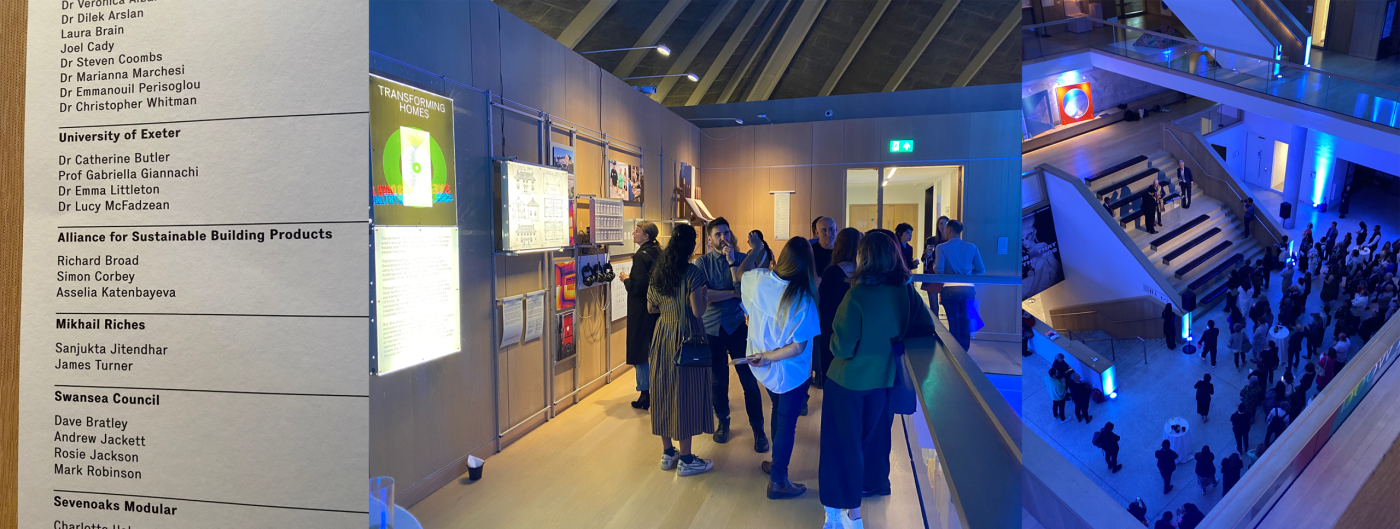
On 11th September we attended the launch of the Tools for Transition exhibition at the Design Museum in London. The free-to-view display (curated by the Future Observatory) will run until August 2026 and showcases the Transforming Homes project, of which ASBP is a project partner, alongside three other Green Transition Ecosystem research projects from across the UK funded by the Arts and Humanities Research Council.
ASBP Director Richard Broad attended the launch alongside colleagues from the Universities of Bath, Bristol, Cardiff and Exeter, and Mikhail Riches
The projects (based in Scotland, Northern Ireland, North Wales, Bristol and Swansea) are driving change in housing, healthcare, local planning and resource management, and show how scalable, design-led research can be translated into practical tools for transitioning to a greener future.
The display is divided into 4 sections:
Design HOPES
The display begins in Scotland’s hospitals, exploring ways in which the NHS can reduce its environmental footprint. From circular waste systems to new digital services and toolkits, researchers are designing scalable interventions to transform the UK’s healthcare services.
Future Island-Island
The second section focuses on Rathlin island and its efforts to safeguard its community’s future. Drawing on local knowledge and expertise, researchers are advancing circular approaches to waste – helping the island build resilience and self-sufficiency.
Transforming Homes
The third section focuses on Transforming Homes which focusses on nine council-built houses in Bristol and Swansea – each of which is undergoing a major transformation. Incorporating bio-based materials, harnessing renewable energy and designing more liveable spaces, researchers are testing ways to future-proof our homes and address the UK’s housing crisis.
Public Map Platform
The display ends in Ynys Môn where the processes for planning and development decisions are being rethought. By engaging with young people and gathering different types of data – environmental, social and cultural – researchers are developing a new kind of map which prioritises the cares and concerns of future generations.
To provide the best experiences, we use technologies like cookies to store and/or access device information. Consenting to these technologies will allow us to process data such as browsing behavior or unique IDs on this site. Not consenting or withdrawing consent, may adversely affect certain features and functions.
Functional
Always active
The technical storage or access is strictly necessary for the legitimate purpose of enabling the use of a specific service explicitly requested by the subscriber or user, or for the sole purpose of carrying out the transmission of a communication over an electronic communications network.
Preferences
The technical storage or access is necessary for the legitimate purpose of storing preferences that are not requested by the subscriber or user.
Statistics
The technical storage or access that is used exclusively for statistical purposes.The technical storage or access that is used exclusively for anonymous statistical purposes. Without a subpoena, voluntary compliance on the part of your Internet Service Provider, or additional records from a third party, information stored or retrieved for this purpose alone cannot usually be used to identify you.
Marketing
The technical storage or access is required to create user profiles to send advertising, or to track the user on a website or across several websites for similar marketing purposes.