A key contributor to this effort is Woodknowledge Wales (WKW), whose deep commitment to building a sustainable, low-carbon future has shaped both the content and direction of this Yearbook. Led by Sarah Lawton, an editor and communicator working to connect the timber industry with the wider climate, land-use and design agenda, the WKW team has played a central role in curating the insights, case studies, and technical contributions you'll find in these pages.
Tom Henderson believes a strategic circular timber economy can unlock climate, housing and economic benefits for Wales—but only if we align forest policy, processing, and procurement.
As global efforts to decarbonise accelerate, timber is back in the spotlight—not just as a renewable material, but as a strategic climate solution. And yet, in Wales, despite world-class growing conditions and deep cultural connections to land, our timber resource remains underutilised.
We import most of the wood we use. Our forests are not expanding fast enough to meet national afforestation targets. And of the timber we do harvest, the vast majority is directed to short-lived uses—pallets, fencing, biomass— while only 6% is structurally graded for housing.
Meanwhile, demand for timber in construction is booming. If Wales is serious about climate leadership, rural regeneration, and affordable housing, we must ask: what would it take to turn our timber value chain into an engine of low-carbon prosperity?
Circular economy, rooted in place
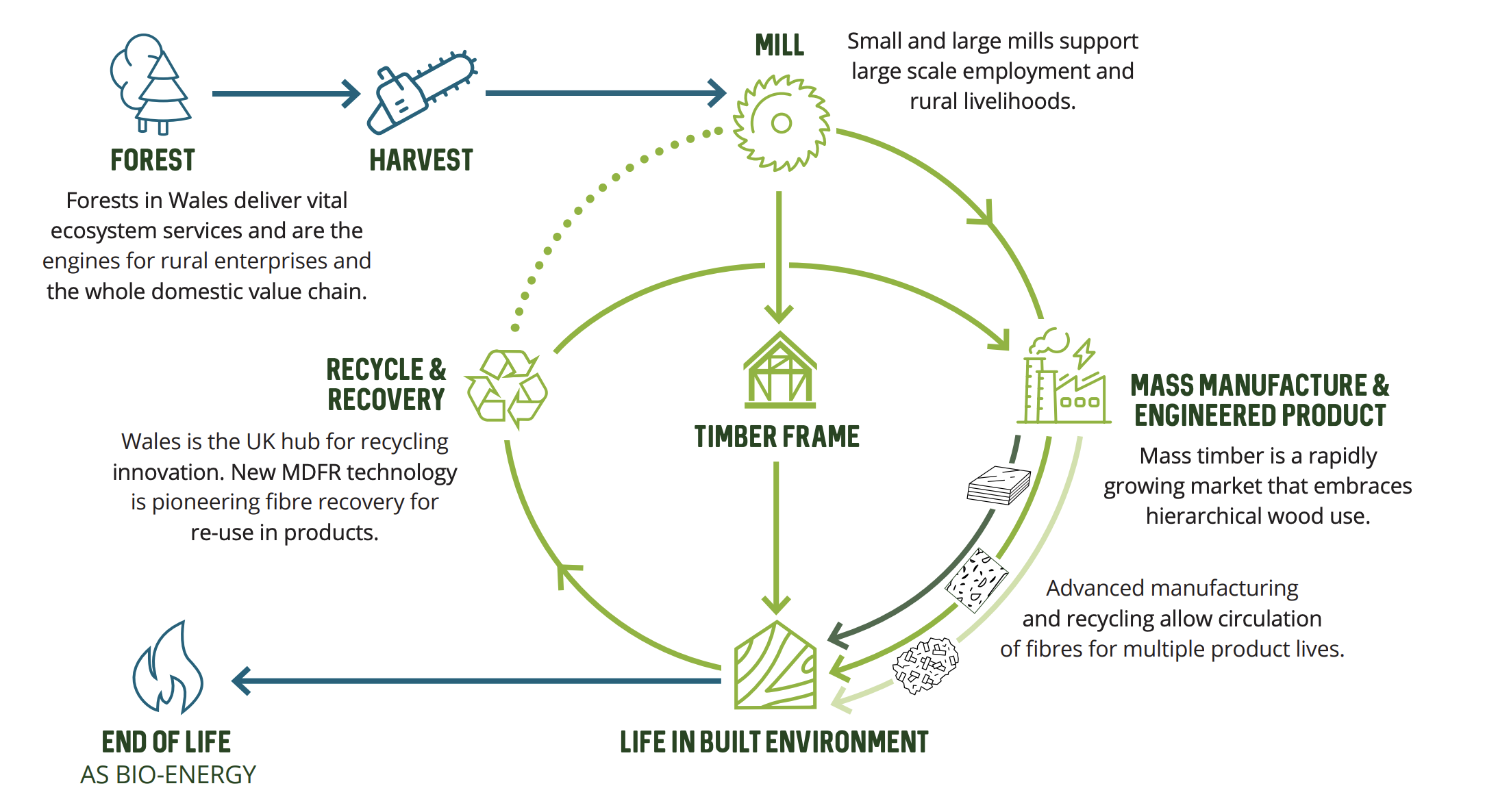
Timber and Decarbonising Wales1 , an evidence-based report written as part of the Timber Industrial Strategy for Wales is an attempt to answer that question. It sets out a joined-up vision: expanding forest cover, managing it well, using timber wisely, and recovering its value through reuse, remanufacturing and recycling.
Timber is uniquely suited to circularity. Though it degrades over time, each piece can serve multiple lives. A beam can become joinery; offcuts become panel board; fibres can be recycled into insulation; and only at the very end should timber become fuel. When wood is kept in circulation – in buildings, products and fibres – it stores carbon, displaces more harmful materials, and generates greater economic value from every tree harvested.
Manufacturing our way to net zero
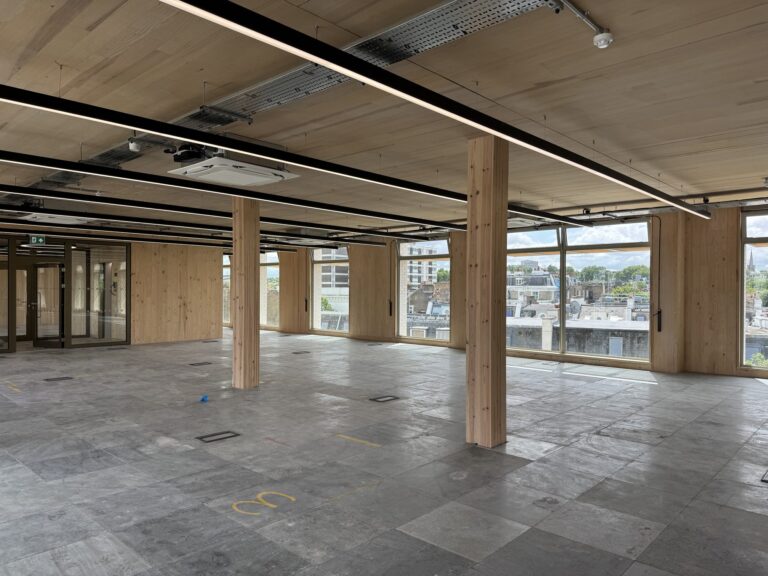
A key piece of the puzzle is engineered timber. Products like cross- laminated timber and glulam offer high-performance, low-carbon alternatives to steel and concrete. Yet the UK currently has no large-scale engineered timber production—and imports dominate.
Wales has the softwood resource (notably Sitka spruce), the workforce potential, and the market need to change that. A modest-scale CLT facility using 60,000 m3 of Welsh timber could produce 30,000 m3 of panels a year – storing over 22,000 tonnes of CO2 annually, creating skilled rural jobs, and keeping value in the domestic economy.
The same logic applies to wood fibre insulation—ideal for retrofitting homes, yet less than 0.1% of the UK insulation market. As new fibre recovery techniologies and systems come on line, Wales could lead the way in recycling and manufacturing bio- based materials for net-zero construction.
Forests as climate infrastructure
But manufacturing is only one part of the story. It begins—and depends—on what we grow. Forest creation and management are crucial to the long-term carbon story.
Afforestation alone, if scaled to 5,000 hectares per year, could deliver around 15 million tonnes of CO2e removals by 2050. Add to that the carbon stored in timber products, and the avoided emissions from substitution, and forestry becomes a major contributor to national climate targets.
Forest management matters too. Adaptive forest management—silviculture suited to site and climate— can enhance both forest resilience and the provision of ecosystem services. As climate pressures mount across all European temperate forests, shifts in what we grow will be unavoidable—and there is an opportunity to align this with demand. We therefore need to bring markets and processing into step with adaptive management, while also considering the long-term markets for the alternative species we establish. At the same time, Wales has a comparative advantage in being able to grow trees exceptionally quickly. In the context of European forestry, where traditional systems are increasingly threatened by climate pressures and institutional inertia, Wales’ more fluid land use and timber sector creates scope for dynamism. Without this, we risk degradation—or worse, offshoring our climate impacts by relying on slow- growing boreal forests elsewhere, as Elidh Forster warns.
From softwood to social housing
Housing is where many of these threads come together. Timber- frame construction offers one of the clearest climate wins—each home locking in 15–18 tonnes of CO2 from the wood alone, and avoiding another 15–20 tonnes by replacing concrete and steel.
Redirecting just 15% of Wales’s current timber harvest into housing could support over 8,000 homes per year and save around 0.56 MtCO2e annually. That’s equivalent to the emissions from over 120,000 cars.
Most Welsh softwood—primarily Sitka spruce—can meet C16 construction standards, but specifier confidence remains low. This is where public procurement and programmes like Tai ar y Cyd come in—creating stable demand for Welsh-grown timber and supporting a homegrown industrial base.
Joining the dots
Timber alone is not a silver bullet. But used wisely, it can help us meet our goals for climate action, housing supply, rural jobs, and resource resilience.
To get there, we need to act on several fronts:
Scale up afforestation on suitable land—with multifunctional, productive forests that serve both climate and biodiversity.
Invest in domestic manufacturing—especially engineered timber and wood fibre insulation, to retain value and reduce imports.
Upgrade circular infrastructure—from advanced sorting to fibre recovery, ensuring wood stays in the system longer.
Reform procurement and design standards— so low-carbon, circular materials like Welsh C16 become the default, not the exception.
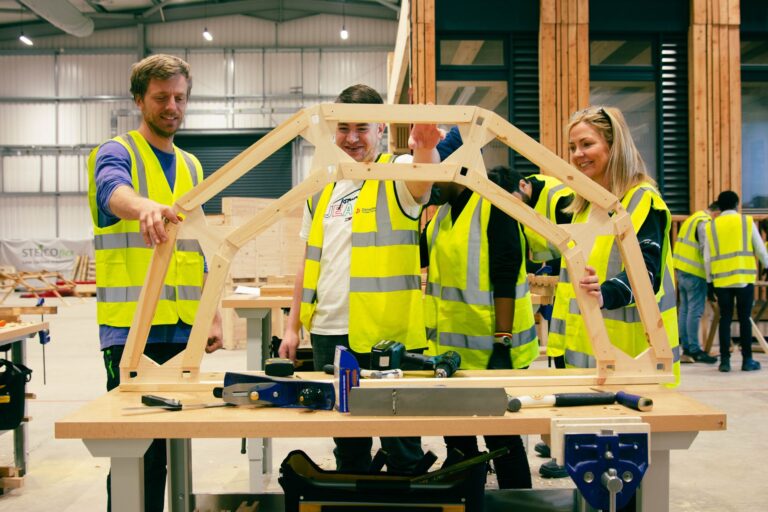
Support rural enterprise and workforce development—particularly the small mills and nurseries that add value locally.
This is not a prescriptive roadmap…
This is not a prescriptive roadmap, but a shared evidence base to guide future investment, policy and practice. It offers a practical foundation for decision-makers across forestry, housing, manufacturing and public procurement to coordinate action— helping Wales transition from extractive to regenerative systems, and from imported dependency to homegrown opportunity.
References
Henderson T Timber and Decarbonising Wales Woodknowledge Wales 2025 www.woodknowledge.wales/timber-and-decarbonising-wales
Forster EJ, Styles D, Healey JR Temperate forests can deliver future wood demand and climate-change mitigation dependent on afforestation and circularity Nat Commun 2025;16:3145 www.nature.com/articles/s41467-025-58463-5
To provide the best experiences, we use technologies like cookies to store and/or access device information. Consenting to these technologies will allow us to process data such as browsing behavior or unique IDs on this site. Not consenting or withdrawing consent, may adversely affect certain features and functions.
Functional
Always active
The technical storage or access is strictly necessary for the legitimate purpose of enabling the use of a specific service explicitly requested by the subscriber or user, or for the sole purpose of carrying out the transmission of a communication over an electronic communications network.
Preferences
The technical storage or access is necessary for the legitimate purpose of storing preferences that are not requested by the subscriber or user.
Statistics
The technical storage or access that is used exclusively for statistical purposes.The technical storage or access that is used exclusively for anonymous statistical purposes. Without a subpoena, voluntary compliance on the part of your Internet Service Provider, or additional records from a third party, information stored or retrieved for this purpose alone cannot usually be used to identify you.
Marketing
The technical storage or access is required to create user profiles to send advertising, or to track the user on a website or across several websites for similar marketing purposes.