A key contributor to this effort is Woodknowledge Wales (WKW), whose deep commitment to building a sustainable, low-carbon future has shaped both the content and direction of this Yearbook. Led by Sarah Lawton, an editor and communicator working to connect the timber industry with the wider climate, land-use and design agenda, the WKW team has played a central role in curating the insights, case studies, and technical contributions you'll find in these pages.
At Woodknowledge Wales, a small team works with its members to connect forests, housing and communities through applied research, collaboration and practical tools— supporting the shift towards a more sustainable, home-grown built environment.
From sustainable forestry to housing design, and from carbon accounting to circular economy innovation, positive change is taking root—guided by a small team at Woodknowledge Wales and shaped through the insight and involvement of our growing membership.
As a not-for-profit, mission-led organisation we exist to build a better future using timber as a catalyst for systemic change. Through cross-sector partnerships, applied research, capacity- building, and policy influence, WKW helps turn Welsh trees into community value—socially, environmentally, and economically. While still rooted in Wales, we are now branching out to support joined-up progress in timber policy, practice and innovation more widely across the UK.
At the heart of this work is a team whose expertise spans the entire wood value chain—from ecosystem services and forest planning, through production, manufacturing, design, skills and construction, to placemaking, performance evaluation and policy development.
Here, we introduce the team shaping this forest-to-home transition and the strategic programmes making it real.
Be part of one of our Communities of Practice. Source: WKW
Forests as a foundation for regeneration
Thomas Henderson, a researcher based at Bangor University, leads WKW’s internal forestry work. His focus on life-cycle carbon modelling and timber ecosystem services helps shape the organisation’s evidence base for resilient land use and supply chain design. He works closely with Anna Dauksta, who manages forestry engagement and coordinates external partnerships, helping connect forest stakeholders to construction, manufacturing and housing outcomes.
Supporting their work are seasoned advisors Chris Jones, a forester with 35+ years of experience in woodland resilience, and Dainis Dauksta, a wood scientist and sawmiller whose technical insight into species performance and future timber supply brings long-term thinking to the fore.
Together, this group informs WKW’s cross-sector engagement— from horizon scans and woodland carbon valuation to stakeholder workshops on climate-adapted forestry.
Thomas Henderson and Heddwyn Bye, both carried out research at Bangor University. Their focus includes life-cycle analysis and farm woodland valuation, and use of LiDAR technology to quantify timber and carbon potential. Read more about this research in the articles; Reimagining Timber for a Decarbonised Wales and Seeing the Wood for the Trees.
As Wales increases its ambition to build with home-grown materials, attention must turn to skills, processing infrastructure, and supply chain coordination. James Moxey leads WKW’s work in this area—driving skills innovation, funding applications, and cross-sector research programmes. He helps design the Timber 101 webinar series, alongside Phil O’Leary, now a WKW board member. Together, they’ve supported the upskilling of sawmillers, contractors and housing professionals across Wales.
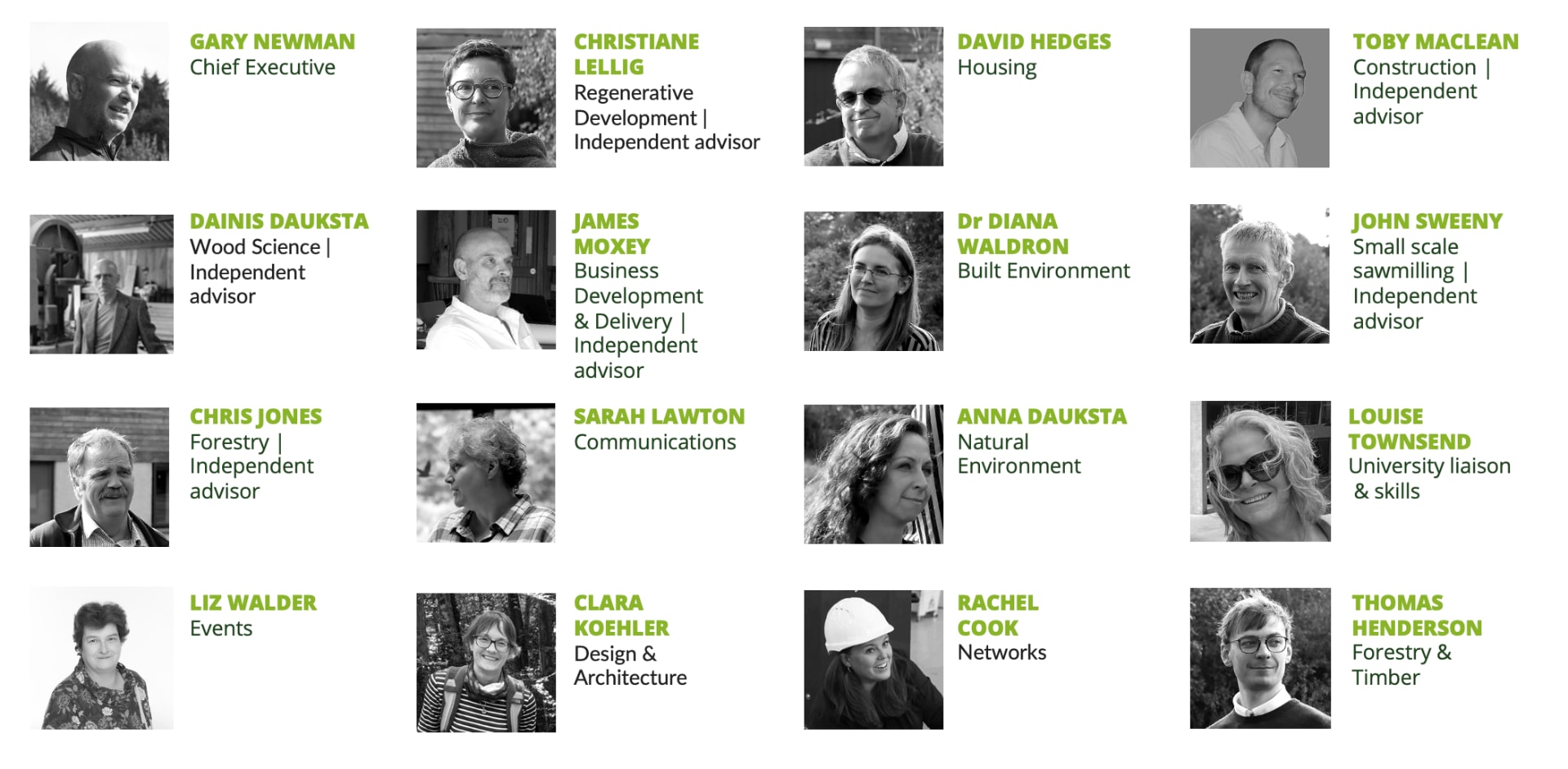
The Woodknowledge Wales team. Source: WKW
Home-Grown Homes: from low-carbon to long-term value
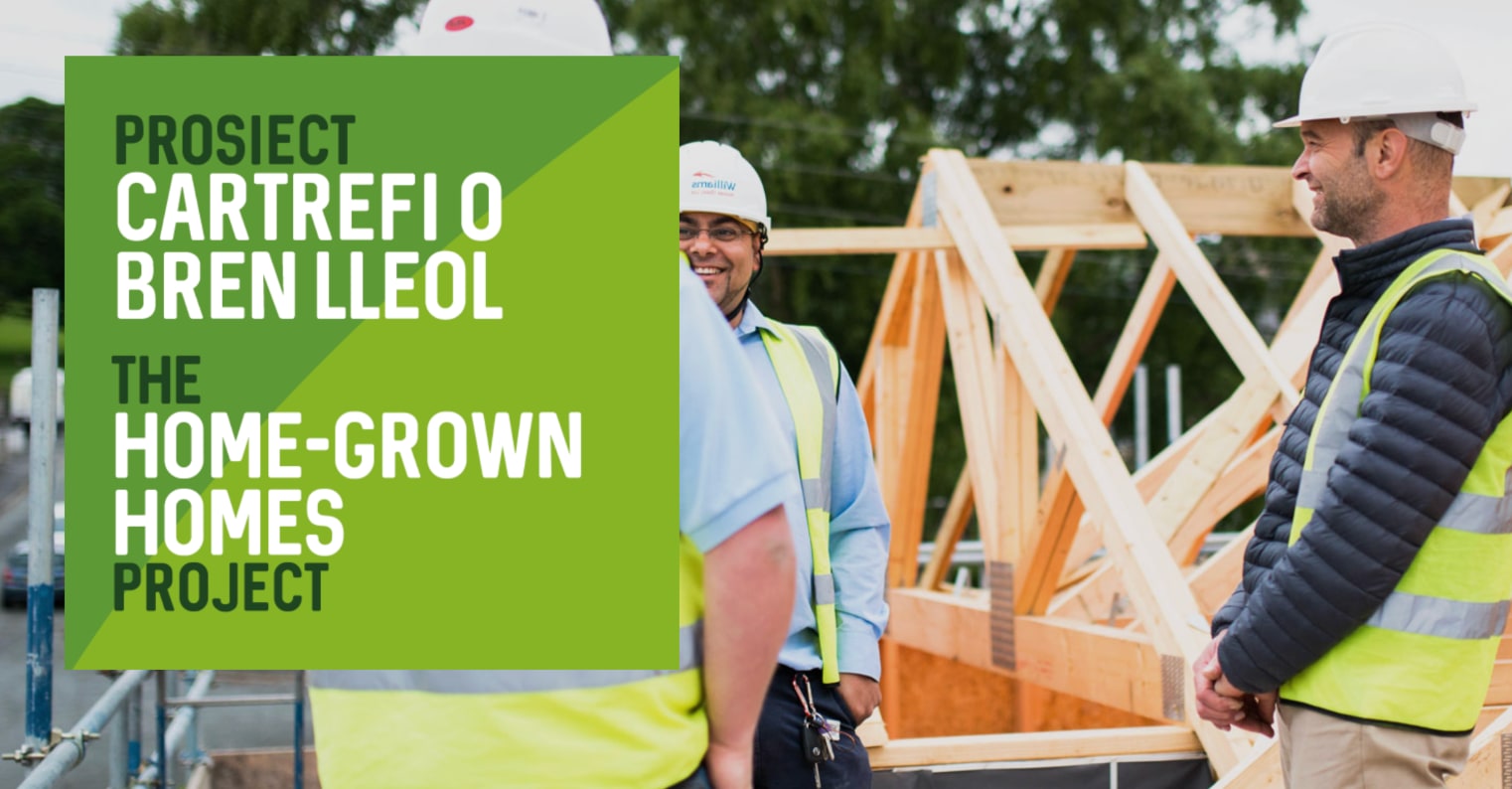
David Hedges leads WKW’s flagship collaboration with Welsh Government: the Home-Grown Homes (HGH) project. This body of work connects policy, housing design, materials, carbon and supply chains through a suite of practical tools and thought leadership reports.
Recent Home-Grown Home outputs include:
The Early Stage Embodied Carbon Tool (ESECT)
A report on Greenhouse Gas Removal through timber construction
Case studies on home-grown housing projects
Technical guidance and carbon measurement frameworks
Films, webinars and public engagement tools
Alongside earlier work, these outputs are designed to make timber housing delivery easier, smarter and more impactful— helping social landlords and local authorities build better with what Wales grows.
Architecture, carbon and placemaking
Dr Diana Waldron leads WKW’s work on Building Performance Evaluation (BPE)—a cornerstone of our mission to close the performance gap between design and real-world outcomes. Through detailed in-use testing of new timber buildings, Diana’s work is helping to redefine what high-performing, low-carbon housing truly looks like in Wales. Read more about Diana’s work in the article; Reimagining Materials for Circular Construction.
Clara Koehler, a technical architect with deep knowledge of sustainable design, works closely with Diana to integrate performance-led thinking into housing and architectural practice. Clara also played a lead role in developing the Early Stage Embodied Carbon Tool (ESECT) and authored guidance on placemaking. Her work provides actionable tools for housing professionals and design teams navigating Wales’ low carbon aspirations. Read about Clara’s work in the Reducing embodied carbon from the outset article.
Supporting both is Toby Maclean, a structural engineer and regenerative design expert whose practical innovations demonstrate what’s possible when we rethink construction from first principles. Toby’s input to placemaking guidance, carbon modelling and the design of exemplar timber buildings— including his award-winning concrete-free ‘Secret Campsite’ structure—has shaped a growing narrative around regenerative practice in Welsh architecture.
“It’s about finding better ways to use what we already have—our trees, our skills, our knowledge.”
Rooting a new materials economy
The Regenerative First Materials project—soon to be relaunched as ROOT—is led by Louise Townsend, a nationally recognised leader in social value and circular procurement. ROOT reimagines how materials are valued, sourced, and verified—not just for carbon, but for their wider contribution to community, health and ecosystem resilience.
Networks, communities and events
None of this work happens in isolation. WKW convenes Communities of Practice (CoPs) for contractors, joiners, sawmillers, housing providers and designers through the leadership of Rachel Cook, who manages our membership and stakeholder networks. These CoPs act as shared learning environments— where problems are solved, ideas tested, and relationships built.
Source: WKW
Sarah Lawton leads Communications, editing this yearbook and creating high-impact storytelling, press engagement, digital resources and strategic campaigns. Dr Liz Walder runs WKW’s event programme both on- and offline, including the annual WoodBUILD conference, which brings together leaders from forestry, housing, manufacturing, policy and academia to plan and facilitate collaboration across traditional industry silos.
Christiane Lellig, a sociologist who has deep experience in European sustainable construction markets, brings critical facilitation and international expertise to WKW’s collaboration design, helping connect Welsh innovation to global conversations.
A mission-led team driving systemic change
At the helm is Gary Newman, WKW’s Chief Executive, who offers strategic oversight, political engagement, and mission- led drive. With decades of experience in engineering and sustainable construction, Gary ensures that every project is grounded in system-level thinking and long-term public value. Gary recently published the key report on Using Wood in Construction as a significant Greenhouse Gas Removal Mechanism. Read about the potential impact of this report here in the article: Timber construction as climate infrastructure.
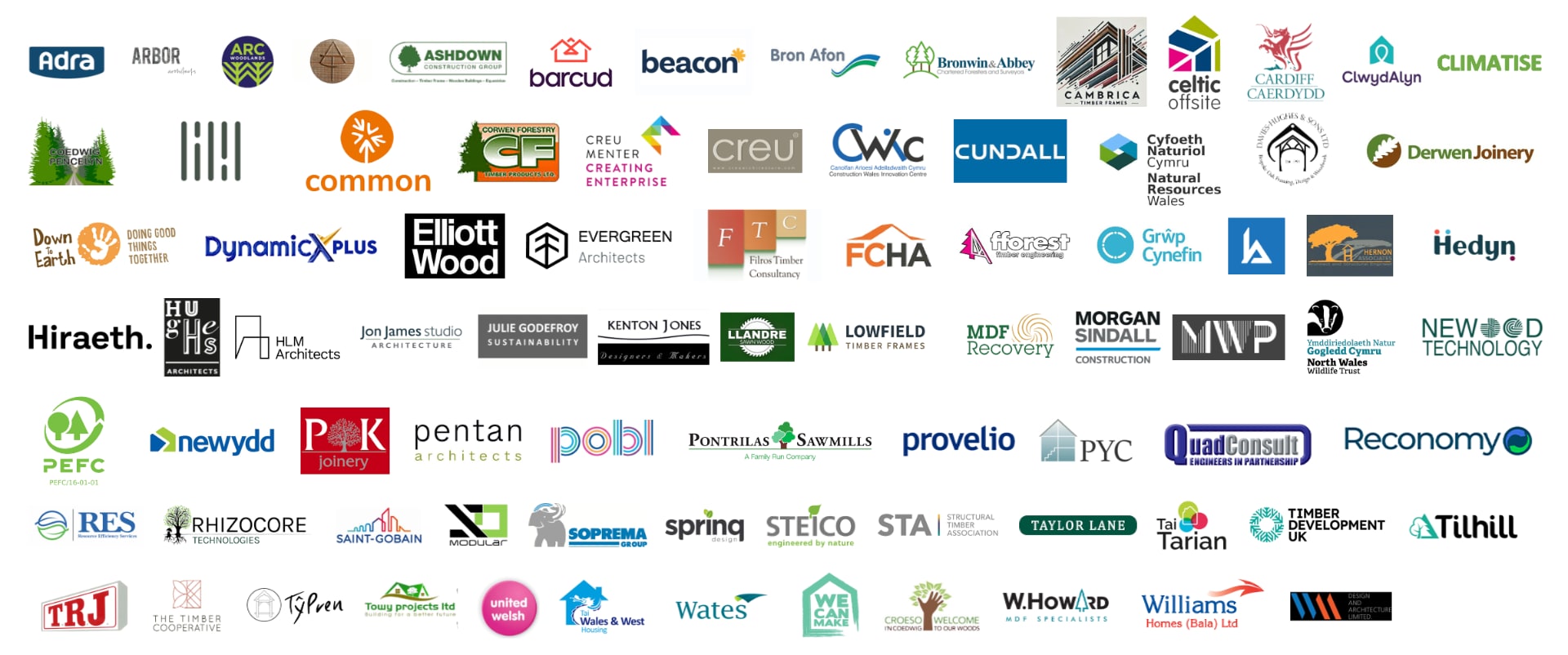
Woodknowledge Wales Members September 2025. Source: WKW
Backed by a dedicated, voluntary Board of Directors and a growing network of advisors, the WKW team is working to reimagine how forests, buildings and people thrive together.
Get involved
Whatever your sector, if you work within or have links to the wood value chain WKW exists to support your journey to a more regenerative, locally rooted construction future. Our work is only possible through the support of our members and partners—thank you for being part of the journey.
Together, we’re building a forest nation—tree by tree, home by home.
To provide the best experiences, we use technologies like cookies to store and/or access device information. Consenting to these technologies will allow us to process data such as browsing behavior or unique IDs on this site. Not consenting or withdrawing consent, may adversely affect certain features and functions.
Functional
Always active
The technical storage or access is strictly necessary for the legitimate purpose of enabling the use of a specific service explicitly requested by the subscriber or user, or for the sole purpose of carrying out the transmission of a communication over an electronic communications network.
Preferences
The technical storage or access is necessary for the legitimate purpose of storing preferences that are not requested by the subscriber or user.
Statistics
The technical storage or access that is used exclusively for statistical purposes.The technical storage or access that is used exclusively for anonymous statistical purposes. Without a subpoena, voluntary compliance on the part of your Internet Service Provider, or additional records from a third party, information stored or retrieved for this purpose alone cannot usually be used to identify you.
Marketing
The technical storage or access is required to create user profiles to send advertising, or to track the user on a website or across several websites for similar marketing purposes.