A key contributor to this effort is Woodknowledge Wales (WKW), whose deep commitment to building a sustainable, low-carbon future has shaped both the content and direction of this Yearbook. Led by Sarah Lawton, an editor and communicator working to connect the timber industry with the wider climate, land-use and design agenda, the WKW team has played a central role in curating the insights, case studies, and technical contributions you'll find in these pages.
Woodknowledge Wales brings together expertise from across forestry, manufacturing, housing and construction to support better decisions, stronger supply chains and greater confidence in timber and biobased construction.
For more than a decade, the organisation has worked across traditional sector boundaries to help increase the value derived from forests and timber resources. Through applied research, industry collaboration, practical guidance and policy engagement, Woodknowledge Wales connects knowledge with action.
While rooted in Wales, the organisation increasingly works across issues that are shared throughout the UK, including timber supply, housing delivery, embodied carbon, building performance and regenerative procurement. As interest grows in forest-based materials and circular construction, the evidence, tools and approaches developed through Woodknowledge Wales programmes are finding application far beyond their place of origin.
Its work is founded on a simple principle: forests and timber have a far greater role to play in the future of our built environment. Well-managed woodlands can support biodiversity, water quality and climate resilience while providing renewable materials for homes, workplaces and communities. Realising that potential requires more than tree planting or timber production alone. It depends on strong connections between forests, manufacturers, designers, contractors, clients and policymakers.
Woodknowledge Wales exists to help create those connections.
Building the evidence base
The Home-Grown Homes Project has become one of Woodknowledge Wales’ most influential bodies of work. Running from 2018 to 2026, the project explored how timber supply chains can support better outcomes in both the natural and built environment.
Phase one established the foundations through research, tools and guidance focused on the use of home-grown timber in high-performance social housing. Phase two moved further into implementation, supporting the development and launch of Wales’ first Timber Industrial Strategy and producing a wide range of practical outputs for policymakers, housing providers, designers, manufacturers and the wider supply chain.
Recent Home-Grown Homes outputs show the breadth of this work. Reports have examined the performance of home-grown timber for timber frame manufacture, the potential role of timber-rich social housing as a carbon removal strategy, farm woodland creation, timber in retrofit and repairs, and the future of circular wood use in construction.
Together, these outputs demonstrate a shift from asking whether timber can contribute to better construction outcomes towards understanding what needs to change for timber to be used more effectively, confidently and at scale.
Practical tools for early decisions
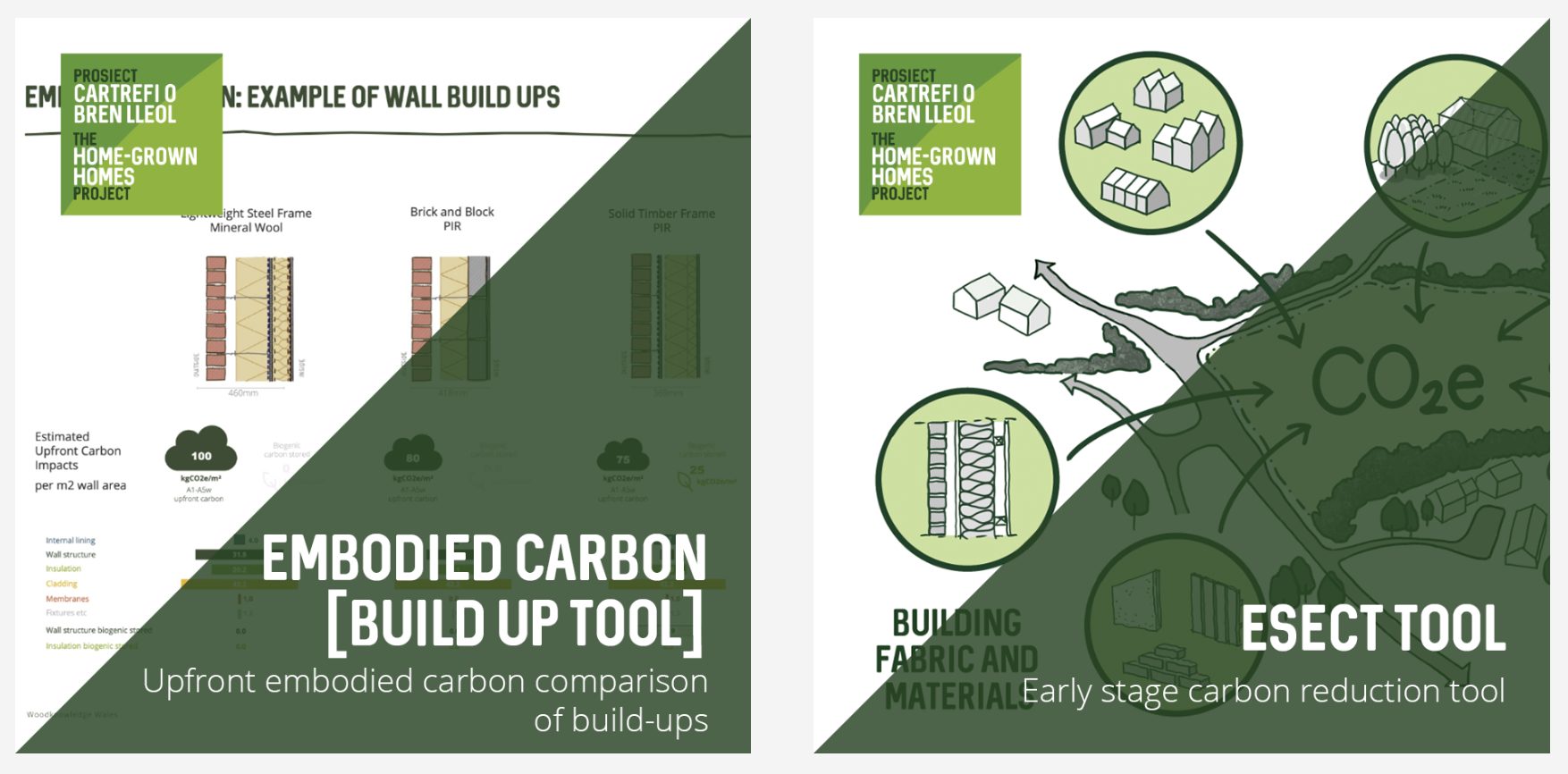
One of the clearest examples of this applied approach is the Early Stage Embodied Carbon Tool, known as ESECT.
Developed through the Home-Grown Homes Project, ESECT is a simple web-based tool designed to help housing associations, local authorities, designers and project teams assess and reduce upfront embodied carbon at the earliest stages of low-rise housing design.
The tool focuses on site conditions, building form, fabric, foundations, materials, construction, heating, hot water and renewables. It helps users explore the carbon implications of early design choices before decisions become difficult or expensive to change.
In July 2025, Woodknowledge Wales also launched a New Build-Up Library linked to ESECT. This provides free downloadable comparisons of common construction solutions, including wall build-ups, roof build-ups, ground floors, foundations, windows and building services. The library is intended to improve carbon literacy and make embodied carbon impacts easier to understand across project teams.
This work reflects a central principle of Woodknowledge Wales: knowledge is most useful when it can be applied.
Understanding materials and supply chains
A key challenge for timber construction is confidence in material performance.
The recent report on home-grown timber for timber frame manufacture explores why home-grown structural timber is often perceived as less suitable than imported timber, and what might be needed to improve its stability, strength and suitability for timber frame construction.
The report identifies technical issues such as growth rings, juvenile wood, reaction wood, spiral grain, drying and moisture management, while also highlighting commercial barriers, market inertia and the need for stronger policy support. Its central conclusion is important: producing stable, home-grown timber for timber frame use is technically very achievable and becoming increasingly commonplace, but industry wide adoption depends on a more integrated forest-to-frame approach.
This kind of work matters because the timber transition is not only about material substitution. It is about understanding the whole chain, from woodland management and log selection through to manufacture, specification, procurement and building performance.
Widening the opportunity
Woodknowledge Wales’ recent research also broadens the conversation beyond new-build housing.
The report on timber in retrofit, repairs, maintenance and improvement identifies a significant opportunity for home-grown and reclaimed timber products in social housing upgrades. It highlights the potential for timber windows, doors, joinery, sawn timber and wood fibre insulation, while recognising the procurement, certification and supply-chain barriers that currently limit wider use.
The circular wood use report takes this further by exploring how reclaimed and cascaded timber could strengthen the UK timber sector, reduce emissions, extend carbon storage and support a more resilient circular bioeconomy. Developed through a programme of webinars and a roundtable with industry partners, it highlights the need for standards, certification, procurement flexibility, skills and demonstration projects if circular wood use is to move from concept to mainstream practice.
On the forestry side, the farm woodlands report brings the discussion back to land use and future timber supply. Based on insights from early-adopter farmers and advisers in mid-Wales, it explores the practical, financial and cultural considerations involved in integrating trees into farm businesses. The findings underline the importance of woodland creation that works for farmers as well as policy.
These strands are connected. Future timber supply, material performance, embodied carbon, retrofit, circularity and procurement all form part of the same system.
From research to market
The next stage of Woodknowledge Wales’ work is increasingly focused on implementation.
ROOT to Market, launched in 2026, is a national Dynamic Marketplace procurement vehicle designed to support the adoption of regenerative and low-carbon materials across UK construction. Developed by Woodknowledge Wales and their partners Value Match, with support from a consortium of construction, design, procurement and circular economy partners, the marketplace aims to connect clients, designers, contractors and suppliers through a practical procurement route.
The initiative builds on several years of work exploring how to increase the market for biogenic and reclaimed materials in construction. ROOT to Market seeks to address a persistent challenge: how to make better materials easier to find, specify and procure within real projects. By aggregating and socialising the learning from these projects ROOT to Market can accelerate the journey to a more regenerative built environment.
ROOT to Market marks an important development in the Woodknowledge Wales story. It shows the organisation moving from evidence-gathering and sector engagement into direct support for market formation, supplier visibility and procurement practice.
Rooted in place, relevant across borders
Woodknowledge Wales remains rooted in Wales, with a strong commitment to Welsh forestry, manufacturing, housing and communities. That foundation matters. Much of the organisation’s value comes from its ability to connect policy ambition with practical experience on the ground.
At the same time, many of the challenges it addresses are shared across the UK. Housing delivery, timber supply, embodied carbon, building performance, circularity and regenerative procurement do not stop at national borders.
Increasingly, organisations beyond Wales are engaging with the tools, evidence and approaches developed through Woodknowledge Wales programmes. This creates opportunities to share learning more widely while retaining the organisation’s distinctive Welsh grounding.
As demand grows for sustainable materials, resilient supply chains and higher-performing buildings, Woodknowledge Wales continues to focus on the space between evidence and action.
By connecting forests, materials and construction, it is helping to shape a more resilient and productive future for the built environment.
Explore Home-Grown Homes project outputs – scan the QR code for reports, tools, and videos.
Try the ESECT tool and its associated Build-Up Library
Explore ROOT to Market and discover how regenerative materials are entering mainstream procurement.
Images:
Some of the Woodknowledge Wales team at The 2026 Royal Welsh Show. Credit: Welsh Government
To provide the best experiences, we use technologies like cookies to store and/or access device information. Consenting to these technologies will allow us to process data such as browsing behavior or unique IDs on this site. Not consenting or withdrawing consent, may adversely affect certain features and functions.
Functional
Always active
The technical storage or access is strictly necessary for the legitimate purpose of enabling the use of a specific service explicitly requested by the subscriber or user, or for the sole purpose of carrying out the transmission of a communication over an electronic communications network.
Preferences
The technical storage or access is necessary for the legitimate purpose of storing preferences that are not requested by the subscriber or user.
Statistics
The technical storage or access that is used exclusively for statistical purposes.The technical storage or access that is used exclusively for anonymous statistical purposes. Without a subpoena, voluntary compliance on the part of your Internet Service Provider, or additional records from a third party, information stored or retrieved for this purpose alone cannot usually be used to identify you.
Marketing
The technical storage or access is required to create user profiles to send advertising, or to track the user on a website or across several websites for similar marketing purposes.