A key contributor to this effort is Woodknowledge Wales (WKW), whose deep commitment to building a sustainable, low-carbon future has shaped both the content and direction of this Yearbook. Led by Sarah Lawton, an editor and communicator working to connect the timber industry with the wider climate, land-use and design agenda, the WKW team has played a central role in curating the insights, case studies, and technical contributions you'll find in these pages.
John Healey discusses the case for domestic wood production, as outlined in a Nature Communications paper co-authored with Eilidh Forster, Research Associate at Bangor University, and David Styles, Associate Professor at the University of Galway.
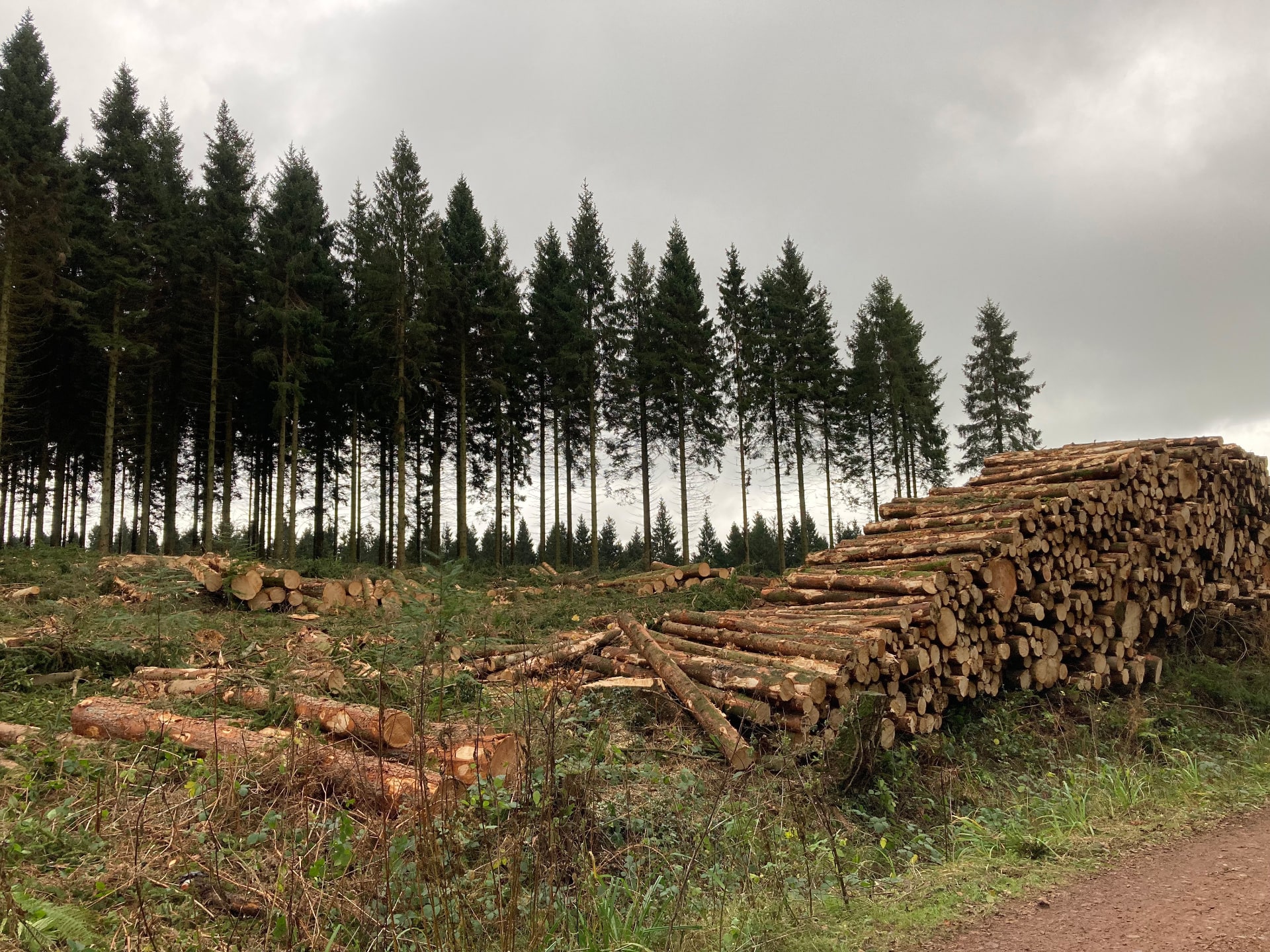
Productive forestry in Wales. Photo: Woodknowledge Wales
“Only a strategy that combines large-scale expansion of productive forest area and a substantial increase in tree growth rates will enable higher rates of wood use to make a positive contribution to reducing global warming over the coming century.”
Wood is a low-carbon alternative to materials like steel, concrete, and plastic, and plays an increasingly prominent role in strategies to decarbonise the built environment. But while the UK government has highlighted increased wood use as a key element in meeting climate goals, there is a critical issue often overlooked: the supply chain behind that wood.
Despite its ambitions, the UK currently imports more wood than almost any other country and has one of the lowest levels of forest cover in Europe, with just 14% of its land area under woodland. Only a fifth of UK demand is met by domestic timber production. This reliance on imported wood not only increases vulnerability to global market shocks—it also risks undermining the environmental benefits of choosing wood in the first place.
The carbon cost of imported timber
New research published in Nature Communications (www.doi.org/10.1038/s41467-025-58463-5) explores how national net zero strategies could be affected by these supply dynamics. In particular, it examines the carbon implications of sourcing wood from domestic sources or importing it from different types of overseas forest.
The findings highlight a crucial point: using more wood in construction and manufacturing can indeed contribute to lowering emissions—but only if the wood comes from forests managed in a way that enables rapid regrowth and sustained carbon sequestration. It takes far longer for the stocks of carbon in slow-growing boreal forests, such as those in Scandinavia and the Baltic States, to recover after harvesting than is the case for faster-growing temperate conifer forests, such as those in the UK.
A new model for understanding long-term climate impact
To investigate this further, researchers at Bangor University developed an advanced consequential life cycle assessment (LCA) modelling methodology. We used “prospective dynamic LCA” to project global warming impacts over the next century. Our approach combined modelling forest carbon stock dynamics (using the Canadian CBM-CFS3 model) with our new model for wood harvesting, transport, processing and use to generate an integrated analysis of future net greenhouse gas emissions for the whole wood value chain system. We included the emissions resulting from greater use of alternative materials—such as concrete and fossil fuel derivatives—if timber was not available in sufficient quantities, using “expanded system boundary LCA”.
Our results show that it is possible to increase wood use and still achieve substantial benefits of reduced global warming—provided there is a sufficient uplift in temperate
“The findings highlight a crucial point: using more wood in construction and manufacturing can indeed contribute to lowering emissions—but only if the wood comes from forests managed in a way that enables rapid regrowth and sustained carbon sequestration.”
forest production in countries like the UK. Under modest growth in wood demand (1.1% annually), this would require at least a 50% increase in the area of productive conifer forest over the next 50 years. A more ambitious approach, involving both a doubling of productive forest area and an increase in forest productivity by 33% (e.g. from a yield class of 18 to 24), would amplify climate benefits of reducing global warming further—by as much as 175%.
To illustrate this specifically: starting with 100,000 hectares of temperate conifer forest at yield class 18, expanding this to 200,000 hectares while improving productivity to yield class 24 could deliver cumulative greenhouse gas emissions reduction of around 277 million tonnes of carbon dioxide equivalent over a 100-year period. However, this scenario depends on maintaining forest health and growth rates, which are threatened by tree pests, diseases and drought, all of which are predicted to increase due to climate change.
The challenge becomes even more pressing under higher rates of increase in wood demand. If annual demand rises by 2.3%, individual measures—whether increasing temperate forest productivity, expanding forest area, or adjusting rotation cycles—will not be sufficient on their own. Only a combined strategy including a doubling of productive conifer forest area and a 33% increase in forest growth rates will sustain a net reduction in global warming over the coming century.
Sawlogs awaiting transport. Photo: Woodknowledge Wales
Four priorities for future-proofing the UK timber strategy
The study outlines four core priorities for the UK:
Reassess sourcing strategies: The timber industry needs to examine more closely its future sources of wood in terms of their potential impacts on net carbon emissions. There is a significant risk that increasing supply from the main current source forests will have harmful global warming impacts.
Reverse the stagnation in afforestation: The UK has seen virtually no increase in productive conifer forest over the past three decades. Harvestable volumes are expected to decline after 2039, while rise in demand is forecast to continue. Strategic land use planning is urgently needed to address the priority of wood security alongside those of food security and biodiversity conservation.
Improve forest resilience and productivity: Research and investment should focus on enhancing the productivity of UK forests while building resilience to threats from pests, pathogens and drought.
Use timber more efficiently: We need to moderate future increases in demand by reducing waste, extending the life of wood products and promoting reuse, in line with circular economy principles.
Sawlogs in transit. Photo: Woodknowledge Wales
Ultimately, our study provides strong evidence of the need for better alignment between net zero strategies and land use policy. The full potential of timber as a contributor to greenhouse gas removal lies not just in its use, but in how and where it is grown, harvested and reused. As such, policy assessments must integrate forest and wood product carbon accounting, including material substitution, using the kind of forward-looking analysis developed in our study.
By ensuring that more of the UK’s wood demand is met domestically—through well-managed, productive forestry—the nation can reduce pressure on overseas forests, lowering the risk of ‘offshoring’ carbon and biodiversity impacts of our wood consumption. Just as food security is advocated as a priority for national resilience, so too must wood security become a strategic priority in the transition to a low-carbon future.
To provide the best experiences, we use technologies like cookies to store and/or access device information. Consenting to these technologies will allow us to process data such as browsing behavior or unique IDs on this site. Not consenting or withdrawing consent, may adversely affect certain features and functions.
Functional
Always active
The technical storage or access is strictly necessary for the legitimate purpose of enabling the use of a specific service explicitly requested by the subscriber or user, or for the sole purpose of carrying out the transmission of a communication over an electronic communications network.
Preferences
The technical storage or access is necessary for the legitimate purpose of storing preferences that are not requested by the subscriber or user.
Statistics
The technical storage or access that is used exclusively for statistical purposes.The technical storage or access that is used exclusively for anonymous statistical purposes. Without a subpoena, voluntary compliance on the part of your Internet Service Provider, or additional records from a third party, information stored or retrieved for this purpose alone cannot usually be used to identify you.
Marketing
The technical storage or access is required to create user profiles to send advertising, or to track the user on a website or across several websites for similar marketing purposes.