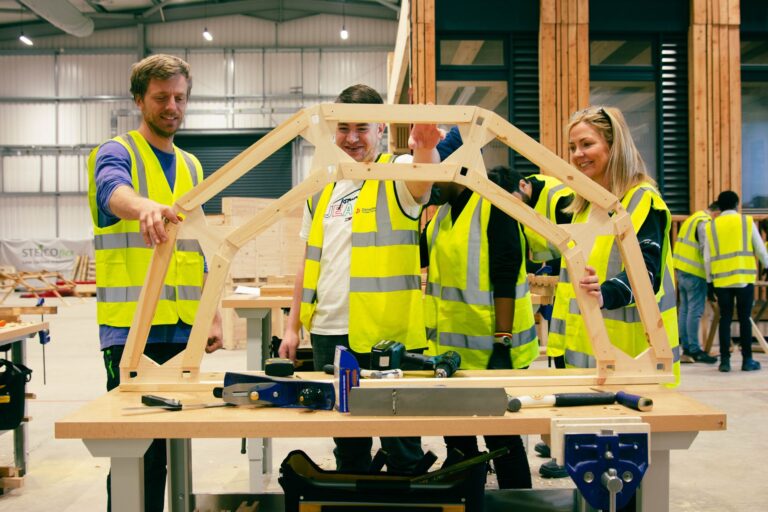
WoodBUILD 2026 brought together professionals from across forestry, manufacturing, design, construction, housing, finance and government to explore how policy and practice can work together to support more resilient forest landscapes, stronger regional economies and better buildings.
Held at the University of South Wales in Trefforest on 30 June and 1 July, with a programme of pre-conference site visits on 29 June, the event continued Woodknowledge Wales’ commitment to connecting the entire forest-to-construction value chain. Delegates from across the UK and beyond joined policymakers, researchers, practitioners and industry leaders to examine how forests, timber and the built environment can contribute to wider environmental, social and economic objectives.
A conference rooted in place
WoodBUILD has always sought to connect ideas with real places and practical delivery. The 2026 programme reflected this through a series of site visits exploring housing manufacture, productive forestry, community-led woodland initiatives and the conservation of the built environment.
Visits included Celtic Offsite’s timber frame manufacturing facility and Tai ar y Cyd housing initiative, Llantrisant Forest, Welcome to our Woods in Treherbert and St Fagans National Museum of History. Together, they provided delegates with a first-hand understanding of the relationships between forests, manufacturing, communities and construction.
From future vision to present action
The two-day conference programme explored a central question: how can forests, timber and construction contribute to more resilient futures?
Day one focused on long-term challenges and opportunities. Sessions examined future forest resources, housing needs, finance, community-led initiatives and the role of policy in shaping regional economies. Speakers shared perspectives from Wales and across Europe, highlighting how collaboration between government, industry and communities can help unlock new opportunities throughout the timber value chain.
A particular focus was placed on learning from international experience. Contributions from Catalonia and other European regions encouraged discussion around how policy can support productive forestry, local processing, resilient supply chains and greater use of timber in construction.
The questions that matter
Day two shifted attention towards practical challenges facing the sector today.
Workshops and breakout sessions explored subjects including circular timber use, woodfibre insulation, public procurement, future productive tree species, home-grown timber for social housing, timber grading, healthy public buildings and the role of forestry in supporting rural communities. Delegates were encouraged to contribute directly to discussions, reflecting WoodBUILD’s longstanding emphasis on knowledge exchange and collaborative problem solving.
The programme deliberately brought together people who do not commonly occupy the same room. Foresters, manufacturers, housing providers, architects, engineers, policymakers, educators and investors were invited to consider challenges from multiple perspectives and identify opportunities for collective action.
More than a conference
Alongside the formal programme, the exhibition remained a focal point for networking and collaboration.
Exhibitors and sponsors represented a broad cross-section of the sector, showcasing developments in timber manufacture, offsite construction, responsible sourcing, building products and technical innovation. Informal discussions throughout the event continued many of the themes explored on stage, reinforcing the importance of relationships across the supply chain.
What continues to distinguish WoodBUILD is its ability to bring together strategic thinking and practical delivery. Discussions ranged from future forest landscapes and policy frameworks to timber grading, housing manufacture and construction detail. Throughout, the emphasis remained on understanding how decisions made in one part of the system influence outcomes elsewhere.
As the timber sector continues to evolve, this whole-system perspective remains central to the conference’s purpose. WoodBUILD 2026 demonstrated that responsible timber futures will depend not only on innovation, but also on collaboration, shared understanding and a willingness to work across traditional boundaries.
WoodBUILD 2026 at a glance
Venue: University of South Wales, Trefforest
Dates: 30 June – 1 July 2026
Pre-conference site visits: 29 June 2026
Theme: Responsible Timber Futures through policy and practice
Audience: Forestry, manufacturing, housing, construction, design, policy, research and education professionals
Find out more
Woodknowledge Wales newsletter
News, events and technical insights from across the forest-to-construction supply chain.